Author

admin

Browsing

Massive wildfires have torn through Syria’s coastal mountain region of Jabal Turkman since Thursday, destroying thousands of hectares of forest and overwhelming emergency services.

Abdel Kafi Kayyal, director of civil defense in Lattakia province, said efforts to control the fires have been hampered by strong winds, rugged terrain and the danger of landmines left behind from years of war.

The fires come as Syria’s new government tries to drive the country’s recovery after more than a decade of war and crippling sanctions, with basic services non-existent in many parts of the country.

The fires have burned along a line of 20-kilometers (12 miles), cutting off roads and forcing thousands to flee their homes. They have also left some areas without power.

Drone video showed fires advancing along a broad front in rugged territory, occasionally flaring up as they encounter tinder-dry woodland.

The fires have now spread into parts of Tartous province, despite the efforts of more than 60 firefighting units.

Syrian authorities have appealed for international assistance. Turkey has sent two helicopters and 11 firefighting vehicles, and on Sunday Jordanian civil defense teams crossed the border to join efforts to contain the fires.

Satellite data from NASA’s FIRMS service indicates the burned area now exceeds 180 square kilometers, an area larger than the capital, Damascus.

According to Syrian government figures from 2023, the country’s forest cover stands at around 5,270 square kilometers, suggesting that these fires have consumed more than 3% of the country’s total forested land in just three days.

The country is also in the grip of a long-running drought. The Carnegie Endowment Middle East program reported last year that the entire Euphrates Basin region, particularly the southern and eastern desert areas of Syria, had suffered from low rainfall and exceptionally high temperatures for four years.

This post appeared first on cnn.com

The far-right Alternative for Germany (AfD) is now Germany’s largest opposition group and even topped several opinion polls – briefly putting it ahead of now-Chancellor Friedrich Merz’s center-right party – in the weeks after February’s federal election.

At the same time, the AfD is facing growing calls for an outright ban, most recently from another major political party.

In May, the country’s domestic intelligence agency formally classified the AfD as an extremist entity that threatens democracy. In a 1,100-page report, the Federal Office for the Protection of the Constitution, or BfV, also laid out its findings that the party was racist, anti-Muslim, and devaluing of “entire segments” of Germany’s population.

That move, which enables the BfV to better monitor the group , has reignited attempts to impose a ban, despite the party claiming a significant 20.8% of the vote in February’s national election – the best performance by a far-right party in the country since World War II.

The AfD has also enjoyed very vocal support from the Trump administration, with Tesla billionaire Elon Musk – who has since left his position in the Department of Government Efficiency (DOGE) – urging Germans to vote for the party in the run-up to the election. More recently, both US Vice President, JD Vance, and Secretary of State Marco Rubio have criticized Germany’s decision to classify the AfD as extremist.

On Monday, the center-left Social Democratic Party (SPD), which is currently serving as the junior coalition partner in Berlin’s conservative-led government, voted unanimously to begin efforts to outlaw it.

Yet the legal path to banning the AfD is lengthy – and largely unprecedented.

Set up to avoid a repeat of Nazi rule, Germany’s political system operates on the basis of streitbare Demokratie, or “militant democracy,” meaning it is a democracy “determined and able to defend itself.”

In other words, the German state can actively defend itself against internal threats to its democratic principles and constitutional order, including through the banning of political parties.

However, two criteria must be met by Germany’s Federal Constitutional Court to form a legal basis for a ban.

Firstly, the party in question must be found to work against the country’s free democratic order, demonstrating an “actively belligerent, aggressive stance.” Secondly, the party must be popular enough to pose a tangible threat to democracy, a provision created in 2017 and called “potentiality.”

Parties found to meet the first criterion, but not the second, can be prohibited from accessing public campaign financing, but are allowed to continue with other activities.

“The opposite is true: its size demonstrates that it fulfills the criterion of ‘potentiality.’”

To begin the process of banning a party, a formal request must be made to the federal court. This request can only be made by either the government itself, the Bundestag, Germany’s lower house of parliament, or the Bundesrat, the legislative body that represents the country’s 16 regional states.

The court then decides whether to begin proceedings or throw out the application as unsubstantiated.

It must hold a full trial, examining thousands of pages of evidence and hearing witnesses, and considers whether the party violates the constitution in practice, Holterhus explained.

The court can then declare a party unconstitutional. The party would then be dissolved and banned from all political activity. It would also be prohibited from creating any substitute organizations.

At least two-thirds of the court’s justices must be in agreement in order to make the declaration.

In practical terms, if the AfD were to be banned, its sitting lawmakers would receive an automatic loss of mandate at the regional and federal level as well as in the European parliament.

Of the 152 seats the AfD currently has in the Bundestag , 42 are direct seats, where the respective candidates individually won the districts by majority. These 42 districts would need to vote again to fill the seats with new candidates from other parties. The other 110 AfD seats, which are allocated using a party list system, would remain vacant until the next election cycle. Similarly, the AfD’s seats in the European Parliament would remain vacant.

In either case, this would result in a shifting of the majority ratio, meaning that the seats of all other parties would gain a higher significance.

The German Federal Constitutional Court has only banned two parties in the country’s history – and both were in the early postwar years. The Socialist Reich Party (SRP), a successor to the Nazi Party, was outlawed in 1952. Four years later, in 1956, the far-left Communist Party of Germany (KPD) was also banned.

Repeated attempts – in 2003, 2016 and 2021 – to ban the neo-Nazi National Democratic Party of Germany (NPD) have failed. Although the court in 2017 openly acknowledged the party was unconstitutional, it found that it didn’t pose a significant threat to the constitutional order. In January 2024, the court approved the freezing of the NPD’s state funding for six years.

Overall, Holterhus believes that it is difficult to impose a ban on a political party in Germany. “A party ban is considered a measure of last resort against the enemies of a democracy,” he said.

Adding fuel to the fire?

The rise of the AfD has triggered widespread unease, with protesters calling for it to be outlawed – most notably in early 2024, when tens of thousands of demonstrators descended on cities across Germany after it emerged that senior AfD party members had discussed a plan to deport migrants en masse.

Yet German lawmakers remain divided over the issue, with some fearing the move could backfire and fuel far-right sympathies.

Pointing to its classification as a right-wing extremist organisation, SPD co-leader Lars Klingbeil told party members at a conference Monday that efforts to ban the AfD should begin.

“The moment the domestic intelligence agency says this is a confirmed right-wing extremist party, there can be no more tactics,” he said.

Yet Merz’s Christian Democratic Union (CDU) – which leads Germany’s coalition government – is hesitant.

German Interior Minister Alexander Dobrindt, a member of the Christian Social Union (CSU) – the CDU’s Bavarian sister party – poured cold water on the SPD’s motion. Speaking to German news podcast “Table. Today,” he said that “decisions made at the SPD party conference are not yet a mandate for the interior minister.”

Merz has himself expressed caution over the move, telling newspaper Die Zeit in May that he is “skeptical” of procedures to ban political parties.

The AfD’s unparalleled public approval, not to mention support from the Trump administration, a powerful transatlantic ally, means its prohibition could have significant reverberations.

Some opinion polls found that, in the weeks after the Germany’s election , support for the AfD had crept up even higher than its 20.8% official result, briefly making it the most popular party in the country.

National polling agency Forsa in April found that the AfD was polling at a record 26% – putting it two percentage points higher than the CDU, on 24%. Currently, Forsa shows the AfD at 24% – four points behind the CDU.

With the AfD’s support reaching such heights, Holterhus sees a risk of creating a “martyr effect” in the case of a ban, with the AfD “staging itself as a victim of political opponents.” This, he said, could result in further radicalization of some of its supporters and even politically motivated violence.

Lengthy legal proceedings, he said, could further heighten the AfD’s platform while the move also risks the “wrath” of the Trump administration and could play into the populist narrative of an “undemocratic Europe.”

This post appeared first on cnn.com

Thousands of people gathered in India’s Dharamshala on Sunday to celebrate the 90th birthday of the Dalai Lama – a key milestone in the life of the spiritual leader and Nobel Peace laureate known for his message of compassion and his quest for greater freedoms for Tibet under Beijing’s rule.

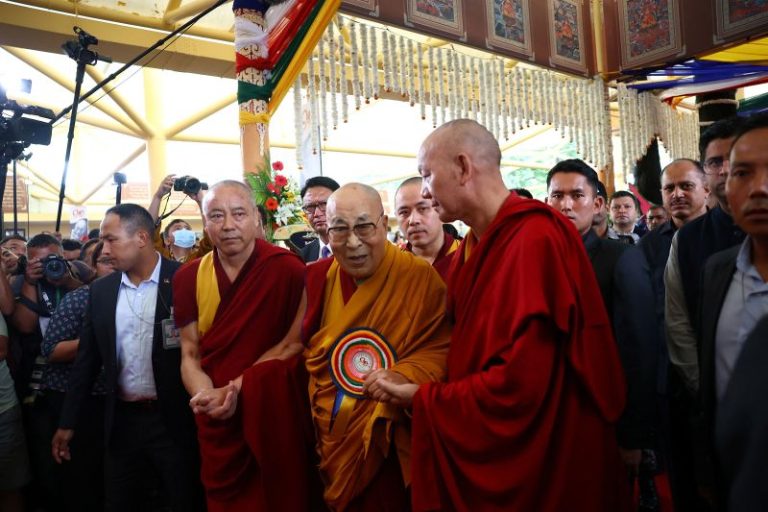
Undeterred by heavy monsoon rain and thick fog, crowds dressed in their finery packed the narrow streets from early morning and queued in droves hoping to catch a glimpse of the Dalai Lama at the Tsuklakhang Tibetan Buddhist complex.

Hundreds of hopeful attendees were left waiting to see if they would be allowed into the temple which reached full capacity before the festivities began, and was heavily manned by Indian police and security personnel.

Masked dancers in traditional outfits twirled to the sounds of gongs, pipes and horns as the Dalai Lama was led into the complex by two attendants.

Indian government ministers were set to attend the cutting of the celebratory cake, as well as Hollywood actor Richard Gere, a longtime supporter of the Dalai Lama.

The gathering marked the culmination of a days-long celebration that brought supporters and spiritual heads to the small city in India’s Himalayan foothills, which has served as the seat of the Tibetan government-in-exile and home of the Dalai Lama since he fled Tibet during a failed 1959 uprising against Chinese communist rule.

Many had traveled far to join the celebration, such as Namgyal Dorjee Gongpa, from New Jersey in the United States.

“Every year, we take trips to India, which is the epicenter of the exile Tibetan setup so that my kids who are born in a foreign country… get back to their roots and learn and live their culture. So this is a great occasion because we can all take part in the celebration of His Holiness the Dalai Lama’s 90th birthday.”

In a birthday message on X, the Dalai Lama emphasized the importance of “achieving peace of mind through cultivating a good heart and by being compassionate.” Woven into his reflections was a pledge to continue promoting human values, religious harmony, ancient Indian wisdom and Tibetan culture, which “has so much potential to contribute to the world.”

At a ceremony on Saturday, as attendees prayed for his long life, he assured them of his “great physical condition” and raised his longevity goal to 130, two decades beyond his previous prediction.

While crowds gathered to celebrate his life, this year’s festivities carry heightened significance as a stage for the charismatic leader to address the looming question of what happens after his death.

Reincarnation

In a video message to religious elders on Wednesday, the Dalai Lama announced that he will have a successor after his death, and affirmed that his office has the “sole authority” to recognize his future reincarnation.

“No one else has any such authority to interfere in this matter,” the Dalai Lama said in his recorded message.

The statement sets the stage for a struggle over his succession between Tibetan Buddhist leaders in exile and China’s atheist Communist Party, which insists it alone holds the authority to approve the next dalai lama.

The Dalai Lama’s announcement was welcomed by many Tibetan Buddhists, who had been waiting for his decision on whether the centuries-old institution would end with his death – a question he had earlier said he would re-evaluate around his 90th birthday.

“I feel that he has thoughtfully considered the future and made it clear that the decision will be guided by the Tibetan people and Buddhist traditions and not by any external political interference,” she added.

“At the same time, like many Tibetans, I do have concerns about China’s attempts to politicize the reincarnation process by potentially appointing its own dalai lama… Their appointment of a dalai lama would not only be a distortion of our faith but also a strategy to undermine Tibetan identity.”

Tibetan Buddhists believe in the circle of rebirth, and that when an enlightened spiritual master like the Dalai Lama dies, he will be able to choose the place and time of his rebirth through the force of compassion and prayer.

But the religious tradition has increasingly become a battleground for the control of Tibetan hearts and minds, and experts expect that Beijing will seek to establish its own dalai lama after the current one – part of the party’s campaign to “sinicize” religion to ensure it aligns with Communist Party leadership and maintain its tightening grip over Tibet.

The Dalai Lama has previously stated that his successor will be born in the “free world” outside China, urging his followers to reject any candidate selected by Beijing.

Asked about the Dalai Lama’s latest statement on his reincarnation, a spokesperson for the Chinese Foreign Ministry on Wednesday reiterated Beijing’s long-held stance that the spiritual leader’s reincarnation must comply with Chinese laws and regulations, with search and identification conducted in China and approved by the central government.

Beijing has long sought to discredit the Dalai Lama and claims he is a dangerous “separatist.”

Since the 1970s, however, the Dalai Lama has maintained that he no longer seeks full independence for Tibet, but “meaningful” autonomy that would allow Tibetans to preserve their distinct culture, religion and identity. His commitment to the nonviolent “middle way” approach has earned him international support and the Nobel Peace Prize in 1989.

As China’s political and economic clout has grown, however, the Dalai Lama’s global influence appears to be waning, especially as old age makes it difficult to sustain his extensive globe-trotting. The spiritual leader has not met a sitting US president since Barack Obama in 2016, after numerous visits to the White House since 1991.

On his birthday, however, heartfelt messages poured in from world leaders, politicians, lawmakers and artists in a video compiled by Tibet TV, run by the Tibetan government-in-exile.

Obama wished a “very happy birthday to the youngest 90-year-old I know,” and thanked the Dalai Lama for his friendship.

“You’ve shown generations what it means to practice compassion and speak up for freedom and dignity. Not bad for someone who describes himself as a simple Buddhist monk,” he added.

Former US President Bill Clinton described the Dalai Lama as “one of the world’s greatest voices for peace, for dialogue, for understanding” whose teachings have “inspired millions to follow in your footsteps.”

He added: “In a time when we see the forces of division tearing at the fabric of our common humanity, we need your wisdom more than ever to remind us that what we share is more important than our interesting differences.”

Indian Prime Minister Narendra Modi said in a statement on X: “I join 1.4 billion Indians in extending our warmest wishes to His Holiness the Dalai Lama on his 90th birthday.

“He has been an enduring symbol of love, compassion, patience and moral discipline. His message has inspired respect and admiration across all faiths. We pray for his continued good health and long life.”

But in Dharamshala, the Dalai Lama’s life and legacy were center stage on Sunday, a day Nyidon said “holds deep spiritual and emotional meaning for our community, symbolizing resilience and hope.”

This post appeared first on cnn.com

A summit of leaders from the BRICS group of major emerging economies kicks off in Brazil Sunday – but without the top leader of its most powerful member.

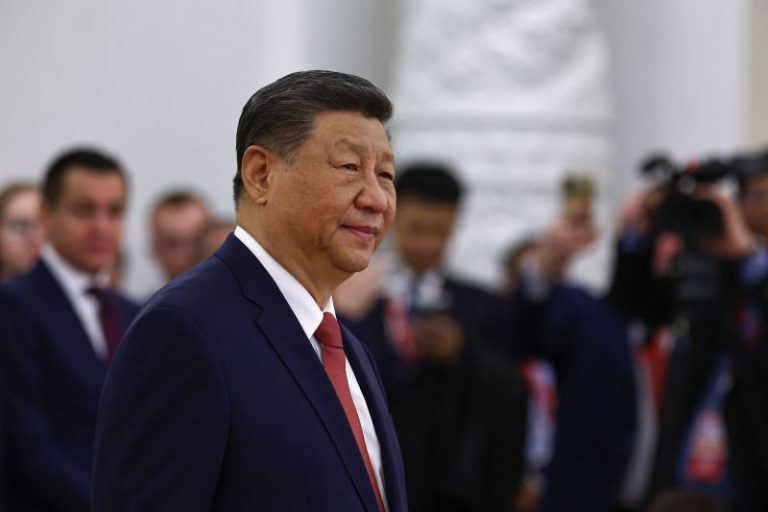
For the first time in more than one decade of rule, Chinese leader Xi Jinping – who has made BRICS a centerpiece of his push to reshape the global balance of power – will not attend the annual leaders’ gathering.

Xi’s absence from the two-day summit in Rio de Janeiro comes at a critical moment for BRICS, which owes its acronym to early members Brazil, Russia, India, China and South Africa, and since 2024 has expanded to include Egypt, the United Arab Emirates, Ethiopia, Indonesia and Iran.

Some members are up against a July 9 deadline to negotiate US tariffs set to be imposed by US President Donald Trump, and all face the global economic uncertainty brought on by his upending of American trade relations – putting the club under more pressure show solidarity.

Xi’s absence means the Chinese leader is missing a key opportunity to showcase China as a stable alternative leader to the US. That’s an image Beijing has long looked to project to the Global South, and one recently elevated by Trump’s shift to an “America First” policy and the US decision last month to join Israel in bombing Iranian nuclear facilities.

But the Chinese leader’s decision not to attend – sending his No. 2 official Li Qiang instead – doesn’t mean Beijing has downgraded the significance it places on BRICS, observers say, or that it’s less important to Beijing’s bid to build out groups to counterbalance Western power.

“(BRICS) is part and parcel of Beijing’s effort to make sure it isn’t hemmed in by the US allies,” said Chong Ja Ian, an associate professor at the National University of Singapore.

But that pressure may have lessened with Trump in office, Chong added, referencing the US president’s shake-up of relations even with key partners, and for Xi, BRICS may just not be “his greatest priority” as he focuses on steering China’s domestic economy. Beijing may also have low expectations for major breakthroughs at this year’s summit, he said.

BRICS attendance sheet

Xi is not the only head of state expected to be absent in Rio.

The Chinese leader’s closest ally in the group, Russia’s Vladimir Putin, will only attend via video link, for the same reason he also joined a 2023 BRICS gathering in South Africa remotely. Brazil, like South Africa, is a signatory to the International Criminal Court and so would be obligated to arrest Putin on a court charge alleging war crimes in Ukraine.

The absence of two global heavy hitters leaves ample limelight for Indian Prime Minister Narendra Modi, who will visit Brazil both for the summit and a state visit. South African President Cyril Ramaphosa is also expected to attend.

Some new club members have yet to announce their plans, though Indonesia’s Prabowo Subianto is expected in Rio after Southeast Asia’s largest economy officially joined BRICS earlier this year. BRICS partner countries, including some who aspire to join the group, will also send delegations. Uncertainty remains over whether Saudi Arabia has accepted an invitation to become a full member.

The sting of Xi’s absence for Brazil’s President Luiz Inácio Lula da Silva may be blunted by the fact that the Chinese leader visited Brazil in November for the G20 summit and a state visit, when he and Lula inked a raft of cooperation agreements. The Brazilian leader also visited China in May, after attending a military parade in Moscow alongside Xi.

That recent diplomacy, low expectations for major breakthroughs at this year’s summit, and a heightened focus on domestic issues all likely factored into Xi’s decision to send Li, a trusted second-in-command, observers say.

China is facing steep economic challenges in the face of trade frictions with the US – and its leaders are busy charting a course for the five years ahead of a key political conclave expected this year.

In Rio, Li will likely be charged with advancing priorities like shoring up energy ties between Beijing and BRICS’ major oil-exporting members, while pushing for the expanded use of China’s offshore and digital currency for trade within the group, according to Brian Wong, an assistant professor at the University of Hong Kong, who added that Xi’s absence shouldn’t be interpreted as a snub to BRICS.

“Whether it be the Sino-Russian partnership or Beijing’s desire to project its purported leadership of the Global South, there is much in BRICS+ that resonates with Xi’s foreign policy worldview,” said Wong, using a term for the extended group.

De-dollarization?

Launched in 2009 as an economic coalition of Brazil, Russia, India and China before South Africa joined a year later, BRICS roughly positions itself as the Global South’s answer to the Group of Seven (G7) major developed economies.

It’s taken on greater significance as countries have increasingly pushed for a “multipolar world” where power is more distributed – and as Beijing and Moscow have looked to bolster their international clout alongside deepening tensions with the West.

But BRICS’ composition – a mix of countries with vastly different political and economic systems, and with occasional friction between each other – and its recent expansion have also drawn criticism as leaving the group too unwieldy to be effective.

The disparate group’s efforts to speak with one voice distinct from that of the West often become mired in opposing views. A statement last month expressed “grave concern” over the military strikes against BRICS member Iran, but stopped short of specifically naming the US or Israel, the two countries that carried out the strikes.

Nonetheless, the US will be watching how the countries talk about one issue that has typically united them: moving their trade and finance to national currencies – and away from the dollar. Such de-dollarization is particularly attractive to member countries such as Russia and Iran, which are heavily sanctioned by the US.

Earlier this year, among the goals of Brazil’s host term, Lula included “increasing payment options” to reduce “vulnerabilities and costs.” Russia last year pushed for the development of a unique cross-border payments system, when it hosted the club.

What’s unlikely to be on the negotiating table, however, is the lofty goal of a “BRICS currency” – an idea suggested by Lula in 2023 that has drawn ire from Trump even as other BRICS leaders have not signaled it’s a group priority.

The US president in January threatened to place “100% tariffs” on “seemingly hostile” BRICS countries if they supported a BRICS currency, or backed another currency to replace “the mighty U.S. Dollar.”

As countries convene in Rio, observers will be tracking how strident their leaders are in promoting the use of national currencies at a meeting of a group where China is the leading member, but US global economic clout still looms large.

This post appeared first on cnn.com
Cornerstone investor brings proven regional track record; company now fully funded into 2026 for multi-project advancement in Colombia

Quimbaya Gold Inc. (CSE: QIM) (OTCQB: QIMGF) (FSE: K05) (‘Quimbaya’ or the ‘Company’) is pleased to announce the closing of its upsized non-brokered private placement of 11,525,299 units of the Company (each, a ‘Unit’) at a price of C$0.35 per Unit for gross proceeds of $4,033,854 (the ‘Offering’).

Each Unit is comprised of one common share in the capital of the Company (a ‘Share‘) and one common share purchase warrant (a ‘Warrant‘). Each Warrant entitles the holder to acquire one Share at a price of C$0.60 per Share for a period of 36 months expiring on July 4, 2028.

As previously disclosed, the upsizing was driven by a single investor group with a long-term outlook and a successful track record of supporting exploration and development projects in South America. The Company views this as a strong endorsement of its team, strategy, and pipeline of high-potential assets across Colombia’s Antioquia district.

‘With this raise, we are now well-funded into 2026,’ said Alexandre P. Boivin, President & CEO. ‘These funds will allow us to deepen our work at the Tahami South project while expanding efforts across the broader portfolio. We’re committed to smart, disciplined execution and are very encouraged by the high conviction backing we’ve received.’

The proceeds from the Offering will be used to advance the Company’s exploration programs, including drilling at the Tahami South project and follow-up work on regional copper-gold and gold targets, as well as for general working capital.

Clarification on Finder’s Fees and Warrants

The Company wishes to clarify that a cash commission of $16,800 was paid and 48,000 broker warrants were issued in connection with the Offering. However, as previously disclosed, no commissions or other broker compensation were paid on the strategic investment that drove the upsizing.

In connection with the Offering, the Shares, Warrants and broker warrants are subject to a four-month and one-day hold period expiring on November 4, 2025.

Insider Participation

Certain insiders of the Company participated in the Offering subscribing for an aggregate of 435,714 units for an aggregate subscription amount of $152,500. Each of the subscriptions from insiders constitutes a ‘related party transaction’ pursuant to Multilateral Instrument 61-101 – Protection of Minority Security Holders in Special Transactions (‘MI 61-101‘). The Company has relied on the exemptions from the formal valuation and minority shareholder approval requirements of MI 61-101 contained in sections 5.5(b) and 5.7(1)(a) thereof, respectively, as the common shares of the Company are not listed on a specified market and neither the fair market value (as determined under MI 61-101) of the subject matter of, nor the fair market value of the consideration for, the transaction, insofar as it involved the related parties, exceeded 25% of the Company’s market capitalization (as determined under MI 61-101).

Appointment of Vice President, Business Development

Quimbaya is further pleased to announce the appointment of Sebastian Wahl as Vice President, Business Development. Mr. Wahl has served on the Company’s Board of Directors for the past six months and has played a pivotal role in shaping its strategic direction and external positioning.

Given his contributions to date and the Company’s growth trajectory, Mr. Wahl’s transition into an executive role is both timely and natural. As VP of Business Development, he will work closely with the CEO on capital markets initiatives, strategic partnerships, and internal structuring to ensure the Company is well-positioned for its next phase of growth.

‘Sebastian brings an exceptional network and a sharp sense of capital markets strategy,’ said Alexandre P. Boivin, President & CEO. ‘His insight and drive have already proven instrumental at the board level, and we’re excited to now have his energy full-time as we accelerate our momentum.’

Mr. Wahl’s appointment reinforces Quimbaya’s commitment to building a high-caliber leadership team capable of advancing its ambitious vision in Colombia and delivering value to shareholders.

Grant of Incentive Securities

The Company also announces that it has granted an aggregate of 1,730,000 restricted share units (RSUs) and 1,655,000 stock options to certain directors, officers, advisors, and consultants of the Company in accordance with its long-term performance incentive plan (the ‘LTIP‘). The stock options are exercisable at $0.50 per share for a period of three years.

About Quimbaya

Quimbaya aims to discover gold resources through exploration and acquisition of mining properties in the prolific mining districts of Colombia. Managed by an experienced team in the mining sector, Quimbaya is focused on three projects in the regions of Segovia (Tahami Project), Puerto Berrio (Berrio Project), and Abejorral (Maitamac Project), all located in Antioquia Province, Colombia.

Contact Information

Alexandre P. Boivin, President and CEO apboivin@quimbayagold.com 

Jason Frame, Manager of Communications jason.frame@quimbayagold.com, +1-647-576-7135‎

Quimbaya Gold Inc.
Follow on X @quimbayagoldinc
Follow on LinkedIn @quimbayagold
Follow on Instagram @quimbayagoldinc
Follow on Facebook @quimbayagoldinc

Cautionary Statements

Certain statements contained in this press release constitute ‘forward-looking information’ as that term is defined in applicable Canadian securities legislation. All statements, other than statements of historical fact, included herein are forward-looking information. Generally, but not always, forward-looking statements and information can be identified by the use of forward-looking terminology such as ‘intends’, ‘expects’ or ‘anticipates’, or variations of such words and phrases or statements that certain actions, events or results ‘may’, ‘could’, ‘should’, ‘would’ or ‘occur’. Forward-looking statements herein include statements and information regarding the Offering’s intended use of proceeds, any exercise of Warrants, the future plans for the Company, including any expectations of growth or market momentum, future expectations for the gold sector generally, the Colombian gold sector more particularly, or how global or local market trends may affect the Company, intended exploration on any of the Company’s properties and any results thereof, the strength of the Company’s mineral property portfolio, the potential discover and potential size of the discovery of minerals on any property of the Company’s, including Tahami South, the aims and goals of the Company, and other forward-looking information. Forward-looking information by its nature is based on assumptions and involve known and unknown risks, uncertainties and other factors which may cause the actual results, performance or achievements of Quimbaya to be materially different from any future results, performance or achievements expressed or implied by such forward-looking statements or information. These assumptions include, but are not limited to, that the Company’s exploration and other activities will proceed as expected. The future outcomes that relate to forward-looking statements may be influenced by many factors, including but not limited to: future planned development and other activities on the Company’s mineral properties; an inability to finance the Company; obtaining required permitting on the Company’s mineral properties in a timely manner; any adverse changes to the planned operations of the Company’s mineral properties; failure by the Company for any reason to undertake expected exploration programs; achieving and maintaining favourable relationships with local communities; mineral exploration results that are poorer or better than expected; prices for gold remaining as expected; currency exchange rates remaining as expected; availability of funds for the Company’s projects; prices for energy inputs, labour, materials, supplies and services (including transportation); no labour-related disruptions; no unplanned delays or interruptions in scheduled construction and production; all necessary permits, licenses and regulatory approvals are received in a timely manner; the Offering proceeds being received as anticipated; all requisite regulatory and stock exchange approvals for the Offering are obtained in a timely fashion; investor participation in the Offering; and the Company’s ability to comply with environmental, health and safety laws. Although Quimbaya’s management believes that the assumptions made and the expectations represented by such information are reasonable, there can be no assurance that the forward-looking information will prove to be accurate. Furthermore, should one or more of the risks, uncertainties or other factors materialize, or should underlying assumptions prove incorrect, actual results may vary materially from those described in forward-looking statements or information. Readers are cautioned not to place undue reliance on forward-looking information as there can be no assurance that the plans, intentions or expectations upon which they are placed will occur. Forward-looking information contained in this news release is expressly qualified by this cautionary statement. The forward-looking information contained in this news release represents the expectations of Quimbaya as of the date of this news release and, accordingly, is subject to change after such date. Except as required by law, Quimbaya does not expect to update forward-looking statements and information continually as conditions change.

NOT FOR DISTRIBUTION TO UNITED STATES NEWS WIRE SERVICES OR FOR DISSEMINATION IN THE UNITED STATES


To view the source version of this press release, please visit https://www.newsfilecorp.com/release/257712

News Provided by Newsfile via QuoteMedia

This post appeared first on investingnews.com

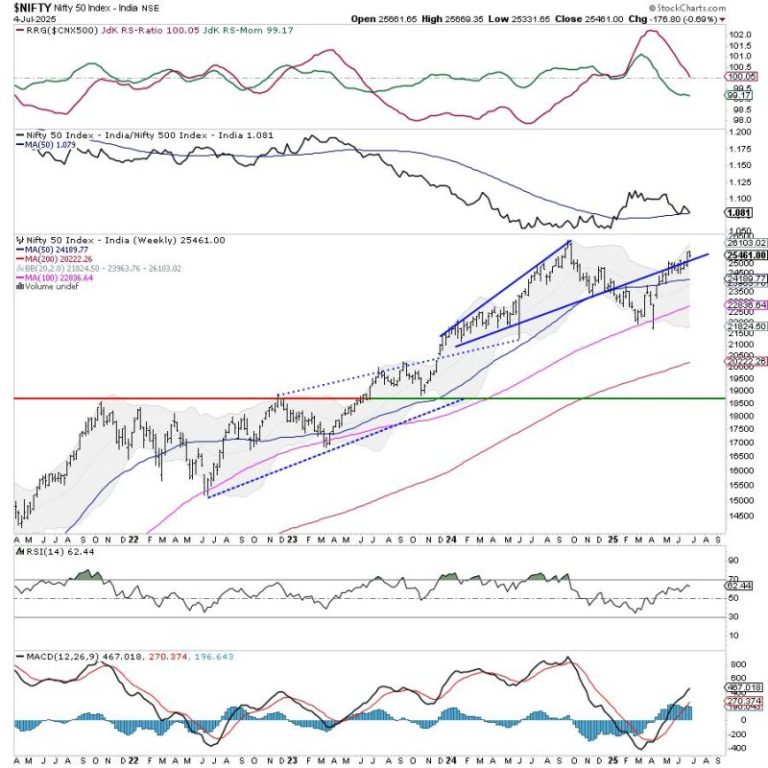
After a strong move in the week before this one, the Nifty spent the last five sessions largely consolidating in a very defined range. The markets traded with a weak underlying bias and lost ground gradually over the past few days; however, the drawdown remained quite measured and within the expected range. As the markets consolidated, the trading range got narrower. The Nifty moved in a 337-point range during the week. While the Index formed a near-similar high, it marked a much higher low. The volatility also retraced; the India VIX came off by 0.59% to 12.31. While showing no intention to trend higher, the headline Index closed with a net weekly loss of 176.80 points (-0.69%).

The Nifty has created an intermediate resistance zone between 25600 and 25650. A trending move on the upside would happen only if the Nifty is able to take out this zone on the upside convincingly. Until that happens, we will see the Nifty continuing to consolidate with 25100 acting as support. This is the prior resistance level, which is expected to act as support in case of any corrective retracement. So long as the Nifty is inside the 25000-25650 zone, it is unlikely to develop any sustainable directional bias on either side.

Friday was a trading holiday in the US. Because of this, we will not have any overnight cues to deal with on Monday. The Indian markets may see a stable and quiet start. The levels of 25650 and 25800 are likely to act as probable resistance points. Support levels come in at 25250 and 25000.

The weekly MACD is bullish and remains above its signal line. The weekly RSI is 62.40; it stays neutral and does not show any divergence against the price. No major formation was noticed on the candles.

The pattern analysis of the weekly chart reveals that after breaking above the rising trendline resistance and moving past the 25000-25150 zone, the Nifty consolidated after trending higher for four consecutive days. Over the past week, it gave up a portion of its gains and consolidated at higher levels. In the process, it has dragged its support level higher to 25000. As long as the Index remains above this point, the breakout and the resumption of the upmove observed in the preceding week remain valid and intact.

Overall, it is expected that the Nifty will remain within the 25000-25650 range over the coming week. The markets are unlikely to develop any directional bias unless they move past the 25650 level or violate the 25000 level. Sector rotation within the market is very much visible; it would be imperative to efficiently rotate sectors and stay invested in those that show improved relative strength and a promising technical setup. We are likely to see improved performance in the Auto, Energy, IT, and broader markets, among other sectors. It is also strongly recommended to protect profits here, where the stocks have run up hard. Any aggressive shorting should be avoided as long as the Nifty stays above the 25000 level. A cautiously positive approach is advised for the coming week.


Sector Analysis for the coming week

In our look at Relative Rotation Graphs®, we compared various sectors against the CNX500 (NIFTY 500 Index), representing over 95% of the free-float market cap of all the listed stocks. 

Relative Rotation Graphs (RRG) show that the Nifty PSU Bank Index and the Midcap 100 Index are the only two groups that are inside the leading quadrant. They are likely to outperform the broader markets relatively.

The Nifty Infrastructure Index is experiencing an improvement in its relative momentum while it remains within the weakening quadrant. Additionally, the PSE, Nifty Bank, and the Financial Services Index are located within the weakening quadrant. While individual stock-specific performance may not be ruled out, the overall relative performance may take a backseat.

The Commodities Index and the Services Sector Index have rolled into the lagging quadrant. The Consumption, Pharma, and the FMCG Indices also continue to languish inside the lagging quadrant. The Metal Index is showing a sharp improvement in its relative momentum against the broader markets, while staying within the lagging quadrant.

The IT, Energy, Media, Realty, and Auto Indices are inside the Improving quadrant. They continue to rotate firmly while improving their relative performance against the broader Nifty 500 Index.


Important Note: RRG charts show the relative strength and momentum of a group of stocks. In the above Chart, they show relative performance against NIFTY500 Index (Broader Markets) and should not be used directly as buy or sell signals.  


Milan Vaishnav, CMT, MSTA

Consulting Technical Analyst

www.EquityResearch.asia | www.ChartWizard.ae


Stallion Uranium Corp. (the ‘ Company ‘ or ‘ Stallion ‘ ) ( TSX-V: STUD ; OTCQB: STLNF ; FSE: FE0 ) is pleased to announce that, further to the Company’s news releases dated May 14 th 2025 and May 21 st 2025, the TSX Venture Exchange (‘ TSX-V ‘) has approved the resumption of trading of the Company’s common shares. Trading will recommence on the TSX-V effective at markets’ open on July 7 th 2025. The Company is also pleased to announce that, further to its news release of November 28 th 2024, it has entered into a binding heads of agreement (the ‘ Heads of Agreement ‘) dated June 7 th 2025 amongst 1503571 B.C Ltd. (‘ 150 BC ‘), the remaining common shareholders of 150 BC (the ‘ Shareholders ‘) and Resolution Minerals Ltd. (‘ RML ‘), an ASX Listed Issuer, pursuant to which RML shall acquire all of the issued and outstanding shares of 150 BC.


The approval follows the revocation of the previously announced Cease Trade Order (‘ CTO ‘) issued by the British Columbia Securities Commission on May 7 th , 2025, as a result of the Company’s failure to file its audited annual financial statements, accompanying management discussion and analysis and certifications for the financial year ended December 31 st , 2024 (the ‘ Annual Filings ‘).


The CTO was issued under Multilateral Instrument 11-103 – Failure-To-File Cease Trade Orders In Multiple Jurisdictions and prohibits the trading or purchase by any person or company of any securities of the Company in each jurisdiction in Canada in which the Company is a reporting issuer for as long as the CTO remains in effect; however, the CTO provides an exception for beneficial securityholders of the Company who are not currently (and who were not as of May 7 th , 2025) insiders or control persons of the Company who may sell securities of the Company if both of the following criteria are met: (a) the sale is made through a foreign organized regulated market, as defined in Section 1.1 of the universal market integrity rules of the Investment Industry Regulatory Organization of Canada; and (b) the sale is made through an investment dealer registered in a jurisdiction of Canada in accordance with applicable securities legislation.


Further, the Company announces that Winning Media LLC of Huston, Texas, provided marketing services through one ticker tag article via the Globe and Mail for a one-day term on February 28 th , 2024, in consideration of a payment of USD$3,500. The services are no longer in effect and were not reviewed nor approved by the TSX-V at the time the services were provided as required by the policies of the TSX-V.


With stronger internal controls now in place, Stallion remains focused on unlocking the significant potential of its exploration portfolio in the prolific Athabasca Basin, recognized globally for its high-grade uranium deposits. The Company looks forward to providing further updates on its upcoming exploration activities in the near future.


  Agreement to Sell Shares of 1503571 B.C. LTD.:  


Pursuant to the Heads of Agreement, Stallion, along with the Shareholders have agreed to sell their common shares of 150 BC (the ‘ 150 BC Shares ‘) to RML (the ‘ Transaction ‘). Stallion acquired its 11,111,111 150 BC Shares in connection with the optioning of the Horse Heaven Property, as described in its news release dated November 8 th , 2024.


In connection with the Transaction, RML shall make the following payments to the Shareholders, on a pro rata basis in proportion to their shareholdings in 150 BC: (i) an aggregate of 444,812,889 fully paid ordinary shares in the capital of RML (‘ Consideration Shares ‘); (ii) an aggregate of 222,406,445 options to acquire fully paid ordinary shares in the capital of RML exercisable at A$0.018 each on or before July 31 st 2028 (‘ Consideration Options ‘); (iii) pay the Shareholders an initial aggregate cash payment of A$600,000 on completion of the Transaction (‘ Completion ‘); and (ii) a second aggregate cash payment of A$400,000 payable within nine months of Completion.


Stallion’s pro rata interest in such consideration is anticipated to be: 59,466,963 Consideration Shares, 29,733,482 Consideration Options, and aggregate cash payments of A$145,033. The Consideration Shares shall be subject to contractual escrow whereby 25% shall be released on Completion, 25% on the three-month anniversary from Completion, 25% on the six-month anniversary from Completion, and the final 25% on the 12-month anniversary from Completion.


The Transaction is subject to due diligence, RML shareholder approval, regulatory approvals, and other customary conditions to closing. There can be no guarantee that the Transaction will be completed as anticipated, or at all. RML and the Shareholders are arm’s length parties to Stallion.


  About Stallion Uranium Corp.  


 Stallion Uranium is working to ‘Fuel the Future with Uranium’ through the exploration of roughly 1,700 sq/km in the Athabasca Basin, home to the largest high-grade uranium deposits in the world. The company, with JV partner Atha Energy holds the largest contiguous project in the Western Athabasca Basin adjacent to multiple high-grade discovery zones and deposits.


Our leadership and advisory teams are comprised of uranium and precious metals exploration experts with the capital markets experience and the technical talent for acquiring and exploring early-stage properties. For more information visit stallionuranium.com .


  On Behalf of the Board of Stallion Uranium Corp.  


Matthew Schwab
CEO and Director


  Corporate Office:  
700 – 838 West Hastings Street,
Vancouver, British Columbia,
V6C 0A6


T: 604-551-2360
info@stallionuranium.com  


  Neither the TSX Venture Exchange nor its Regulation Services Provider (as that term is defined in the policies of the TSX Venture Exchange) accepts responsibility for the adequacy or accuracy of this release.  


  This news release contains forward-looking statements and forward-looking information within the meaning of Canadian securities legislation (collectively, ‘forward-looking statements’) that relate to the Company’s current expectations and views of future events. Any statements that express, or involve discussions as to, expectations, beliefs, plans, objectives, assumptions or future events or performance (often, but not always, through the use of words or phrases such as ‘will likely result’, ‘are expected to’, ‘expects’, ‘will continue’, ‘is anticipated’, ‘anticipates’, ‘believes’, ‘estimated’, ‘intends’, ‘plans’, ‘forecast’, ‘projection’, ‘strategy’, ‘objective’ and ‘outlook’) are not historical facts and may be forward-looking statements and may involve estimates, assumptions and uncertainties which could cause actual results or outcomes to differ materially from those expressed in such forward-looking statements. No assurance can be given that these expectations will prove to be correct and such forward-looking statements included in this material change report should not be unduly relied upon. These statements speak only as of the date they are made.  


  Forward-looking statements are based on a number of assumptions and are subject to a number of risks and uncertainties, many of which are beyond the Company’s control, which could cause actual results and events to differ materially from those that are disclosed in or implied by such forward-looking statements. The Company undertakes no obligation to update or revise any forward-looking statements, whether as a result of new information, future events or otherwise, except as may be required by law. New factors emerge from time to time, and it is not possible for the Company to predict all of them or assess the impact of each such factor or the extent to which any factor, or combination of factors, may cause results to differ materially from those contained in any forward-looking statement. Any forward-looking statements contained in this presentation are expressly qualified in their entirety by this cautionary statement .


News Provided by GlobeNewswire via QuoteMedia

This post appeared first on investingnews.com

Melbourne, Australia (ABN Newswire) – Lithium Universe Limited (ASX:LU7) (FRA:KU00) (OTCMKTS:LUVSF) is pleased to announce an interview with Executive Chairman, Iggy Tan at the recent Lithium Supply & Battery Raw Materials Conference in Las Vegas. The interview was conducted by The Rock Stock Channel.

Interview Highlights

– Discussions with potential spodumene feedstock offtakers ongoing

– Further talks with potential OEMs on battery grade lithium carbonate offtake

– All work completed on Becancour Lithium Project – waiting for lithium market recovery

– Acquisition of global rights photovoltaic (PV) solar panel recycling technology

– ‘Microwave Joule Heating Technology’ (MJHT) from Macquarie University

– Utilizes microwave technology to selectively heat and delaminate PV cells

– Today only 15% of waste solar cells are recycled, rest end up in land fill

– Difficult to recycle, high temperature furnace, toxic chemicals, low recovery

– To investigate further recovery of silver, silicon, gallium and indium

To Watch the Interview, please visit:
https://www.abnnewswire.net/lnk/S0S4T95N


About Lithium Universe Ltd:  

Lithium Universe Ltd (ASX:LU7) (FRA:KU00) (OTCMKTS:LUVSF), headed by industry trail blazer, Iggy Tan, and the Lithium Universe team has a proven track record of fast-tracking lithium projects, demonstrated by the successful development of the Mt Cattlin spodumene project for Galaxy Resources Limited.

Instead of exploring for the sake of exploration, Lithium Universe’s mission is to quickly obtain a resource and construct a spodumene-producing mine in Quebec, Canada. Unlike many other Lithium exploration companies, Lithium Universe possesses the essential expertise and skills to develop and construct profitable projects.


Source:
Lithium Universe Ltd


Contact:
Iggy Tan
Executive Chairman
Lithium Universe Limited
Email: info@lithiumuniverse.com


News Provided by ABN Newswire via QuoteMedia

This post appeared first on investingnews.com

Syntheia Corp. (CSE – SYAI) (‘Syntheia’ or the ‘Company’) (Syntheia.ai), a leading provider of conversational AI solutions for inbound telephone call management, is pleased to announce that further to its press release on May 16, 2025, it has entered into a definitive agreement dated July 5, 2025 (the ‘Definitive Agreement’), to acquire certain assets from Call Center Guys Inc. (‘CCG Assets’), an arm’s length party (the ‘Transaction’). The Assets consist primarily of employees, customers and intellectual property of CCG.

Acquisitions Terms:

Subject to the fulfillment of certain closing conditions, the CCG Assets will be acquired for consideration from Syntheia as follows:

  • 20,000,000 common shares in the capital of the Company;
  • $8,000,000 cash to be financed through a debt financing on terms to be determined (the ‘Debt Financing‘) less the Canadian equivalent of USD$1,485,000 payable to a third party in connection with a further acquisition of assets pursuant to an asset acquisition agreement to be assigned to the Company prior to closing (the ‘Cash Payment‘); and

No finder fees will be paid in connection with the Transaction. The terms of the Debt Financing required to make the Cash Payment noted above will be provided in due course. It is expected that the closing of the Transaction will occur following completion of the Debt Financing.

All common shares of the Company to be issued in connection with the Transaction pursuant to the terms of the Definitive Agreement will be subject to a four-month and a day statutory hold period from the date of issuance.

‘This acquisition, upon completion will bring an immediate $10M+ in revenue with a projected $2.2M+ of EBITDA on annual basis. When we then combine with our Syntheia conversational AI platform, we expect savings and efficiencies resulting from deploying our technology of 30% while increasing the customer experience. Welcome to the power of AI’ commented Tony Di Benedetto CEO of Syntheia. ‘We look to continue this industry wide roll out across North America deploying our conversational AI platform in call center acquisitions where we can enhance revenue growth, realize savings, increase customer satisfaction, and create consistent accretive shareholder value. Stay tuned!’; said Tony Di Benedetto, Chief Executive Officer

About Syntheia

Syntheia is an artificial intelligence technology company which is developing and commercializing proprietary algorithms to deliver human-like conversations and deploying our technology to enhance customer satisfaction while dramatically reducing turnover and traditional staffing issues.

For further information, please contact:

Tony Di Benedetto
Chief Executive Officer
Tel: (844) 796-8434

Cautionary Statement

Neither the Canadian Securities Exchange nor its Market Regulator (as that term is defined in the policies of the Canadian Securities Exchange) accepts responsibility for the adequacy or accuracy of this news release.

This news release contains certain ‘forward-looking information’ within the meaning of applicable securities law. Forward-looking information is frequently characterized by words such as ‘plan’, ‘expect’, ‘project’, ‘intend’, ‘believe’, ‘anticipate’, ‘estimate’, ‘may’, ‘will’, ‘would’, ‘potential’, ‘proposed’ and other similar words, or statements that certain events or conditions ‘may’ or ‘will’ occur. These statements are only predictions. Forward-looking information is based on the opinions and estimates of management at the date the information is provided and is subject to a variety of risks and uncertainties and other factors that could cause actual events or results to differ materially from those projected in the forward-looking information. Forward-looking statements in this news release includes, but are not limited to, the synergies derived from the acquisition of the assets in the Transaction. Readers are cautioned that forward‐looking information is not based on historical facts but instead reflects the Company’s management’s expectations, estimates or projections concerning the business of the Company’s future results or events based on the opinions, assumptions and estimates of management considered reasonable at the date the statements are made.

Although the Company believes that the expectations reflected in such forward‐looking information are reasonable, such information involves risks and uncertainties, and undue reliance should not be placed on such information, as unknown or unpredictable factors could have material adverse effects on future results, performance or achievements. Please refer to the Company’s listing statement available on SEDAR+ for a list of risks and key factors that could cause actual results to differ materially from those projected in the forward‐looking information. Should one or more of these risks or uncertainties materialize, or should assumptions underlying the forward‐looking information prove incorrect, actual results may vary materially from those described herein as intended, planned, anticipated, believed, estimated or expected.

Although the Company has attempted to identify important risks, uncertainties and factors which could cause actual results to differ materially, there may be others that cause results not to be as anticipated, estimated or intended. The Company undertakes no obligation to update forward-looking information if circumstances or management’s estimates or opinions should change unless required by law. The reader is cautioned not to place undue reliance on forward-looking information.

The securities of the Company have not been and will not be registered under the United States Securities Act of 1933, as amended and may not be offered or sold in the United States absent registration or an applicable exemption from the registration requirement. This press release shall not constitute an offer to sell or the solicitation of an offer to buy nor shall there be any sale of the securities in any jurisdiction in which such offer, solicitation or sale would be unlawful.

To view the source version of this press release, please visit https://www.newsfilecorp.com/release/257850

News Provided by Newsfile via QuoteMedia

This post appeared first on investingnews.com

Families are demanding answers after authorities in Ciudad Juárez, Mexico, discovered that 383 bodies had been stored in a crematorium for months and years after the people had died.

Norma Guardado Meraz was one of many locals who visited the Chihuahua Prosecutor’s Office this week to get more information about its investigation into the discovery, fearing that among the bodies are those of their relatives.

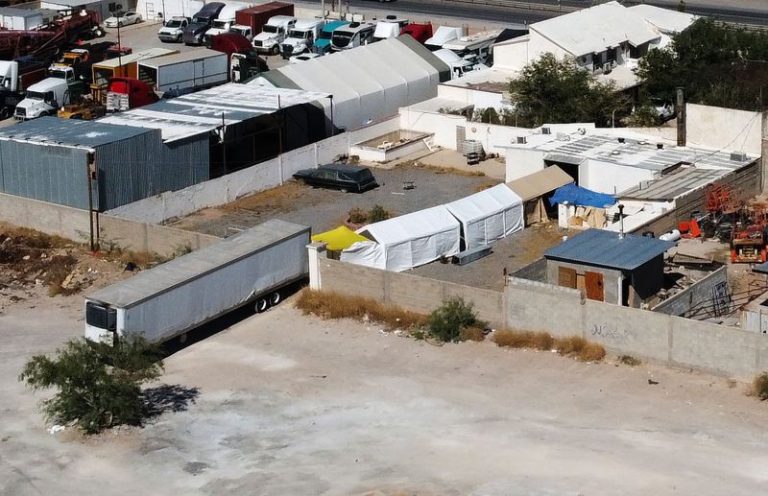
The discovery was made on June 26 after several municipal police officers found a hearse containing two bodies and other corpses piled up in a room in the building’s courtyard.

Prosecutor César Jáuregui said the pile of bodies had accumulated since 2020, suggesting that the Plenitud crematorium had failed to perform services it had been subcontracted for by six funeral homes.

She and her family want clarity about the fate of the remains of her mother, María Nieves Meraz, who died three years ago and was mourned at one of the funeral homes that had subcontracted the crematorium.

Another resident, Javier Ramírez, went to the prosecutor’s office Wednesday to determine if the remains he had received actually belong to his father, who died two months ago and whose wake was held at one of the other funeral homes.

The office said Tuesday that of the 383 bodies found, 218 were men, 149 were women and the gender of 16 could not been identified.

As the case moves forward, the prosecutor’s office is promising a thorough investigation and says it encourages more people to come forward and demand answers.

This post appeared first on cnn.com