Author

admin

Browsing

QQQ and tech ETFs are leading the surge off the April low, but there is another group leading year-to-date. Year-to-date performance is important because it includes two big events: the stock market decline from mid February to early April and the steep surge into early June. We need to combine these two events for a complete performance picture.

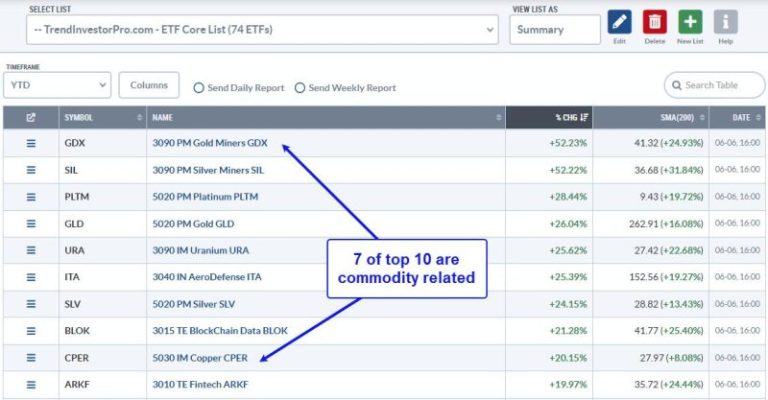
TrendInvestorPro uses a Core ETF ChartList to track performance and rank momentum. This list includes 59 equity ETFs, 4 bond ETFs, 9 commodity ETFs and 2 crypto ETFs. The image below shows the top 10 performers year-to-date (%Chg). Seven of the top ten are metals-related ETFs. Gold Miners (GDX), Silver Miners (SIL), Platinum (PLTM) and Gold (GLD) are leading the way. The Aerospace & Defense ETF (ITA), Transformational Data Sharing ETF (BLOK) and ARK Fintech Innovation ETF (ARKF) are the only three non-commodity leaders. The message here is clear: metals are leading.

********************

Subscribe to TrendInvestorPro and get these four bonuses:

  • Adding and Testing an Exit Strategy for the Zweig Breadth Thrust
  • The Bottoming Sequence: Capitulation, V Reversals, Thrusts and Bull Market
  • 200-day Cross for SPY/QQQ: Improve Performance with Smoothing, Filters and a Twist
  • Core ETF ChartList (59 equity ETFs, 4 bond ETFs, 9 commodity ETFs, 2 crypto ETFs)

Click here to take a trial and gain full access

********************

TrendInvestorPro has been tracking the Platinum ETF (PLTM) and Palladium ETF (PALL) since their big breakout surges on May 20th. The chart below shows PALL with a higher low from August to April and a breakout on May 20th. The ETF fell back below the 200-day SMA (gray line) in late May, but resumed its breakout with a 7.75% surge this week.

The bottom window shows the PPO(5,200,0) moving above +1% on May 21st to signal an uptrend in late May. This signal filter means the 5-day EMA is more than 1% above the 200-day EMA. The uptrend signal remains valid until a cross below -1% (pink line). As with all trend-following signals, there are bad signals (whipsaws) and good signals (extended trends). Given overall strength in metals, this could be a good signal that foreshadows an extended uptrend.

TrendInvestorPro is following this signal, as well as breakouts in other commodity-related ETFs. Our comprehensive reports and videos focus on the leaders. This week we covered flags and pennants in several tech ETFs (XLK, IGV, SMH, ARKF, AIQ, MAGS). Click there to take a trial and get your four bonuses. 

/////////////////////////////////

They know all about glory days on the Kop – the fabled terrace that is the spiritual home of fans of Liverpool – England’s Premier League champions.

But they’re more used to legends like Kenny Dalglish or Mohamed Salah banging in goals than political cries for help. So, it was surreal to watch alongside thousands of middle-aged Brits as Bruce Springsteen bemoaned America’s democracy crisis on hallowed footballing ground.

“The America that I love … a beacon of hope and liberty for 250 years, is currently in the hands of a corrupt, incompetent and treasonous” administration, Springsteen said at Anfield Stadium on Wednesday night.

The Boss’s latest warnings of authoritarianism on his European tour were impassioned and drew large cheers. But they did seem to go over the heads of some fans who don’t live in the whirl of tension constantly rattling America’s national psyche.

Liverpudlians waited for decades for Springsteen to play the hometown of The Beatles, whose “I Wanna Hold Your Hand” set his life’s course when he heard it on the radio as a youngster in New Jersey.

Most had a H-H-H-Hungry heart for a party. They got a hell of a show. But also, a lesson on US civics.

“Tonight, we ask all of you who believe in democracy and the best of our American experiment to rise with us, raise your voices, stand with us against authoritarianism and let freedom ring!” Springsteen said.

His European odyssey is unfolding as Western democracies are being shaken again by right-wing populism. So, his determination to engage with searing commentary therefore raises several questions.

What is the role of artists in what Springsteen calls “dangerous times?” Can they make a difference, or should stars of entertainment and sports avoid politics and stick to what they know? Fox News polemicist Laura Ingraham once told basketball icon LeBron James, for instance, that he should just “shut up and dribble.”

Springsteen’s gritty paeans to steel towns and down-on-their-luck cities made him a working-class balladeer. But as blue-collar voters stampede to the right, does he really speak for them now?

Then there’s this issue that Springsteen emphatically tried to answer in Liverpool this week: Does the rough but noble America he’s been mythologizing for 50 years even exist anymore?

How Springsteen and Trump mine the same societal ground

Trump certainly wants to bring the arts to heel – given his social media threats to “highly overrated” Springsteen, Taylor Swift and other superstars and his takeover of the Kennedy Center in Washington. Any center of liberal and free thought from pop music to Ivy League universities is vulnerable to authoritarian impulses.

But it’s also true that celebrities often bore with their trendy political views, especially preaching at Hollywood awards ceremonies. Springsteen, however, has been penning social commentary for decades. And what’s the point of rock ’n’ roll if not rebellion? Rockers usually revolt in their wild-haired youth, rather than in their mid-70s, but desperate times call for desperate measures.

Oddly, given their transatlantic dialogue of recent weeks, Trump and Springsteen mine the same political terrain – globalization’s economic and spiritual hollowing of industrial heartlands.

“Now Main Street’s whitewashed windows, And vacant stores, Seems like there ain’t nobody, Wants to come down here no more,” Springsteen sang in 1984 in “My Hometown” long before Trump set his sights on the Oval Office.

The White House sometimes hits similar notes, though neither the Boss nor Trump would welcome the comparison. “The main street in my small town, looks a heck of a lot worse than it probably did decades ago before I was alive,” Trump’s press secretary Karoline Leavitt said rather less poetically in March.

Political fault lines are also shifting. In the US and Europe, the working class is rejecting the politics of hope and optimism in dark times.

And the Democratic politicians that Springsteen supported – like defeated 2004 nominee John Kerry, who borrowed Springsteen’s “No Surrender” as his campaign anthem, and former President Barack Obama – failed to mend industrial blight that acted as a catalyst to Trumpism.

Shifting political landscapes in England and the US

There are warning signs in England too. The Boss’s UK tours often coincided with political hinge moments. In the 1970s he found synergy with the smoky industrial cities of the North. In his “Born in the USA” period, he sided with miners clashing with Prime Minister Margaret Thatcher. A new BBC documentary revealed this week he gave $20,000 in the 1980s to a strikers’ support group.

Liverpool, a soulful, earthy city right out of the Springsteen oeuvre is a longtime Labour Party heartland. But in a recent by-election, Nigel Farage’s populist, pro-Trump, Reform Party overturned a Labour majority of nearly 15,000 in Runcorn, a decayed industrial town, 15 miles upstream from Liverpool on the River Mersey. This stunner showed Labour’s working class “red wall” is in deep peril and could follow US states like Ohio in shifting to the right as workers reject progressives.

Labour Cabinet Minister Lisa Nandy, whose Wigan constituency is nearby, warned in an interview with the New Statesman magazine this month that political tensions were reaching a breaking point in the North.

“People have watched their town centers falling apart, their life has got harder over the last decade and a half … I don’t remember a time when people worked this hard and had so little to show for it,” Nandy said, painting a picture that will be familiar to many Americans.

In another sign of a seismic shift in British politics last week, Reform came a close third in an unprecedented result in a parliamentary by-election in a one-time industrial heartland outside Glasgow. Scotland has so far been immune to the populist wave – but the times are changing.

Still, there’s not much evidence Trump or his populist cousins in the UK will meaningfully solve heartland pain. They’ve always been better at exploiting vulnerability than fixing it. And Trump’s “big, beautiful bill” would hurt the poor by cutting access to Medicaid and nutrition help while handing the wealthy big tax cuts.

“When conditions in a country are ripe for a demagogue, you can bet one will show up,” Springsteen told the crowd in Liverpool, introducing “Rainmaker” a song about a conman who tells drought-afflicted farmers that “white’s black and black is white.” As the E Street Band struck up, Springsteen said: “This is for America’s dear leader.”

A battle for America’s soul

Springsteen has his “Land of Hope and Dreams.” But Trump has his new “Golden Age.” He claims he can “Make America Great Again” by attacking perceived bastions of liberal power like elite universities and the press, with mass deportations of undocumented immigrants and by challenging due process.

Springsteen implicitly rejected this as un-American while in Liverpool, infusing extra meaning into the lyrics of “Long Walk Home,” a song that predates Trump’s first election win by a decade: “Your flag flyin’ over the courthouse, Means certain things are set in stone. Who we are, what we’ll do and what we won’t.”

Sending fans into a cool summer night, the Boss pleaded with them not to give up on his country.

“The America I’ve sung to you about for 50 years now is real, and regardless of its many faults, is a great country with a great people and we will survive this moment,” he said.

But his fight with Trump for America’s soul will go on. The contrast would be driven home more sharply to Americans if he tours on US soil at this, the most overtly politicized phase of a half-century-long career.

Perhaps in America’s 250th birthday year in 2026?

This post appeared first on cnn.com

Russia claimed Sunday that its forces are for the first time pushing into the central Ukrainian region of Dnipropetrovsk, an area it has been trying to reach for months, in a move that could create new problems for Kyiv’s much-stretched forces.

Subunits from the Russian military’s 90th tank division reached the border of Dnipropetrovsk with the Donetsk region, large parts of which are already under Russian occupation, according to the Russian Ministry of Defense. After this, they continued into Dnipropetrovsk, the defense ministry claimed.

But if confirmed, the Russian advance would be a setback for Ukrainian forces at time when peace talks have stalled. Russian forces have also in recent weeks made incremental progress in the northern Sumy region, as well as near Lyman in Donetsk.

The Russian advance would also put further pressure on the Ukrainians’ grip on the town of Pokrovsk, a key hub that has been under Russian assault for months. Ukraine’s General Staff said Sunday morning that its troops had stopped 65 “offensive” Russian actions in the Pokrovsk direction.

An Institute for the Study of War (ISW) assessment of Russia’s offensive campaign found that Russian forces continued their offensive operations in the Pokrovsk direction on Saturday, but did not advance.

Dnipropetrovsk is bordered by three regions that are partially occupied by Russia – Donetsk, Kherson and Zaporizhzhia.

One of Russia’s declared goals is capturing all three regions. It already occupies all but a slither of a fourth region, Luhansk.

Dnipropetrovsk is more sparsely populated and rural than those four regions, known as the Donbas, and will be more difficult to defend. It is an important mining and logistics center and had an estimated population of three million before the war began.

Russia’s claim comes days after its forces advanced further in the northern Sumy region, bringing the region’s capital within range of drones and artillery.

While capturing the region’s capital city, also named Sumy, is likely beyond what Moscow is setting out to do, the move underlines the pressure Kyiv is under, from the northern border to the Black Sea.

This post appeared first on cnn.com

Ukraine sent dozens of its own citizens to Russia last month, releasing them from prisons in an attempt to secure the release of dozens of Ukrainian civilians held illegally in Russian jails – a move described by human rights activists as desperate and worrying.

According to the Ukrainian government, 70 Ukrainian civilians convicted of collaborating with Russia were released as part of the 1,000 for 1,000 prisoner exchange between Kyiv and Moscow last month.

Ukraine said all of them went into exile voluntarily, as part of a government scheme that gives anyone convicted of collaborating with Russia the option of being sent there.

But human rights groups and international lawyers say the scheme is problematic, contradicts previous statements made by the Ukrainian government, and could potentially put more people at risk of being snatched by the Russians.

“I completely understand the sentiment, we all want the people (who are detained in Russia) to be released as quickly as possible and Russia has no will to do that… but the solution that is offered is definitely not the right one,” said Onysiia Syniuk, a legal analyst at Zmina, a Ukrainian human rights group.

The program, called “I want to go to my own,” was launched last year by Ukraine’s Coordination Headquarters for the Treatment of Prisoners of War, the Ministry of Defense, the Security Service and the parliament’s Commissioner for Human Rights.

A government website outlining the program includes photos and personal information of some of the 300 Ukrainian people that the government says have signed up to the program.

The profiles of 31 of them are stamped with a picture of a suitcase and the words “HAS LEFT,” with a note saying he or she “left for Russia while at the same time real Ukrainians returned home.”

Bargaining chips

According to Kyiv, at least 16,000 Ukrainian civilians are known to be detained in Russia, although the real number is likely to be much higher. Some 37,000 Ukrainians, including civilians, children and members of the military, are officially recognized as missing.

Many have been detained in occupied territories, detained for months or even years without any charges or trial, and deported to Russia. They include activists, journalists, priests, politicians and community leaders as well as people who appear to have been snatched by Russian troops at random at checkpoints and other places in occupied Ukraine.

The detention of civilians by an occupying power is illegal under international laws of conflict, except for in a few narrowly defined situations and with strict time limits.

Because of that, there is no established legal framework for the treatment and exchange of civilian detainees in the same way there is for prisoners of war.

Russia has, in some cases, claimed that the Ukrainian civilians it is holding are prisoners of war and should be recognized as such by Ukraine. Kyiv has been reluctant to do so because it could put civilians living in occupied areas of Ukraine at risk of being arbitrarily detained by Russia as it seeks to grow its pool for future exchanges.

Kyiv has rallied its allies to increase pressure on Russia over the issue and tried to get Moscow to agree to release the detained civilians through third countries, similar to the way some Ukrainian children have been returned with the help of Qatar, South Africa and the Vatican.

Several international organizations, including the United Nations and the Organization for Security and Co-operation in Europe (OSCE), have also repeatedly called on Moscow to unconditionally release its civilian detainees.

Russia has ignored the pleas.

The “I want to go to my own” program is an attempt by Kyiv to get some of the detained civilians back without having to recognize them as prisoners of war.

But human rights groups are urging the Ukrainian government to continue to press for unconditional release of civilians. “Under international humanitarian law, it is not possible to talk about exchanging civilians. All civilians unlawfully detained must be released unconditionally,” said Yulia Gorbunova, a senior researcher on Ukraine at Human Rights Watch (HRW).

Announcing the 1,000 for 1,000 exchange, Ukraine’s President Volodymyr Zelensky hinted as much.

“I would like to thank our law enforcement officers today for adding Russian saboteurs and collaborators to the exchange fund,” the president said, while also thanking Ukrainian soldiers for capturing Russian troops on the front lines.

‘Political prisoners’

But it seems that the scheme did not yield the results Kyiv was hoping for.

The headquarters said the returnees included a group of at least 60 Ukrainian civilians who were convicted of criminal offenses unrelated to the war.

After completing their sentences, Russian authorities were supposed to deport these prisoners from the occupied territories back to Ukraine. Instead, it kept them, unlawfully, in detention centers normally used for illegal immigrants and only released them as part of the 1,000 for 1,000 prisoner swap.

The RussianHuman Rights Commissioner Tatyana Moskalkova described the convicted Ukrainian collaborators sent to Russia as “political prisoners,” but did not give any more details on who they were or what would happen to them next.

The “I want to go to my own” website gives details of some those sent to Russia in the prisoner exchange, including the offenses they were convicted of. Many were serving years-long sentences for collaboration with Moscow. Some were convicted of supporting the invasion or sharing information with Russian troops. Most received sentences of between five and eight years in prison.

But human rights lawyers say the Ukrainian collaboration law under which these people were sentenced is itself problematic.

HRW has previously issued an extensive report criticizing the anti-collaboration law, calling it flawed.

Gorbunova said the group analyzed close to 2,000 verdicts and that while there were genuine collaborators among them, a lot of them were “people who, under international humanitarian law, should not have been prosecuted.”

She said these included cases where there’s been “little or no harm done” and or where there was no intent to harm national security. Some of the cases involve people who had been working in public service in areas that were then occupied and who had simply continued doing their jobs.

“Helping people on the streets, people who are sick or have disabilities, distributing humanitarian aid. Teachers, firefighters, municipal workers who collect trash, that type of thing – they could be convicted of working for the occupation as collaborators,” she said.

“That is not to say that there are no actual collaborators who commit crimes against national security…who should be punished, (but) this legislation is so vague that essentially a very wide range of activities of people living and working under occupation could qualify as collaboration, which is troubling and problematic,” she said.

While the initiative’s website includes what it says are handwritten notes from each of the convicted collaborators indicating their wish to leave for Russia, human rights organizations say the way in which they have been disowned by their country is ethically dubious.

This post appeared first on cnn.com

Colombian senator Miguel Uribe, in the running to join next year’s presidential race, has been shot at an event in Bogota, according to national police.

The mayor of Bogota, Carlos Galán, said Uribe was receiving emergency care after being attacked in the Fontibon district on Saturday and that the “entire hospital network” of the Colombian capital was on alert in case he needed to be transferred.

The mayor added that the suspected attacker had been arrested.

Colombian President Gustavo Petro expressed his solidarity with the senator’s family in a tweet on X, saying, “I don’t know how to ease your pain. It is the pain of a mother lost, and of a wounded homeland.”

Colombia’s government has issued a statement condemning the attack on Uribe.

This is a developing story and will be updated.

This post appeared first on cnn.com

The Israeli military says it has killed the leader of a Palestinian militant group that took part in the October 7, 2023, terror attacks on southern Israel.

Asaad Abu Sharia, who led the Palestinian Mujahideen Movement and its armed wing the Mujahideen Brigades, was killed in a joint operation with Israel’s Shin Bet security agency, the Israel Defense Forces (IDF) said on Saturday.

His death and that of his brother Ahmed Abu Sharia were confirmed by the militant group hours after Gaza’s Civil Defense reported that an Israeli airstrike had hit their family home in the Sabra area of Gaza City.

Hamas run Al-Aqsa TV said the strike killed at least 15 people and injured several. Video showed people searching through the debris of a demolished four-story house.

The Mujahideen Brigades took part in the October 7 attacks alongside Hamas and other Palestinian terror groups and took hostage some of the most high-profile captives, including a family whose suffering became a symbol of the attack.

According to the Israeli military, Sharia was among the militant leaders who stormed Kibbutz Nir Oz, a small Israeli community near the Gaza border where many residents were killed or taken hostage during the brutal terror assault that led to Israel’s war in Gaza.

Despite not being aware of Hamas’ plans in advance, fighters from the jihadist group joined in the cross-border assault “as an extension of the Hamas attack,” the Israeli military said.

According to Israel, Sharia was directly involved in the abduction and murders of Shiri, Ariel and Kfir Bibas – a family that became one of the most recognizable victims of the attack, partly because of the young ages of Kfir and Ariel, who were nine months and four years old respectively at the time.

Kfir was the youngest hostage kidnapped into Gaza and the youngest to have been killed. The boys’ mother, Shiri, was 32 at the time of her kidnap. Their father Yarden was also captured, but was released alive in February after 484 days in captivity.

Reacting to news of Sharia’s killing, the Bibas family expressed their “heartfelt gratitude” to the Israeli military, saying his death was “another step on the journey towards closure.”

“While Shiri, Ariel, and Kfir cannot be brought back, we find some measure of comfort knowing these despicable murderers will not harm another family,” the Bibas family said in a statement shared via the Hostages and Missing Families Forum.

Israel’s military said Sharia was also involved in the abduction of the Israeli-American couple Gad Haggai and Judi Lynn Weinstein Haggai and the abduction and killing of Thai national Nattapong Pinta.

The Israeli-American couple were killed near their home in Kibbutz Nir Oz during the attack in 2023. The body of Nattapong, an agricultural worker who was abducted alive on October 7, was recovered from southern Gaza in a military operation on Friday.

Israel said it believes the Mujahideen Brigades are still holding the body of an additional foreign national. The group has previously denied killing their captives.

This post appeared first on cnn.com
President Donald Trump has escalated his sudden rupture with Elon Musk by implying the government could sever ties with the tech titan’s businesses.

‘The easiest way to save money in our Budget, Billions and Billions of Dollars, is to terminate Elon’s Governmental Subsidies and Contracts. I was always surprised that Biden didn’t do it,’ Trump wrote Thursday on Truth Social.

Various estimates have been put forward about just how much Musk’s firms, primarily SpaceX and Tesla, benefit from U.S. government contracts and subsidies. The Washington Post has put the figure at $38 billion, with SpaceX President and COO Gwynne Shotwell estimating that company alone benefits from $22 billion in federal spending. Reuters has reported that the true figure is classified because of the nature of many of the contracts Musk’s firms are under.

NASA relies on SpaceX to ferry astronauts to and from the International Space Station. The agency’s only other option at the moment is to pay around $90 million for a seat aboard Russia’s Soyuz capsule.

Last year, SpaceX was selected to develop a vehicle capable of safely de-orbiting the International Space Station in 2030, when NASA and its partner space agencies agreed to end operation of the orbiting laboratory. SpaceX is also expected to play a major role in NASA’s efforts to return astronauts to the moon and eventually travel beyond to Mars.

Later Thursday afternoon, Musk posted that he would begin ‘decommissioning’ SpaceX’s Dragon spacecraft, which regularly flies astronauts and cargo to the ISS, in response to Trump’s threat.

NASA spokesperson Bethany Stevens said the agency ‘will continue to execute upon the President’s vision for the future of space.’

‘We will continue to work with our industry partners to ensure the President’s objectives in space are met,’ she said in a statement on X.

Tesla, meanwhile, has benefited from approximately $11.4 billion in total regulatory credits aimed at boosting electric-vehicle purchases, though that figure also includes state-level subsidies. Musk has claimed he no longer needs the credit, which he says now primarily benefits rivals.

Following Trump’s threat, shares in Tesla, which had already fallen 8% on Thursday as the tit-for-tat escalated on social media, declined as much as 15% following Trump’s post. SpaceX is privately held and its shares do not trade on the open market.

Trump’s warning came as part of a stunning exchange with Musk — who spent more than $250 million to help him get elected — that erupted into public view.

Earlier in the day, president told reporters in the Oval Office that he was disappointed in Musk’s criticism of the Republican policy bill that is making its way through Congress. Musk has blasted the bill, calling it a ‘disgusting abomination,’ amid concerns it would worsen the U.S. fiscal deficit.

Musk, who officially left his White House role last week to spend more time on his companies, spent much of Thursday launching into a tirade on X, his social media platform, where he posted a variety of critiques of Trump, the bill and other Republican politicians.

A make-good on Trump’s threat would come at a sensitive time for Tesla, which has seen global sales plunge partly in response to Musk’s very involvement with the Trump campaign. Year to date, its shares are down some 25%.

Trump’s warning also raises the specter that Trump could resurface pending government investigations into Musk’s firms. According to a report in April from Democratic staff of the Senate Homeland Security Permanent Subcommittee on Investigations, Musk’s firms were facing $2.37 billion in potential federal liabilities when Trump took office in January.

Since then, many of those actions have been paused or outright dismissed alongside the rise of the previously Musk-helmed Department of Government Efficiency, which gutted many of the agencies looking into Musk’s businesses.

This post appeared first on NBC NEWS

Most religions of the world have the fundamental beliefs that are strikingly similar to the Ten Commandments. History has taught humanity that life does not seem to work well without such guiding principles. As responsible parents, we should have a parallel foundation of ten life skills that we impart part to our children. Your list will vary from mine, of course, but these are the ten essential precepts which I imparted to my son.

  1. Learn the basic life skills such as hygiene, cooking, cleaning, etc.
  2. Develop and maintain positive relations with friends and family.
  3. Keep a positive ‘can-do’ attitude exuding confidence and good self-esteem.
  4. Have strong ethics and values centered around honesty, morality and empathy for others.
  5. Develop strong communication skills, both verbal and written.
  6. Develop strong problem solving skills, curiosity, education, and rational thinking.
  7. Set goals and maintain the motivation to overcome life’s inevitable challenges.
  8. Appreciate the spiritual side of life.
  9. Keep healthy habits pertaining to diet, exercise, and lifestyle.
  10. Understand the tenets of financial literacy relating to money, saving, budgeting, and spending.

Many parenting books have been written on each of these ten topics, but I’d like to highlight the last one – #10. I propose that financial literacy alone has 10 essential skills that we should cultivate in our children. Giving them the gift of a money-wise toolkit along with your time will go along way to ensure their long-term success. It will be the proud legacy you leave and how you’ll be remembered.

These are my Ten Financial Commandments to teach your offspring.

  1. Start early and encourage your kids to embrace investing as a hobby. It’s intellectually stimulating and they’ll meet great people.
  2. Invest consistently and regularly. Don’t try to time the market. As of yet, no one has successfully created that algorithm.
  3. Warren Buffet famously described the magic of compounding as “the eighth wonder of the world.” He likened it to a snowball rolling down a long hill, accumulating more snow as it rolls. Do the math; it’s true.
  4. Avoid debt and leverage. Buying a house or college loan aside, credit card debt and onerous fees can ruin you.
  5. Ignore fads and hot tips. You’ll be inevitably late, pay too much and experience the bursting of the bubble eventually.
  6. Day trading is not investing, and it’s important to understand the difference. If you are an adrenaline addict and absolutely must day trade, then allocate a small percentage of your portfolio to this activity and consider it your “funny money” that’s expendable. Trading is indeed part of successful investing, but overtrading is not.
  7. Pay attention to fees. One percent a year may not sound like much, but when you do the calculations and look at a 10-15 year timeframe, you’ll lose out big-time. Fees represent your money that doesn’t get reinvested or compounded for you over the span of those 15 years.
  8. Be careful which assets you marry. Some have long-term handcuffs, high fees, unattractive risk-to-reward ratios and low probabilities of making you wealthier. I’ve never forgotten this famous quote from John Bogle, who founded Vanguard: “Don’t look for the needle in the haystack; buy the haystack.” In other words, buying the S&P 500 Index (SPY) is a reasonable strategy.
  9. Investing is a marathon, not a sprint. Young people often think that if they lose big, they’ll have many years to recover. My point is, why lose at all? Asset protection should always be a paramount objective throughout one’s life. Start young.
  10. Be action-oriented. Start today. Don’t procrastinate. Don’t make excuses. Buy a good investment book. (I humbly suggest the one I wrote with my son.) Start a free trial at StockCharts.com. Do some paper trading. You might discover you are the second coming of Warren Buffett!

In a spirit of full disclosure, it’s important that I acknowledge the other half of the equation in writing about the ten basic life skills and financial commandments instilled in my son. He was also raised by a devoted and well-educated mother who has an MBA and understands the markets as well.

The bottom line: teach your children about money management. If you don’t, you are intentionally placing them instead into the hands of that merciless professor called “Experience”. The tutorial will be ruthless, and the lessons learned will be costly and late.

Trade well; trade with discipline!

Gatis Roze, MBA, CMT

StockMarketMastery.com

P.S. If you would like to be notified when I post a new Traders Journal blog, please submit your preference via the tile in the right column titled FOLLOW THIS BLOG.

Stay ahead of the market in under 30 minutes! In this video, Mary Ellen breaks down why the S&P 500 just broke out, which sectors are truly leading (industrials, technology & materials), and what next week’s inflation data could mean for your portfolio.

This video originally premiered June 6, 2025. You can watch it on our dedicated page for Mary Ellen’s videos.

New videos from Mary Ellen premiere weekly on Fridays. You can view all previously recorded episodes at this link.

If you’re looking for stocks to invest in, be sure to check out the MEM Edge Report! This report gives you detailed information on the top sectors, industries and stocks so you can make informed investment decisions.

This week, we got a smorgasbord of jobs data — JOLTS, ADP, weekly jobless claims, and the nonfarm payrolls (NFP). Friday’s NFP, the big one the market was waiting for, showed that 139,000 jobs were added in May, which was better than the expected 130,000. Unemployment rate held steady at 4.2%, and average hourly earnings rose 0.4% for the month.

The stock market rallied on the news. The S&P 500 rose above the 6000 level and closed slightly above it. That’s the first time the index has hit the 6K level since February. And the party wasn’t just in the S&P 500. All the major stock market indexes closed higher, and the Cboe Volatility Index ($VIX) closed below 17, suggesting investors are pretty complacent.

Sector Performance: Tech Takes the Lead

When you look at which sectors did best this week, it’s pretty clear that Technology was leading the charge. But is the leadership as strong as it was last year?

To answer, we can begin by taking a look at the MarketCarpet for S&P Sector ETFs below. It clearly illustrates the strength of the Technology sector.

FIGURE 1. WEEKLY PERFORMANCE OF THE S&P SECTOR ETFS. Technology is in the lead while Consumer Staples is the laggard.Image source: StockCharts.com. For educational purposes.

Now, if you drill down, it’s evident from the MarketCarpet of the Technology Sector that heavily weighted large-cap stocks, across the many different categories within the sector, displayed strong performance for the week.

FIGURE 2. WEEKLY PERFORMANCE OF TECHNOLOGY SECTOR. Large-cap heavily weighted stocks were in the green this week.Image source: StockCharts.com. For educational purposes.

Semis Grind Higher

Within tech, the semiconductors look especially strong, with several dark green squares in the MarketCarpet. This warrants a closer look at this industry group.

The weekly chart of the VanEck Vectors Semiconductors ETF (SMH) shows an upside move, with the ETF trading above its 40-week simple moving average. However, SMH is still underperforming the SPDR S&P 500 ETF (SPY). The Relative Strength Index (RSI) is trending higher and is in better shape since the end of March, but needs to gain more momentum to push it into overbought territory.

FIGURE 3. WEEKLY CHART OF VANECK VECTORS SEMICONDUCTOR ETF (SMH). While the price action in SMH is leaning towards the bullish side, it’s underperforming the SPY and needs more momentum.Chart source: StockCharts.com. For educational purposes.

If SMH continues to move higher with strong momentum, it would be a positive indication for the equity markets. However, there are several moving parts that investors should monitor.

Closing Position

While stocks are inching higher on low volatility, news headlines disrupt trends, sometimes drastically.

The weakening U.S. dollar and rising Treasury yields can sometimes signal headwinds for the stock market. Next week is going to be all about inflation, and we’ll get the Consumer Price Index (CPI) and Producer Price Index (PPI) for May.

With the job numbers in the rearview mirror, investors will be focused on inflation, especially since the Fed meets the following week. As of now, the Fed isn’t expected to make any changes to interest rates until perhaps their September meeting. Let’s see if next week’s inflation data changes the picture.

Watch the price action unfold by monitoring the StockCharts MarketCarpets and the StockCharts Market Summary page.


Disclaimer: This blog is for educational purposes only and should not be construed as financial advice. The ideas and strategies should never be used without first assessing your own personal and financial situation, or without consulting a financial professional.