Author

admin

Browsing

Catherine, Princess of Wales visited a wellbeing garden at Colchester Hospital on Wednesday, marking her first public appearance since she unexpectedly dropped out of an appearance at Royal Ascot two weeks ago.

Kate visited the hospital garden in the southeast of England to “celebrate the incredible healing power of nature,” according to Kensington Palace.

During the visit, the princess also met with patients and staff at the hospital’s Cancer Wellbeing Centre “to understand how gardens in healthcare settings play a crucial role in promoting good health outcomes, preventing poor health and supporting increased recovery time,” the palace said.

Kate, 43, has underlined the importance of nature in her health journey over the last year.

“Over the past year, nature has been my sanctuary,” she said in a video posted on X to mark Mental Health Awareness Week in May.

Kate revealed her cancer diagnosis and that she had started chemotherapy last March. As she underwent treatment, she stepped back from public life and only made a few rare appearances last summer. In September, she announced she had completed chemotherapy and was “doing what I can to stay cancer free.”

Although she has taken on more appearances this year, the popular royal is understood to be working to find the right balance as she returns to public duties after treatment.

Before dropping out of Ascot at short notice, Kate had attended a number of engagements in recent weeks, including two major events in the royal calendar, the Trooping the Colour parade in London and the Order of the Garter service in Windsor.

She resumed in-person duties last week when she and Prince William invited Melinda French Gates for a meeting at Windsor Castle. They were understood to have discussed their philanthropic work, according to Britain’s PA Media news agency.

Kate’s visit to Colchester Hospital on Wednesday coincided with the hospital accepting a donation of 50 “Catherine’s Rose” plants, a specially-bred rose named in her honor by the Royal Horticultural Society. She planted some of these roses, which, when sold commercially, will have their proceeds donated to The Royal Marsden Cancer Charity.

Kate has become deeply involved in the charity since her diagnosis. In January, Kensington Palace announced that she had been named the joint patron of The Royal Marsden NHS Foundation Trust, the specialist cancer center in Chelsea, west London, where she was treated.

Funds from the sale of these roses will be used to help the charity establish a specialist program helping cancer patients live well with the disease, and after their treatment has been completed.

This post appeared first on cnn.com

North Korea is set to triple the number of its troops fighting for Russia along the front lines with Ukraine, sending an additional 25,000 to 30,000 soldiers to assist Moscow, according to an intelligence assessment from Ukrainian officials.

The assessment also says there are signs that Russian military aircraft are being refitted to carry personnel, reflecting the vast undertaking of moving tens of thousands of foreign troops across Russian Siberia, which shares a border with North Korea in its far southwest.

North Korea initially sent 11,000 troops to Russia in the fall of 2024 in great secrecy, with Russian President Vladimir Putin only confirming the deployment in late April.

In October, North Korean soldiers were pictured being handed equipment for the frontlines at the Sergeevka military base in Primorskyi Krai.

A month later, a Ropucha-class Russian ship docked at the Dunai port near Nakhodka, 95 kilometers (59 miles) to the southwest, which could carry up to 400 troops, analysts said.

“Satellite imagery shows a Russian personnel carrier arriving at Dunai in May, and activity at Sunan airport in May and June,” said Joe Byrne, senior analyst at the Open Source Centre. “This appears to indicate the routes previously used to move DPRK troops are active, and could be used in any large-scale future transfer of personnel.”

Jenny Town, senior fellow and director of the Korean program at the Stimson Center, said the Ukrainian assessment of up to 30,000 sounded “high… but they can certainly come up with that number. They won’t be elite soldiers. Kim Jong Un has said he is all in, so it depends on what Russia has asked for.”

Town said 10,000 to 20,000 “sounds more realistic,” and that North Korea might slowly deploy the troops in stages. “There have been rumors that Russian generals have been inside North Korea training troops there already,” she said.

Ukraine’s Defense Minister Rustem Umerov said Thursday that Kyiv suspected further North Korean troops might be deployed but added that the country’s leader, Kim Jong Un, risked putting his own government in peril by exposing so many elite troops to the high casualty rates of the front line. “Russia’s use of elite North Korean troops demonstrates not only a growing reliance on totalitarian regimes but also serious problems with its mobilization reserve,” Umerov said. “Together with our partners, we are monitoring these threats and will respond accordingly.”

On Friday, Ukraine’s military chief, Oleksandr Syrskyi, said Russia was amassing 110,000 troops near the front-line hotspot town of Pokrovsk, in preparation for a possible offensive on the strategic population center.

Sergei Shoigu, a top adviser to Putin who previously served as his defense minister, visited Pyongyang on June 17 – a trip made on Putin’s orders, and his second visit in a fortnight, the Russian state-run TASS news agency reported. During the visit, Shoigu announced 1,000 North Korean sappers and 5,000 military construction workers would be sent to Russia, to clear mines and “restore infrastructure destroyed by the occupiers” in the Kursk region, according to TASS.

South Korea’s National Intelligence Service (NIS) has briefed lawmakers in Seoul that North Korea has begun selecting personnel for overseas deployment which could occur as early as July or August, according to remarks by lawmaker Lee Seong-kweun. He highlighted Russia’s public announcement of another 6,000 North Korean mine clearers and military construction workers being sent. It is unclear if the NIS shares the Ukranian intelligence assessment that the deployment could be as many as 30,000.

The six-minute video shows a Russian military instructor declaring that North Koreans aged 23 to 27 arrive “physically well-prepared.” He added, “As fighters they are not worse than ours. The enemy runs away first.”

The Russian trainer discusses with Kim a translation sheet of basic military Russian terms to Korean. It is unclear if the North Korean trainees are new arrivals or the remnants of the 11,000 sent last year. The reporter also visits a trench network where the North Koreans live with basic comfort items such as red Korean pepper, and handwritten posters declaring in Korean “Revenge for our fallen comrades” above their bunks.

Another two videos posted by TASS imply greater integration of North Korean soldiers into the Russian military than was previously seen. North Korean troops’ first exposure to the front line in Kursk was as a distinct, separate unit, owing to the language barrier with Moscow’s troops, according to assessments by Ukrainian officials.

One TASS video shows North Korean and Russian troops working to clear buildings together in close-combat training, and another shows North Koreans receiving training with shotguns, used to tackle the Ukrainian drone threat.

The manuals have emerged at the same time as increasing numbers of videos of North Korean artillery at the front line have been seen online, and as a report from 11 UN member states last month said that Pyongyang had sent at least 100 ballistic missiles and 9 million artillery shells to Russia in 2024.

The report also echoed statements from the South Korean military in March that another 3,000 North Korean troops had been sent to Russia early this year.

Town, from the Stimson Center, said Pyongyang saw a long-term benefit to Moscow being in its debt. “The more ‘blood debt’ there is between them,” she said, “the more North Korea will benefit in the long run, even if they are making sacrifices in the short term.”

This post appeared first on cnn.com

The Dalai Lama has announced that he will have a successor after his death, continuing a centuries-old tradition that has become a flashpoint in the struggle with China’s Communist Party over Tibet’s future.

Tibetan Buddhism’s spiritual leader made the declaration on Wednesday in a video message to religious elders gathering in Dharamshala, India, where the Nobel Peace laureate has lived since fleeing Tibet after a failed uprising against Chinese communist rule in 1959.

“I am affirming that the institution of the Dalai Lama will continue,” the Dalai Lama said in the pre-recorded video, citing requests he received over the years from Tibetans and Tibetan Buddhists urging him to do so.

“The Gaden Phodrang Trust has sole authority to recognize the future reincarnation; no one else has any such authority to interfere in this matter,” he added, using the formal name for the office of the Dalai Lama.

The office should carry out the procedures of search and recognition of the future dalai lama “in accordance with past tradition,” he said, without revealing further details on the process.

The Dalai Lama has previously stated that when he is about 90 years old, he will consult the high lamas of Tibetan Buddhism and the Tibetan public to re-evaluate whether the institution of the dalai lama should continue.

Wednesday’s announcement – delivered days before his 90th birthday this Sunday – sets the stage for a high-stakes battle over his succession, between Tibetan leaders in exile and China’s atheist Communist Party, which insists it alone holds the authority to approve the next dalai lama.

In a memoir published in March, the Dalai Lama states that his successor will be born in the “free world” outside China, urging his followers to reject any candidate selected by Beijing.

That could lead to the emergence of two rival dalai lamas: one chosen by his predecessor, the other by the Chinese Communist Party, experts say.

“Both the Tibetan exile community and the Chinese government want to influence the future of Tibet, and they see the next Dalai Lama as the key to do so,” said Ruth Gamble, an expert in Tibetan history at La Trobe University in Melbourne, Australia.

Samdhong Rinpoche, a senior official at the Dalai Lama’s office, told reporters on Wednesday that any further information about the procedures or methods of the Dalai Lama’s reincarnation would not be revealed to the public until the succession takes place.

Struggle over succession

Over a lifetime in exile, the 14th Dalai Lama, Tenzin Gyatso, has become synonymous with Tibet and its quest for genuine autonomy under Beijing’s tightening grip on the Himalayan region.

From his adopted hometown of Dharamshala, where he established a government-in-exile, the spiritual leader has unified Tibetans at home and in exile and elevated their plight onto the global stage.

That has made the Dalai Lama a persistent thorn in the side of Beijing, which denounces him as a dangerous “separatist” and a “wolf in monk’s robes.”

Since the 1970s, the Dalai Lama has maintained that he no longer seeks full independence for Tibet, but “meaningful” autonomy that would allow Tibetans to preserve their distinct culture, religion and identity. His commitment to the nonviolent “middle way” approach has earned him international support and the Nobel Peace Prize in 1989.

The Dalai Lama has long been wary of Beijing’s attempt to meddle with the reincarnation system of Tibetan Buddhism.

Tibetan Buddhists believe in the circle of rebirth, and that when an enlightened spiritual master like the Dalai Lama dies, he will be able to choose the place and time of his rebirth through the force of compassion and prayer.

But the religious tradition has increasingly become a battleground for the control of Tibetan hearts and minds, especially since the contested reincarnation of the Panchen Lama, the second-highest figure in the religion.

In 1995, years after the death of the 10th Panchen Lama, Beijing installed its own panchen lama in defiance of the Dalai Lama, whose pick for the role – a six-year-old boy – has since vanished from public view.

Under Tibetan tradition, the dalai lamas and the panchen lamas have long played key roles in recognizing each other’s reincarnations. Experts believe Beijing will seek to interfere in the current Dalai Lama’s succession in a similar way.

“There’s a whole series of high-level reincarnated lamas cultivated by the Chinese government to work with it inside Tibet. (Beijing) will call on all of those to help establish the Dalai Lama that they pick inside Tibet,” Gamble said. “There’s been a long-term plan to work toward this.”

Beijing has repeatedly said that the reincarnation of all Living Buddhas – or high-ranking lamas in Tibetan Buddhism – must comply with Chinese laws and regulations, with search and identification conducted in China and approved by the central government.

A “resolution of gratitude” statement released by Tibetan Buddhist religious leaders gathering in Dharamshala on Wednesday said they “strongly condemn the People’s Republic of China’s usage of reincarnation subject for their political gain” and “will never accept it.”

For his part, the current Dalai Lama has made clear that any candidate appointed by Beijing will hold no legitimacy in the eyes of Tibetans or followers of Tibetan Buddhism.

“It is totally inappropriate for Chinese Communists, who explicitly reject religion, including the idea of past and future lives, to meddle in the system of reincarnation of lamas, let alone that of the Dalai Lama,” he writes in his latest memoir, “Voice for the Voiceless.”

This post appeared first on cnn.com

Australian airline Qantas says a data hack on Monday exposed the personal information of six million customers and it expects the amount stolen to be “significant.”

The hack penetrated a third-party customer service platform used by a Qantas contact center, the airline said in a statement on Wednesday. Six million customers have service records on the platform – with data including some of their names, email addresses, phone numbers, birth dates and frequent flyer numbers.

However, the platform does not contain any customer credit card details, financial information or passport details, Qantas said.

After Qantas detected “unusual activity” on the platform, it took action and “contained” the system, it said. The statement said all Qantas systems are now secure, and there is no impact to the company’s operations or safety.

It’s not clear exactly how much data was stolen, “though we expect it to be significant,” the airline said. It is now working to support affected customers, and is cooperating with the Australian Cyber Security Centre, Australian Federal Police and independent cybersecurity experts on the investigation.

“We sincerely apologize to our customers and we recognize the uncertainty this will cause. Our customers trust us with their personal information and we take that responsibility seriously,” said Qantas CEO Vanessa Hudson in the statement.

“We are contacting our customers today and our focus is on providing them with the necessary support.”

Qantas’ share price was down 3.5% in morning trading, against a 0.4% gain in the broader market, according to Reuters.

Australia has seen a series of major cyberattacks and company hacks in recent years. In 2019, a cyberattack targeted Australia’s ruling and opposition parties less than three months before a national election. Two years later, broadcaster Nine News suffered a cyberattack that forced a number of live shows off air – calling it the largest cyberattack on a media company in Australia’s history.

Most recently in 2022, cybercriminals in Russia conducted a ransomware attack on Medibank, one of Australia’s largest private health insurers. Sensitive personal data, including health claims information, was stolen from 9.7 million customers – some of which was then released onto the dark web.

Last year, Australia publicly named and imposed sanctions on a Russian national for his alleged role in the attack. He was an alleged member of the Russian ransomware gang REvil, which had previously launched large attacks on targets in the United States and elsewhere, before Russian authorities cracked down in 2022 and detained multiple people.

This post appeared first on cnn.com

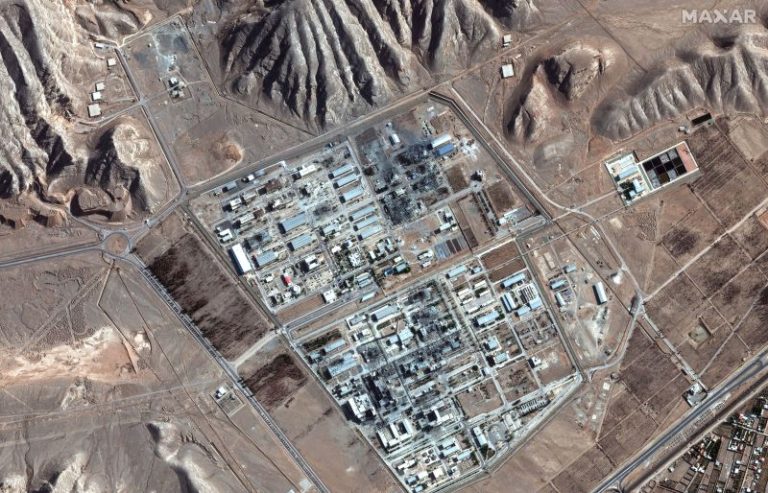
Iranian President Masoud Pezeshkian has approved a law to halt cooperation with the International Atomic Energy Agency (IAEA), a move which will likely obscure any attempt by Tehran to restart its damaged nuclear program.

Wednesday’s decision comes a week after Iran’s parliament passed a law to suspend cooperation with the UN nuclear watchdog. Iran blames the IAEA for collaborating with Israel and providing a pathway for strikes on its nuclear facilities, an accusation which the agency denies.

Pezeshkian ordered Iran’s Atomic Energy Organization, the Supreme National Security Council, and the Ministry of Foreign Affairs to begin implementing the law, state-run news agency IRNA said.

It’s unclear when and how the new law will be implemented, but the decision could pave the way for Iran to rebuild its nuclear program without inspections or monitoring from the IAEA. Iran is a signatory to the Non-Proliferation Treaty (NPT), which requires members to allow monitoring and inspections of facilities to confirm the peaceful nature of nuclear programs.

Israel launched an unprecedented attack on Iran last month that targeted its military commanders, nuclear facilities and the scientists who develop its atomic program. In the week that followed, the United States launched supportive strikes on Iranian nuclear facilities in Natanz, Isfahan and Fordow. A 12-day conflict between Israel and Iran ended with a ceasefire last week.

Iran said its facilities were badly damaged in the attacks but that it intends to continue enriching uranium to continue its “peaceful” nuclear program. On Sunday, the IAEA said US strikes on Iran fell short of causing total damage to the program and that Tehran could restart enriching uranium “in a matter of months.”

Days before Israel attacked the Iranian facilities, the IAEA said it could not verify that Tehran’s nuclear program is entirely peaceful and issued a report saying Iran was enriching uranium to near weapons-grade levels.

That document triggered an IAEA resolution censuring Iran, fueling outrage across the Iranian government who accuse the agency and its director general, Rafael Grossi, of being biased.

Iran’s Supreme Leader Ayatollah Khamenei has repeatedly denied Iran is building a bomb and says weapons of mass destruction are forbidden under Islam. The country began enriching uranium to higher levels after US President Donald Trump withdrew in 2018 from a nuclear agreement signed between the Obama administration and Iran.

This post appeared first on cnn.com

Love your Costco dupes? Lululemon is coming after them.

Lululemon has filed a lawsuit against Costco, accusing the big box store of selling knockoffs of the athleisure brand’s apparel for a fraction of the price.

According to the complaint filed Friday in the Central District of California, Costco allegedly ‘unlawfully traded’ on Lululemon’s ‘reputation, goodwill and sweat equity’ by selling unauthorized and unlicensed knockoffs and dupes, infringing on the company’s popular patents.

The complaint lists several Costco items that appear to rip off Lululemon’s designs and patents: Costco’s ‘Danskin Half-Zip Pullover’ that retails for just $8. The lawsuit claims it’s a dupe for Lululemon’s SCUBA pullover that sells for $118. Costco’s ‘Jockey Ladies Yoga Jacket’ and ‘Spyder Women’s Yoga Jacket,’ which sell for $22, appear to be a dupe of Lululemon’s DEFINE jacket with a price tag of $128. The ‘Kirkland 5 Pocket Performance Pant,’ sold online for $10, is a dupe for Lululemon’s $128 ABC Pant, the complaint contended.

The lawsuit alleged trade dress infringement, unfair competition under the Lanham Act, patent infringement, and violation of the California Unfair Business Practices Act.

Lululemon seeks to recover monetary damages from lost profits, claiming it suffered ‘significant harm’ to its brands and reputation.

Dupes have surged in popularity, fueled by social media and young people seeking trendy, high-quality clothing without breaking the bank. The suit noted that hashtags like ‘LululemonDupes’ have trended on social media platforms like TikTok, with influencers promoting ‘these copycat products.’

Lululemon, based in Vancouver, acknowledged some companies have replicated its proprietary apparel designs and sold them as ‘dupes.’ The company said it has sent cease and desist letters to such companies, including Costco.

Specifically, the suit claimed Costco sells dupes of Lululemon’s popular SCUBA, DEFINE, and ABC lines, ‘which have earned substantial fame and considerable goodwill among the public.’

Costco allegedly profited off confusion and allowed customers to believe the products are authentic, the lawsuit claimed.

The suit said Costco is known to use manufacturers of popular branded products for its own Kirkland label products.

‘This source ambiguity preconditions at least some consumers into believing that private label, Kirkland-branded dupes are in fact manufactured by the authentic suppliers of the ‘original’ products. Defendant does not dispel this ambiguity,’ the complaint said.

In November, Lululemon wrote to Costco about the infringement, and Costco subsequently removed at least some of the products that infringed Lululemon’s SCUBA mark, but later began selling the Hi-Tec Men’s Scuba full zip, the complaint said.

The suit seeks a jury trial and for the court to order Costco to pay Lululemon damages in the form of lost profits, an order to permanently restrain Costco from making or selling more dupes, and an order to remove any ads or posts displaying the infringing products.

Costco did not immediately respond to NBC News’ request for comment on Tuesday.

Lululemon said in a statement that ‘as an innovation-led company that invests significantly in the research, development, and design of our products, we take the responsibility of protecting and enforcing our intellectual property rights very seriously and pursue the appropriate legal action when necessary.’

This post appeared first on NBC NEWS

Clean energy stocks fell Monday as President Donald Trump’s spending legislation now includes a tax on wind and solar projects using Chinese components and abruptly phases out key credits.

Shares of NextEra Energy, the largest renewable developer in the U.S., fell 4%. Solar stocks Array Technologies, Enphase and Nextracker were down between 1% and 9%.

The Senate is voting Monday on amendments to the legislation. The current draft ends the two most important tax credits for solar and wind projects placed in service after 2027.

“The latest Senate draft bill will destroy millions of jobs in America and cause immense strategic harm to our country,” Tesla CEO Elon Musk posted on X over the weekend. “Utterly insane and destructive. It gives handouts to industries of the past while severely damaging industries of the future.”

Previous versions of the bill were more flexible, allowing projects that began construction before 2027 to qualify for the investment and electricity production tax credits, according to Monday note from Goldman Sachs.

The change “compresses project timelines and adds significant execution risk,” Bank of America analyst Dimple Gosal told clients in a note Monday. “Developers with large ’25 pipelines, may struggle to meet the new deadlines — potentially delaying or downsizing planned investments.”

The Senate legislation also slaps a tax on solar and wind projects that enter service after 2027 if they use components made in China.

“The latest draft in the Senate has become more restrictive for most renewable players, moving toward a worst case outcome for solar and wind, with a few improvements for subsectors on the margin,” Morgan Stanley analyst Andrew Percoco told clients in a Sunday note.

To be sure, the rooftop solar industry is viewed by Wall Street as a relative winner from the bill, with Sunrun shares up more than 13% and SolarEdge trading more than 6% higher on Monday. The legislation seems to allow tax credits for leased rooftop systems to remain in place through the end of 2027, which was not the case in previous versions, according to Goldman Sachs.

And First Solar is up more than 9% as the legislation seems to allow the manufacturer to claim credits for both components and final products, according to Bank of America.

This post appeared first on NBC NEWS

Below is the EB Weekly Market Report that I sent out earlier to our EarningsBeats.com members. This will give you an idea of the depth of our weekly report, which is a very small piece of our regular service offerings. We called both the stock market top in February and stock market bottom in April, and encouraged EB members to lower risk at the time of the former and increase risk at the time of the latter.

There is no better time to experience our service for yourself as we’re currently running a FLASH SALE that offers a 20% discount on annual memberships. The timing to join couldn’t be better as I’ll be providing my Q3 outlook to all EB annual members at 5:30pm ET today. A recording will be provided for those who cannot attend the session live. So if you sign up later today or tomorrow or the next day, we’ll make sure you get a time-stamped copy of the recording.

In the meantime, enjoy this complimentary copy of this week’s report….

ChartLists/Spreadsheets Updated

The following ChartLists/Spreadsheets were updated over the weekend:

  • Strong Earnings (SECL)
  • Strong Future Earnings (SFECL)
  • Strong AD (SADCL)
  • Raised Guidance (RGCL)
  • Bullish Trifecta (BTCL)
  • Short Squeeze (SSCL)
  • Leading Stocks (LSCL)
  • Manipulation Spreadsheet*

*We continued to add more stocks to our Manipulation Spreadsheet and you’ll see that a few have tabs, but do not have data yet. Those 3 are still “under construction”. I also added a “Summary” tab where I’ve begun to sort the individual stocks in order based on a proprietary relative AD ranking system. Don’t ask me what it means yet, because it’s still very much a work in progress as well. I’m looking at the intraday relative performance of individual stocks vs. the benchmark S&P 500. So positive percentages represent better intraday AD performance than the S&P 500, while negative percentages represent the opposite. One thing I’ll be watching is to see if stronger relative AD lines precede relative strength in stocks on a forward-looking basis. It certainly did in the case of both Netflix (NFLX) and Microsoft (MSFT) from several weeks ago when I pointed out what appeared to me to be significant accumulation in March/April when the stock market bottomed. Both NFLX and MSFT have soared since that time. I’ll keep everyone posted on the progress of my research over the next many weeks and months.

Weekly Market Recap

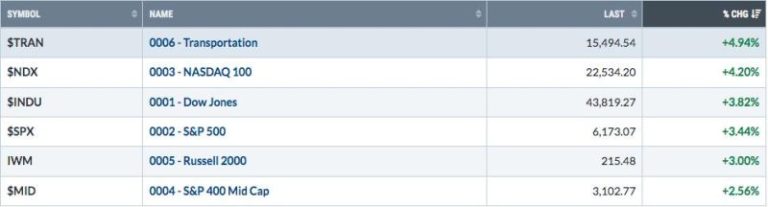
Major Indices

Sectors

Top 10 Industries Last Week

Bottom 10 Industries Last Week

Top 10 Stocks – S&P 500/NASDAQ 100

Bottom 10 Stocks – S&P 500/NASDAQ 100

Big Picture

If you’re a long-term investor, stepping back and looking at the stock market using this 100-year chart enables you to avoid pulling unnecessary sell triggers, because of the media, permabears, negative nellie’s, and all the “news” out there. The above chart never once flashed anything remotely signaling a sell signal and now, here we are, back at all-time highs. Simply put, it filters out all the noise that we hear on a day-to-day basis and keeps our wits about us.

Sustainability Ratios

Here’s the latest look at our key intraday ratios as we follow where the money is traveling on an INTRADAY basis (ignoring gaps):

QQQ:SPY

Absolute price action on both the S&P 500 and NASDAQ 100 has now seen all-time high breakouts, which alone is quite bullish. We want to see aggressive vs. defensive (or growth vs. value) ratios moving higher to indicate sustainability of any S&P 500 advance. In my view, we’re seeing that. But the intraday QQQ:SPY ratio continues to hesitate. A breakout in this intraday relative ratio would most definitely add to the current bullish market environment.

IWM:QQQ

I’m seeing signs of an impending rate cut by the Fed. However, if I’m being completely honest, one signal that we should see is outperformance in small caps and a rising IWM:QQQ ratio. That hasn’t happened – at least not yet. If a rate cut starts to become clearer, I would absolutely expect to see much more relative strength in small caps. Keep an eye out for that.

XLY:XLP

I pay very close attention to the XLY:XLP ratio and, more specifically, this INTRADAY XLY:XLP ratio. This chart helped me feel confident in calling a market top back in January/February. If you recall, that’s when we said it was waaaaay too risky to be long the U.S. stock market. By the time we had bottomed in April, the blue-shaded area highlighted the fact that the XLY vs. XLP ratio had already begun to SOAR! That’s why, on Friday, April 11th, I said I was ALL IN on the long side again.

These signals are golden and, when used in conjunction with all of our other signals, can provide us extremely helpful clues about stock market direction. If these ratios begin to turn lower in a big way, then yes we’ll need to grow more cautious. However, right now, they couldn’t be any more bullish. Expect higher prices ahead.

Sentiment

5-day SMA ($CPCE)

Sentiment indicators are contrarian indicators. When they show extreme bullishness, we need to be a bit cautious and when they show extreme pessimism, it could be time to become much more aggressive. Major market bottoms are carved out when pessimism is at its absolute highest level.

The S&P 500 had struggled a bit once 5-day SMA readings of the CPCE fell to the .55 area, a sign of market complacency and a possible short-term top. We saw a bit of a pullback in June, which many times is all we get during a secular bull market advance. My sustainability ratios are supporting a higher move by stocks and I know from history that overbought conditions can remain overbought. I also know that sentiment does a much better job of calling bottoms than it does calling tops. That’s why I will not overreact every time this 5-day moving average of the CPCE falls back below .55. During Q4 2024, we saw plenty of 5-day SMA readings below .55 and, while the S&P 500 was choppy, bullishness prevailed throughout. So just please always keep in mind that these 5-day SMA readings are our “speed boat” sentiment indicator that changes quite frequently. When it lines up with other bearish or topping signals, we should take note. But reacting to every subtle move in this chart is a big mistake, in my opinion.

253-day SMA ($CPCE)

This longer-term 253-day SMA of the CPCE is our “ocean-liner” signal, unlike our speedboat indicator. This one usually provides us a very solid long-term signal as the overall market environment moves from one of pessimism to complacency and vice versa. Look at the above chart. When the 253-day SMA is moving lower like it is now, it accompanies our most bullish S&P 500 moves. It makes perfect common sense as well. Once this 253-day SMA moves to extremely high levels and begins to roll over, the bears have already sold. We typically have nowhere to go on our major indices, except higher once sentiment becomes so bearish. The opposite holds true when the 253-day SMA reaches extreme complacency and starts to turn higher. We saw that to start 2022, which, at the time, I stated was my biggest concern as we started 2022. If you recall, I said to look for a 20-25% cyclical bear market over a 3-6 month period on the first Saturday in January 2022. The above chart was my biggest reason for calling for such a big selloff ahead of the decline.

These charts matter.

Long-Term Trade Setup

Since beginning this Weekly Market Report in September 2023, I’ve discussed the long-term trade candidates below that I really like. Generally, these stocks have excellent long-term track records, and many pay nice dividends that mostly grow every year. Only in specific cases (exceptions) would I consider a long-term entry into a stock that has a poor or limited long-term track record and/or pays no dividends. Below is a quick recap of how these stocks looked one week ago:

  • JPM – challenging all-time high
  • BA – substantial improvement, would like to see 185-190 support hold
  • FFIV – very bullish action above its 20-month SMA
  • MA – very steady and bullish long-term performer
  • GS – trending higher above 20-month EMA
  • FDX – trying to clear falling 20-week EMA
  • AAPL – monthly RSI at 50, which has been an excellent time to buy AAPL over the past two decades
  • CHRW – 85-90 is solid longer-term support
  • JBHT – would like to see 120-125 support hold
  • STX – long-term breakout in play, excellent trade
  • HSY – breaking above 175 would be intermediate-term bullish
  • DIS – now testing key price resistance in 120-125 range
  • MSCI – monthly RSI hanging near 50, solid entry
  • SBUX – moved back above 50-week EMA, short-term bullish
  • KRE – long-term uptrend remains in play
  • ED – has been a solid income-producer and investment since the financial crisis low in 2009
  • AJG – few stocks have been steadier to the upside over the past decade
  • NSC – continues to sideways consolidate in very bullish fashion
  • RHI – trending down with potential sight set on 30
  • ADM – looks to be reversing higher off long-term price support near 43
  • BG – 65-70 price support held, now looking to clear 50-week SMA to the upside
  • CVS – excellent support at 45 or just below, just failed on bounce at 50-month SMA at 72
  • IPG – monthly RSI now at 37 and also testing 4-year price support near 22.50
  • HRL – long-term price support at 25 and stock now showing positive divergence on monthly chart – bullish
  • DE – one of the better 2025 momentum stocks on this list

Keep in mind that our Weekly Market Reports favor those who are more interested in the long-term market picture. Therefore, the list of stocks above are stocks that we believe are safer (but nothing is ever 100% safe) to own with the long-term in mind. Nearly everything else we do at EarningsBeats.com favors short-term momentum trading, so I wanted to explain what we’re doing with this list and why it’s different.

Also, please keep in mind that I’m not a Registered Investment Advisor (and neither is EarningsBeats.com nor any of its employees) and am only providing (mostly) what I believe to be solid dividend-paying stocks for the long term. Companies periodically go through adjustments, new competition, restructuring, management changes, etc. that can have detrimental long-term impacts. Neither the stock price nor the dividend is ever guaranteed. I simply point out interesting stock candidates for longer-term investors. Do your due diligence and please consult with your financial advisor before making any purchases or sales of securities.

Looking Ahead

Upcoming Earnings

Very few companies will report quarterly results until mid-April. The following list of companies is NOT a list of all companies scheduled to report quarterly earnings, however, just key reports, so please be sure to check for earnings dates of any companies that you own. Any company in BOLD represents a stock in one of our portfolios and the amount in parenthesis represents the market capitalization of each company listed:

  • Monday: None
  • Tuesday: STZ ($29 billion)
  • Wednesday: None
  • Thursday: None
  • Friday: None

Key Economic Reports

  • Monday: June Chicago PMI
  • Tuesday: June PMI manufacturing, June ISM manufacturing, May construction spending, May JOLTS
  • Wednesday: June ADP employment report
  • Thursday: Initial jobless claims, June nonfarm payrolls, unemployment rate & average hourly earnings, May factory orders, June ISM services
  • Friday: None – stock market closed in observance of Independence Day

Historical Data

I’m a true stock market historian. I am absolutely PASSIONATE about studying stock market history to provide us more clues about likely stock market direction and potential sectors/industries/stocks to trade. While I don’t use history as a primary indicator, I’m always very aware of it as a secondary indicator. I love it when history lines up with my technical signals, providing me with much more confidence to make particular trades.

Below you’ll find the next two weeks of historical data and tendencies across the three key indices that I follow most closely:

S&P 500 (since 1950)

  • Jun 30: +34.34%
  • Jul 1: +72.77%
  • Jul 2: +16.76%
  • Jul 3: +77.19%
  • Jul 4: +0.00% (market closed – holiday)
  • Jul 5: +39.40%
  • Jul 6: +22.32%
  • Jul 7: +17.62%
  • Jul 8: -16.29%
  • Jul 9: +76.54%
  • Jul 10: -16.59%
  • Jul 11: +13.23%
  • Jul 12: +36.89%
  • Jul 13: -5.67%

NASDAQ (since 1971)

  • Jun 30: +73.30%
  • Jul 1: +63.18%
  • Jul 2: -47.43%
  • Jul 3: +46.02%
  • Jul 4: +0.00% (market closed – holiday)
  • Jul 5: +7.04%
  • Jul 6: -10.79%
  • Jul 7: +60.19%
  • Jul 8: -10.10%
  • Jul 9: +86.44%
  • Jul 10: -27.94%
  • Jul 11: +11.18%
  • Jul 12: +128.28%
  • Jul 13: +61.52%

Russell 2000 (since 1987)

  • Jun 30: +99.14%
  • Jul 1: +30.53%
  • Jul 2: -113.05%
  • Jul 3: +44.57%
  • Jul 4: +0.00% (market closed – holiday)
  • Jul 5: -4.89%
  • Jul 6: -76.61%
  • Jul 7: +43.95%
  • Jul 8: +37.24%
  • Jul 9: +31.88%
  • Jul 10: -17.39%
  • Jul 11: +29.75%
  • Jul 12: +89.15%
  • Jul 13: +63.13%

The S&P 500 data dates back to 1950, while the NASDAQ and Russell 2000 information date back to 1971 and 1987, respectively.

Final Thoughts

All-time highs are always a time for me to say “I told you so” to the bears, since I’ve been a firm believer that we remain in a secular bull market advance – one in which we should EXPECT to see higher prices and all-time highs. This latest rally is being fully supported by risk-on areas of the market, which will almost certainly lead for more and more all-time highs down the road.

Here are several things I’m watching this week:

  • Jobs. The ADP employment report will be out on Wednesday and the more-closely-watched nonfarm payrolls will be released on Thursday this week since the stock market is closed on Friday. ANY sign of weakness in these reports will begin to put mounting pressure on the Fed to cut rates in late July at their next meeting.
  • Technical Price Action. Any time we’re setting new all-time highs, I start off with a bullish mindset. I only turn bearish if I’m inundated with warning signals. Currently, I see few of those.
  • History. We can now turn our attention to upcoming earnings season and, historically, that’s a bullish thing. Pre-earnings season runs to the upside are common and, if you scroll up and check out historical returns for days over the next couple weeks, you’ll see that July normally performs well – especially the first half of the month.
  • 10-Year Treasury Yield ($TNX). The 10-year treasury yield has been in decline for 3 straight weeks, falling from 4.52% on June 9th to 4.24% just a few minutes ago. The money rotating into bonds is a very strong signal that inflation is NOT a problem. It’s also a signal that the Fed “should be” considering a rate cut at its next meeting.
  • Breakouts. We’ve seen big breakouts in key areas like semiconductors ($DJUSSC), software ($DJUSSW), and investment services ($DJUSSB), but there will be plenty more. Travel & tourism ($DJUSTT) joined the party on Thursday. Banks ($DJUSBK) are on the verge of a breakout. The way I look at it? The more the merrier!

Happy trading!

Tom

In this video, Mary Ellen spotlights key pullback opportunities and reversal setups in the wake of a strong market week, one which saw all-time highs in the S&P 500 and Nasdaq. She breaks down the semiconductor surge and explores the bullish momentum in economically-sensitive sectors, including software, regional banks, and small-caps. Watch as she highlights top stocks to add to your watchlist, including FedEx, XPO, CHRW, and RL, plus identifies downtrend reversal candidates like AeroVironment (AVAV) and Nike, supported by volume and technical breakouts. In addition, she covers smart entry tactics, examining historical precedent with Coinbase.

This video originally premiered on June 27, 2025. You can watch it on our dedicated page for Mary Ellen’s videos.

New videos from Mary Ellen premiere weekly on Fridays. You can view all previously recorded episodes at this link.

If you’re looking for stocks to invest in, be sure to check out the MEM Edge Report! This report gives you detailed information on the top sectors, industries and stocks so you can make informed investment decisions.

A Greek Odyssey

First of all, I apologize for any potential delays or inconsistencies this week. I’m currently writing this from a hotel room in Greece, surrounded by what I can only describe as the usual Greek chaos. Our flight back home was first delayed, then canceled, then rescheduled and delayed again. So instead of being back at my desk as planned, I’m getting back into the trenches from a small Greek town. But the markets wait for no one, so here we are!

Market Sector Shifts: Tech Takes the Lead

The changes in our top five aren’t massive, but they’re certainly worth noting. Technology has muscled its way back to the #1 spot, nudging Industrials down to second. Communication Services and Utilities are holding steady at positions #3 and #4 respectively. The most interesting move, imho, is Financials re-entering the top five at #5, up from #7 last week.

Real estate remains just outside at #6, while Consumer Staples has dropped out of the top five, landing at #7. Materials and Energy are still bringing up the rear at #8 and #9. In a bit of musical chairs, Consumer Discretionary and Health Care have swapped places — Discretionary now at #10 and Health Care down to #11.

  1. (2) Technology – (XLK)*
  2. (1) Industrials – (XLI)*
  3. (3) Communication Services – (XLC)
  4. (4) Utilities – (XLU)
  5. (7) Financials – (XLF)*
  6. (6) Real-Estate – (XLRE)
  7. (5) Consumer Staples – (XLP)*
  8. (8) Materials – (XLB)
  9. (9) Energy – (XLE)
  10. (11) Consumer Discretionary – (XLY)*
  11. (10) Healthcare – (XLV)*

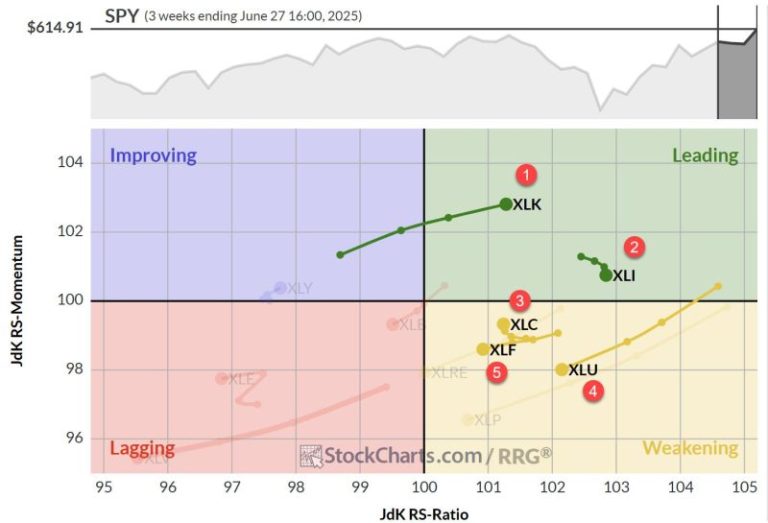
Weekly RRG

The weekly Relative Rotation Graph (RRG) paints a clear picture of Technology’s strength as it powers further into the leading quadrant. Industrials is still in the lead, but has started to lose some relative momentum — though it’s maintaining the highest RS-ratio reading. Communication Services is showing a clear upward rotation, while Financials and Utilities are inside the weakening quadrant with negative headings (but still above the 100 level, keeping them in the top five).

Daily RRG

  • Technology and Communication Services flexing their muscles in the leading quadrant
  • Industrials inside lagging, but turning back up
  • Financials in improving on a positive heading
  • Utilities rotating back down at a negative heading, close to crossing into lagging

The sector at risk here is clearly Utilities — at least for now.

Technology

The Technology sector chart is showing a very clear breakout above the resistance area around 240. It’s a decisive move, and that old resistance should now act as support. This breakout is mirrored in the relative strength line, which has continued its upward trajectory after breaking out of the falling channel.

Industrials

Industrials are also flexing their muscles, clearing overhead resistance with a nice breakout. The relative strength line, already out of its consolidation pattern, appears to be gaining momentum again. This is starting to drag the RS ratio line higher.

Communication Services

Communication Services is showing a clear upward break over the 105 resistance area. Just like Tech and Industrials, that old resistance is now expected to act as support. The price strength is finally reflected in the relative strength line, which has started to move up against the rising support line. This is causing the RS momentum line to pull up, almost crossing back over the 100 level, which should, in turn, push Communication Services back into the leading quadrant on the weekly RRG.

Utilities

Utilities, one of the defensive sectors in this cyclical power play, has remained static within its range. But in this market, standing still means losing relative strength. The utility sector is becoming increasingly at risk, with its relative strength chart returning to the trading range and heading towards the lower boundary. This is dragging the RRG lines lower.

Financials

Financials, our new entrant in the top five, is still grappling with the old rising support line and overhead resistance level. However, last week’s price action seems to have broken the sector out of a small consolidation pattern. If Financials can now take out the overhead resistance just above 52, it’ll be a powerful sign for this sector.

Portfolio Performance

From a portfolio performance perspective, we’re getting hurt by the strength of the Technology sector. It’s in the portfolio, but not enough to keep up with the S&P 500’s performance. We’re still underperforming by around 8%.

To turn this situation around, we need sustained moves higher by Technology, Communication Services, and potentially Financials. If Consumer Discretionary could join the party at some stage, that would be ideal — but it’s still far off at #10. For now, we’ll have to work with what we’ve got, especially from Tech and Communication Services, with potential boosts from Financials and Industrials. Utilities are likely to be a drag while they remain in the top five, given the current bullish market sentiment.

#StayAlert and have a great week. –Julius