Author

admin

Browsing

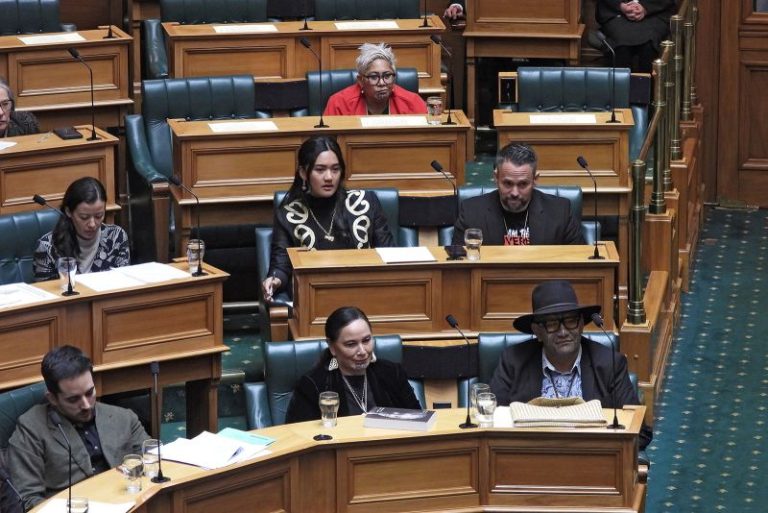
New Zealand legislators voted Thursday to enact record suspensions from Parliament for three lawmakers who performed a Māori haka to protest a proposed law.

Hana-Rāwhiti Maipi-Clarke received a seven-day ban and the leaders of her political party, Debbie Ngarewa-Packer and Rawiri Waititi, were barred for 21 days. Three days had been the longest ban for a lawmaker from New Zealand’s Parliament before.

The lawmakers from Te Pāti Māori, the Māori Party, performed the haka, a chanting dance of challenge, last November to oppose a widely unpopular bill, now defeated, that they said would reverse Indigenous rights.

But the protest drew global headlines and provoked months of fraught debate among lawmakers about what the consequences for the lawmakers’ actions should be and whether New Zealand’s Parliament welcomed or valued Māori culture — or felt threatened by it.

A committee of the lawmakers’ peers in April recommended the lengthy punishments in a report that said the lawmakers were not being punished for the haka itself, but for striding across the floor of the debating chamber towards their opponents while they did it. Maipi-Clarke Thursday rejected that, citing other instances where legislators have left their seats and approached their opponents without sanction.

It was expected that the suspensions would be approved, because government parties have more seats in Parliament than the opposition and had the necessary votes to affirm them. But the punishment was so severe that Parliament Speaker Gerry Brownlee in April ordered a free-ranging debate among lawmakers and urged them to attempt to reach a consensus on what repercussions were appropriate.

No such accord was reached Thursday. During hours of at times emotional speeches, government lawmakers rejected opposition proposals for lighter sanctions.

There were suggestions that opposition lawmakers might extend the debate for days or even longer through filibuster-style speeches, but with the outcome already certain and no one’s mind changed, all lawmakers agreed that the debate should end.
This post appeared first on cnn.com

Snacktime is nigh at the Golden Arches.

On June 3, McDonald’s announced exactly when the Snack Wrap will return to partipating restaurants nationwide: July 10. And, thankfully, it’s not a limited-time offer, either — it’s here for good.

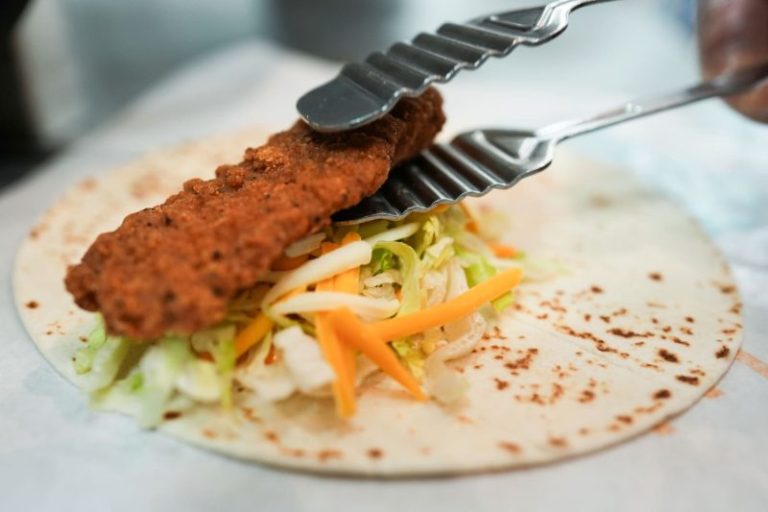
The Snack Wrap, which has been off menus for almost a decade, features one of the chain’s new McCrispy Strips — a chicken strip made with all-white meat — and is topped with shredded lettuce and shredded cheese, wrapped in a flour tortilla.

This go-round, the Snack Wrap comes in two flavors: Spicy, which McDonald’s says “brings the heat with a habanero kick” reminiscent of its Spicy McCrispy sandwich; and Ranch, which “delivers a satisfying burst of cool ranch goodness,” according to the brand, along with hints of garlic and onion.

Customers can get the Snack Wrap on its own or as a combo meal, which will come with two wraps, a medium fries and your drink of choice.

It’s been a long journey for Mickey D’s devotees: On Dec. 5, Joe Erlinger, president of McDonald’s USA, first revealed that the Snack Wrap was on its way back while discussing the new McValue menu.

“The Snack Wrap will be back in 2025,” Erlinger said at the time, declining to reveal the exact date. “It has a cult following, I get so many emails into my inbox about this product.”

Then, on April 15, the chain teased the official release date: “snack wraps 0x.14.2025,” it posted on X, without specifying the month.

Now, for the official rollout, McDonald’s is leaning into the fact that for years, fans have inundated the chain with pleas to reinstate the item after it was kicked off menus in 2016. A Change.org petition started in 2021 in its honor garnered over 17,000 signatures, and fans resorted to posting TikToks and making dedicated Instagram accounts devoted to bringing it back.

While the chicken-craving masses waited for the Snack Wrap’s return, other fast-food chains have dropped their own versions: In March 2023, Wendy’s introduced its Grilled Chicken Ranch Wrap; in July 2023, Taco Bell reintroduced its Crispy Chicken Taco for a limited time; and in August 2023, Burger King launched BK Royal Crispy Wraps for a limited time, too.

Most recently, a single day before McDonald’s announcement, Popeyes dropped its own Chicken Wraps as a limited-time offer. Let the wrap battle commence.

This post appeared first on NBC NEWS

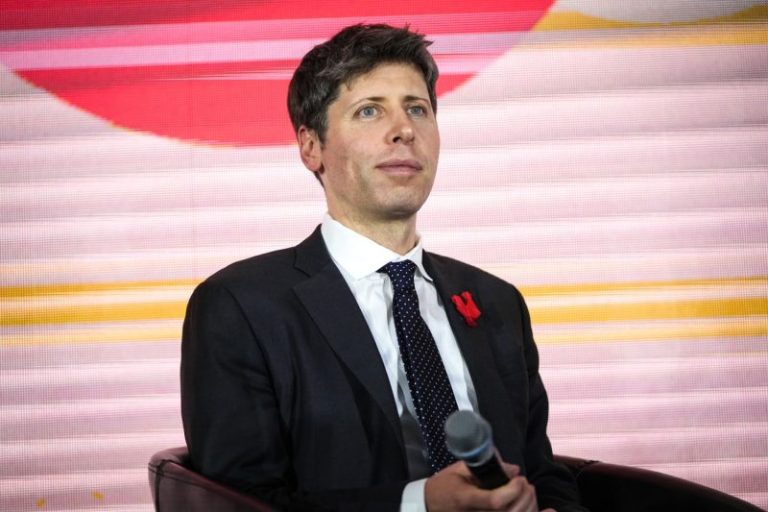
OpenAI on Wednesday announced that it now has 3 million paying business users, up from the 2 million it reported in February.

The San Francisco-based startup rocketed into the mainstream in late 2022 with its consumer-facing artificial intelligence chatbot ChatGPT, and began launching workplace-specific versions of the product the following year.

The 3 million users include ChatGPT Enterprise, ChatGPT Team and ChatGPT Edu customers, OpenAI said.

“There’s this really tight interconnect between the growth of ChatGPT as a consumer tool and its adoption in the enterprise and in businesses,” OpenAI’s chief operating officer Brad Lightcap told CNBC in an interview. The company supported 400 million weekly active users as of February.

OpenAI expects revenue of $12.7 billion this year, a source confirmed to CNBC. In September of last year, the company expected to see an annual loss of $5 billion on $3.7 billion in revenue, according to a person close to the company who asked not to be named because the financials are confidential.

Lightcap said OpenAI is seeing its business tools adopted across industries, including highly regulated sectors like financial services and health care. Companies including Lowe’s, Morgan Stanley and Uber are users, OpenAI said.

The company also announced new updates to its business offerings on Wednesday.

ChatGPT Team and ChatGPT Enterprise users can now access “connectors,” which will allow workers to pull data from third-party tools like Google Drive, Dropbox, SharePoint, Box and OneDrive without leaving ChatGPT. Additional deep research connectors are available in beta.

OpenAI launched another capability called “record mode” in ChatGPT, which allows users to record and transcribe their meetings. It’s initially available with audio only.

Record mode can assist with follow up after a meeting and integrates with internal information like documents and files, the company said. Users can also turn their recordings into documents through the company’s Canvas tool.

Lightcap said enterprise customers have been asking for updates like these, and that they will help make OpenAI’s workplace offerings more useful.

“It’s got to be able to do tasks for you, and to do that, it’s got to really have knowledge of everything going on around you and your work,” Lightcap said. “It can’t be the intern locked in a closet. It’s got to be able to see what you see.”

OpenAI said it has been signing up nine enterprises a week, and Lightcap said the company will try to sustain that pace over time.

“People are starting to really figure out that this is a part of the modern tool stack in the knowledge economy that we live in,” he said.

This post appeared first on NBC NEWS

A nationwide coordinated crackdown on retail crime — what authorities are calling the first of its kind — led to hundreds of arrests in 28 states last week.

The blitz, led by Illinois’ Cook County regional organized crime task force, involved more than 100 jurisdictions and over 30 retailers including Home Depot, Macy’s, Target, Ulta Beauty, Walgreens, Kroger and Meijer.

“When you give specific focus to a crime, it reverberates,” Cook County Sheriff Tom Dart told CNBC. “When they see it is being prosecuted and taken seriously, it deters conduct. They don’t want to get caught.”

Organized retail crime — a type of shoplifting where groups of thieves work together in targeted operations to turn stolen goods into cash — has grown in scale and scope in recent years. CNBC previously reported on the extensive law enforcement efforts to take down retail crime organizations.

While aggregate numbers for retail theft are difficult to quantify, retailers reported 93% more shoplifting incidents on average in 2023 compared with 2019, according to a survey conducted by the National Retail Federation. Those surveyed also reported a 90% increase in the associated dollar losses over that same time period.

Some critics point to a lack of enforcement and felony thresholds for allowing criminals to continue committing theft. It’s something Cook County State’s Attorney Eileen O’Neill Burke has been focused on since taking office in December.

On her first day in office, O’Neill Burke said prosecutors would pursue felony retail theft charges in accordance with state law, when the value of the goods exceeds $300 or when the suspect already has a felony shoplifting conviction.

Before her taking office, retail theft felonies were charged only if the value of the stolen goods was $1,000 or more or if the suspect had 10 or more prior convictions.

Since Dec. 1, the Cook County State’s Attorney’s Office has filed charges in 1,450 felony retail theft cases, the office said.

The goals of the coordinated operation, O’Neill Burke told CNBC, is “to have one day where we focus and concentrate on [retail theft] and we share intelligence about it — about what we learned about the network, so that gives us more tools on how to take this network down.”

It was the coordination between law enforcement and prosecuting attorneys that got a number of the involved retailers to participate in the blitz.

“Collaboration is key to making a meaningful impact,” Ulta Beauty Senior Vice President of Loss Prevention Dan Petrousek told CNBC. “That’s why we were proud to participate in the National ORC Blitz alongside dedicated law enforcement and prosecutorial partners.”

Ulta Beauty had teams participating across nine states in last week’s operation, providing law enforcement with information on incidents of retail crime.

“Organized retail crime remains one of the most significant challenges in our industry,” said Marty Maloney, Walgreens director of media relations. “In this most recent operation we worked closely with law enforcement partners across nearly 20 cities and at over 40 locations to help curb this trend.”

A representative for Home Depot told CNBC that while overall theft is down, investigated incidents of organized retail crime are still up double digits year over year.

Now that the operation has concluded, the group is pulling together each jurisdictions’ observations and sharing data to continue to help crack down on retail theft.

Other participating retailers reached for comment by CNBC, including Macy’s, T.J. Maxx and Target, said they’re committed to partnering with law enforcement and pushing for stronger laws to combat retail crime.

California Highway Patrol arrests retail crime suspect in Long Beach, CA.Courtesy: California Highway Patrol.

This post appeared first on NBC NEWS

In this market update, Frank breaks down recent developments across the S&P 500, crypto markets, commodities, and international ETFs. He analyzes bullish and bearish chart patterns, identifies key RSI signals, and demonstrates how “Go No Go Charts” can support your technical analysis. You’ll also hear updates on Ethereum, Bitcoin, the Spain ETF, silver miners, USO (oil), and sector ETFs like XLP and XLV.

This video originally premiered on June 3, 2025.

You can view previously recorded videos from Frank and other industry experts at this link.

In this video, Dave shares his weekly stock scan strategy used to identify bullish stock trends. He illustrates how to set up this powerful scan, reveals the tips and tricks he uses to identify the most constructive patterns, and explains the four winning chart setups that tend to come up week after week.

Whether you’re a beginner or seasoned trader, this guide will enhance your charting process and help you uncover winning trade setups using technical analysis.

This video originally premiered on June 3, 2025. Watch on StockCharts’ dedicated David Keller page!

Previously recorded videos from Dave are available at this link.

In this video, Mary Ellen highlights key areas of the stock market that gained strength last week, including Staples and Aerospace stocks. She also shares several Dividend Aristocrat stocks that can help stabilize your portfolio in times of market volatility. Whether you’re seeking defensive plays or looking to align with sector rotation trends, this video provides practical insights to strengthen your trading strategy.

This video originally premiered May 30, 2025. You can watch it on our dedicated page for Mary Ellen’s videos.

New videos from Mary Ellen premiere weekly on Fridays. You can view all previously recorded episodes at this link.

If you’re looking for stocks to invest in, be sure to check out the MEM Edge Report! This report gives you detailed information on the top sectors, industries and stocks so you can make informed investment decisions.

Earnings season may be winding down, but a few standout names could still make headlines this week. If you’re looking for potential moves, keep an eye on these three stocks — Dollar Tree, Inc. (DLTR), CrowdStrike Holdings, Inc. (CRWD), and Broadcom, Inc. (AVGO).

Each of these names is at a pretty interesting inflection point right now. It might be worth waiting to see how things play out before making any big bets.

Dollar Tree (DLTR): Quiet Comeback with Room to Run?

Dollar Tree (DLTR) broke out of a long-term downtrend and, as of the last quarter, is back above key moving averages. Many of the beaten-down discount chains, such as Five Below (FIVE) and Dollar General (DG), have started to reverse major downtrends. This week, we will see if earnings momentum can keep going, as DLTR stock has rallied 21% year-to-date.

Investors will be looking for insight into how DLTR is navigating the transition after the $1 billion Family Dollar sale (yes, they paid $8.5 billion in 2015) and how its core stores are performing in the current economic environment. The last two quarters have been relatively calm, as DLTR stabilized with minor gains of 3.1% and 1.9%. That stability comes after a three-quarter losing streak, with average losses of -13.7%.

From a technical standpoint, DLTR made its big move in mid-April as it broke out of a longer-term neutral range and a long-term downtrend. The stock price has eclipsed the 50- and 200-day moving averages and seems to be back on the right track.

The breakout of the rectangular bottom gives an upside target of roughly $98 a share, so there is room for DLTR to run. That move would fill the gap created last September and bring shares into a stronger resistance area around $100. On the downside, there may be an opportunity to enter DLTR, as we have a potential scenario where old resistance becomes support, giving an entry level around $79.50/$80. That would be a good risk/reward set-up for those who may have missed the initial breakout.

Overall, the stock still has room to run, but most of this upside move may already be in the stock, as the price approached an overbought condition with much overhead resistance ahead.

CrowdStrike (CRWD): Heating Up Before Earnings

CrowdStrike (CRWD) has returned from the ashes after last year’s Delta Air Lines, Inc. (DAL) computer outage that caused over 7000 cancelled flights. As it heads into this week’s earnings, shares are trading just under all-time highs.

The cybersecurity company has seen shares decline over the past two results, but that hasn’t stopped its continued momentum. The stock averages a one-day move of +/- 8.5%, so expect volatility.

Technically, CRWD comes into the week at an intriguing pivot point. After breaking out to new highs, the stock pulled back to its old resistance areas from which it broke above.  Will old resistance become support, or are we looking at a potential bull trap?

The relative strength index (RSI) indicates there may be room to run. We have seen some extreme overbought conditions in the past, and we are not there yet. A solid beat and guide could see additional momentum in what continues to be one of the top stocks within the cybersecurity sector.

Speaking of strength, CRWD is shining on a relative basis. It’s up 36.7% year-to-date, outperforming CIBR, the biggest cybersecurity ETF in CIBR, which is up 12.8%. That said, downside risk could be steep given the recent run. Stepping in front of this stock ahead of results could be costly. On weakness, wait for a better risk/reward entry and look for support just around $405.

Broadcom (AVGO): Ready to Step Out of Nvidia’s Shadow?

Broadcom (AVGO) is Nvidia’s baby brother. It is in the $1 trillion market cap club, a top holding in both the Semiconductor ETF (SMH), the Technology ETF (XLK), and the Nasdaq 100 (QQQ).

AVGO has grown mightily in NVDA’s shadow for years now. Shares have rallied just over 500% from their 2022 lows, which pales to the 1250+% rally in Nvidia. However, over the past 52 weeks, AVGO shares have risen 82% compared to Nvidia’s 23% gain.

Now that we’ve seen how price action settled out with NVDA, what could this mean for AVGO?

Technically, if AVGO wanted to step out of NVDA’s shadows, this would be the chance to do so and lead the semiconductors higher. However, momentum is waning, and we continue to see large caps struggle to make new highs.

The table is set for a potentially large breakout. AVGO is at a key resistance area just under $250. It couldn’t break through it last week, but could earnings be the catalyst for getting it over the top? Given the overbought conditions and tough market environment, it should be a challenge. You may be able to buy this stock on a dip and wait for the rest of the market to catch up as we look for more clarity on tariff policy. Look for a pullback to the $220 area to add to or enter the name.

Long-term investors should ignore the noise to come. AVGO has suffered through the worst and should break out in due time. It just may not be this time.

Staples and Tech Swap Positions Again

The weekly sector rotation continues to paint a picture of a market in flux, with defensive sectors gaining ground while cyclicals take a step back. This week’s shifts underscore the ongoing volatility and lack of clear directional trade that’s been characteristic of recent market behavior.

The sudden jump in relative strength for defensive sectors last week has pushed Consumer Staples back into the top 5, at the cost of Technology.

  1. (1) Industrials – (XLI)
  2. (3) Utilities – (XLU)*
  3. (6) Consumer Staples – (XLP)*
  4. (2) Communication Services – (XLC)*
  5. (4) Financials – (XLF)*
  6. (5) Technology – (XLK)*
  7. (8) Real-Estate – (XLRE)*
  8. (9) Materials – (XLB)*
  9. (7) Consumer Discretionary – (XLY)*
  10. (11) Healthcare – (XLV)*
  11. (10) Energy – (XLE)*

Weekly RRG

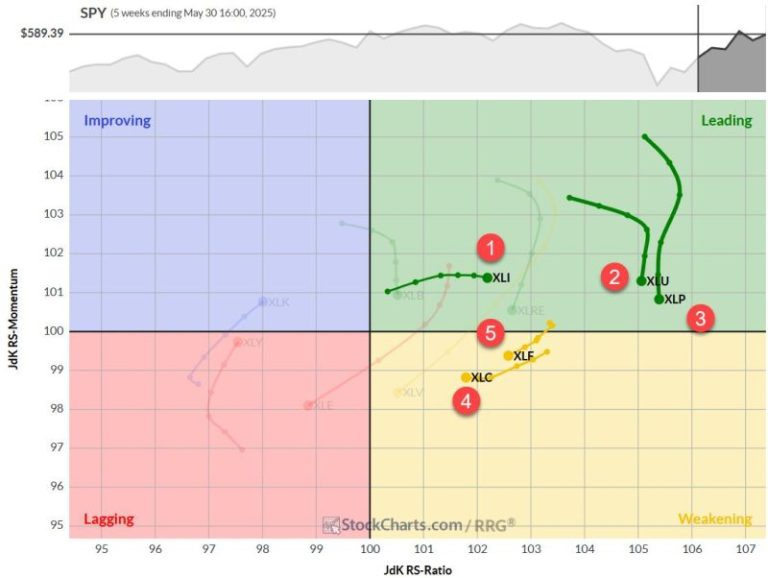
Looking at the weekly Relative Rotation Graph (RRG), we’re seeing some interesting movements. Industrials continues its upward trajectory on the RS-Ratio scale, solidifying its top position. Meanwhile, Utilities and Consumer Staples — our #2 and #3 sectors, respectively — are maintaining high RS-Ratio levels despite a momentum setback.

Communication services and financials, rounding out the top 5, find themselves in the weakening quadrant. However, they’re still comfortably above the 100 level on the RS-Ratio scale. This positioning gives them a good shot at curling back into the leading quadrant before potentially hitting lagging territory.

Daily RRG

Switching to the daily RRG, we can see some significant moves over the past week.

Consumer Staples have made a considerable leap, landing deep in the improving quadrant with the highest RS-Momentum reading. This surge explains its return to the top 5. Utilities isn’t far behind, also making a strong move into the improving quadrant. Financials, while in the lagging quadrant, are showing less dramatic movement compared to staples and utilities. Its shorter tail on the RRG indicates a less powerful move, but its high position on the weekly RRG is keeping it in the top 5 — for now.

Industrials: Strength Confirmed

The #1 sector is pushing against overhead resistance around 143 for the third consecutive week. A break above this level could trigger an acceleration higher. The relative strength chart vs. the S&P 500 has already broken out, continuing to pull the RRG lines upward.

Utilities: Bouncing Back

After a weak showing two weeks ago, utilities closed last week at the top of its range. There’s still resistance lurking just below 85 (around 84), but a break above could spark a rally. The raw RS line is grappling with the upper boundary of its sideways trading range, causing the RRG lines to roll over while remaining in the leading quadrant.

Consumer Staples: Testing Resistance

Staples has rebounded to the upper boundary of its trading range, with key resistance between 82 and 83.50. A spike to $83.90 represents the recent high-water mark. Breaking above this barrier could accelerate the move higher.

The raw RS line has peaked against overhead resistance and needs to form a new low to support the RRG lines.

Communication Services: Holding Steady

XLC is trading around $101.40, with overhead resistance a few dollars away, near $ 105. The raw RS line remains within its rising channel, but we’ll need to see improved relative strength soon to maintain this positive trend. The sector sits in the weakening quadrant, but has the potential to push back into leading territory with a strong relative strength (RS) rally.

Financials: At a Crossroads

The financial sector is struggling with old resistance that’s now acting as support. Its RS line is testing the lower boundary of its rising channel. Financials needs a couple of strong weeks in both price and relative strength to maintain its top 5 position.

Portfolio Performance

As of last Friday’s close, our model portfolio is lagging the S&P 500 by just over 5%. This performance gap has widened slightly from last week, but remains in line with the volatile sector rotations we’ve been seeing.

The current market environment presents an apparent dilemma for sector rotation strategies. While defensive sectors are gaining prominence, cyclicals are taking a back seat — at least for now. This flip-flop situation is common in volatile markets seeking direction, but it’s causing more frequent trades in our model than we’d typically expect.

For meaningful trends to emerge, the market needs to stabilize and establish a clear directional bias. Until then, we’re likely to see continued back-and-forth movement as investors grapple with mixed economic signals and shifting sentiment.

#StayAlert and have a great week. –Julius


Phase 1 1 First-In-Human study designed to assess safety   ,   tolerability   , right dose for Phase 2 and early signs of efficacy   of 177Lu-RAD20   2   in individuals with   advanced HER2-positive solid   tumors

Previous clinical proof-of concept data 2 for targeting HER-2 demonstrated the safety and biodistribution of 99mTc-RAD202 in humans

Radiopharm Theranostics (ASX:RAD, ‘Radiopharm’ or the ‘Company’), a clinical-stage biopharmaceutical company focused on developing innovative oncology radiopharmaceuticals for areas of high unmet medical need, today announced the dosing of the first patient in its Phase 1 ‘HEAT’ clinical trial of RAD202, a proprietary nanobody that targets Human Epidermal Growth Factor Receptor 2 (HER2)-positive expression in a wide array of advanced solid tumors.

The open-label Phase 1 ‘HEAT’ clinical trial is a dose escalation trial of 177Lu-RAD202 that is designed to determine the recommended Phase 2 dose and to evaluate the safety and preliminary clinical activity of this novel radiotherapeutic in individuals with HER2-expressing advanced cancers. The study is currently being conducted at clinical centers across Australia.

‘Dosing patients in the HEAT clinical trial marks an important milestone in our transition to a clinical-stage company,’ said Riccardo Canevari, CEO and Managing Director of Radiopharm Theranostics. ‘Despite progressive improvements in the management of metastatic HER2-positive disease, the majority of patients experience disease progression on current standard of care and require further therapeutic options. The dosing of the first patient in the ‘HEAT’ trial represents a significant step toward achieving RAD202’s potential to address an unmet need for HER2-positive metastatic patients who are progressing or unable to tolerate current treatment options. With RAD202, we hope to provide an option that can meaningfully improve clinical outcomes for HER2-positive patients, while preserving their quality of life.’

HER2 is overexpressed in breast cancer as well as several other solid tumors and represents a validated target in oncology. RAD202 is a proprietary single domain antibody that targets HER2. Ten HER2-positive breast cancer patients previously dosed in a Phase 1 diagnostic study of RAD202 demonstrated clinical proof-of concept as well as the safety and biodistribution of RAD202, validating its potential for the treatment of advanced HER2-expressing cancers 2 . Preclinical findings 3 examining the therapeutic effect in HER2-positive xenografts were also recently reported with 177Lu-RAD202. Collectively, these data further justify first in humans dose finding studies.

‘It is a privilege to be the first centre to administer 177Lu-RAD202, targeting HER2-positive tumors in this Phase 1 clinical trial (HEAT).’ said Dr Aviral Singh, Clinical Head of Theranostics and Nuclear Medicine at St John of God Murdoch Hospital. ‘This opens the possibility of novel therapeutic avenues for patients with aggressive tumor types, including breast, ovarian, gastric, pancreatic, bladder, and several other cancers. With the trust put in us by Radiopharm, we look forward to a successful trial with beneficial outcomes for our patients.’

About Radiopharm Theranostics

Radiopharm Theranostics is a clinical stage radiotherapeutics company developing a world-class platform of innovative radiopharmaceutical products for diagnostic and therapeutic applications in areas of high unmet medical need. Radiopharm is listed on ASX (RAD) and on NASDAQ (RADX). The company has a pipeline of distinct and highly differentiated platform technologies spanning peptides, small molecules and monoclonal antibodies for use in cancer. The clinical program includes one Phase 2 and three Phase 1 trials in a variety of solid tumor cancers including lung, breast, and brain metastases. Learn more at radiopharmtheranostics.com .

Authorised on behalf of the Radiopharm Theranostics board of directors by Chairman Paul Hopper.

For more information:
Riccardo Canevari
CEO & Managing Director
P: +1 862 309 0293
E: rc@radiopharmtheranostics.com

Anne Marie Fields
Precision AQ (Formerly Stern IR)
E: annemarie.fields@precisionaq.com

Paul Hopper
Executive Chairman
P: +61 406 671 515
E: paulhopper@lifescienceportfolio.com

Media
Matt Wright
NWR Communications
P: +61 451 896 420
E: matt@nwrcommunications.com.au

________________________________

1 clinicaltrials.gov/study/NCT06824155
2 Zhao et al, Molecular Pharmaceutics 2021 18 (9), 3616-3622
3 Altunay B. et al, EP-0136, Eur J Nucl Med Mol Imaging (2024) 51 (Suppl 1): S1–S1026. DOI: 10.1007/s00259-024-06838-z

News Provided by GlobeNewswire via QuoteMedia

This post appeared first on investingnews.com