
Author

admin

Browsing

“(Lithium) is not for the faint-hearted. It demands resilience, foresight and leadership,” said Pilbara Minerals (ASX:PLS,OTC Pink:PILBF) Managing Director and CEO Dale Henderson.

He was speaking at Fastmarkets’ Lithium Supply & Battery Raw Materials Conference, held this week in Las Vegas.

Henderson touched on three main points: current lithium market dynamics, how Pilbara Minerals is navigating the lithium landscape and his recommendations for the global lithium industry.

Lithium’s strong long-term fundamentals

Henderson began by going over key numbers relevant to the lithium sector. According to the CEO, there was a 26 percent year-on-year increase in demand for electric vehicles (EVs) from 2023 to 2024.

Lithium plays a vital role in the production of EVs, as it is a key component of the batteries that power them.

Alongside that EV demand increase, mass energy storage also saw a 51 percent leap.

“I don’t think there’ll be any deniers around the long-term prospects of lithium, but it’s worth reflecting on how quickly it’s changing,’ Henderson told the Fastmarkets audience.

Henderson speaks on stage at the Fastmarkets event.

Image via Georgia Williams.

Looking at areas connected to lithium, Henderson mentioned solar, saying it now surpasses all power-generation technology investment combined. Solar falls under the clean energy umbrella, which receives more than $2.2 trillion in investment per year — twice the amount of investment made in fossil fuels.

“We are witnessing and (are) part of an incredible period. Technology, policy (and) consumer sentiment can continue to drive what is a structural shift towards electrification,’ he said. ‘Lithium remains at the center of this shift.’

The paradox, according to Henderson, is that while scaling up is happening, prices have been cycling down.

“We’re 12 months into a period of curtailments and reset. And where we are now — we sit deep into the cost curve with price levels, of course, at unsustainable levels for many operators,’ he noted.

‘But these cycles, or these resets, offer a fantastic reset for market, albeit they’re painful.”

The Pilbara CEO emphasized that while lithium prices have fallen to “clearly unsustainable” levels, the long-term demand and strategic relevance of lithium will survive it.

“This is not a short-term trend. This is a structural transformation, and lithium remains at core.”

Pilbara Minerals’ lithium strategy

Looking over to Pilbara Minerals, Henderson went over its recent achievements and future plans.

“We’re keeping our lives absolutely committed to our strategy,” he said about the company, adding that the past year was Pilbara Minerals’ “most transformational year for business.”

Highlights from the period include the acquisition of Latin Resources and its flagship Salinas lithium project in Brazil, which was announced in August 2024 and closed this past February.

The CEO also discussed the company’s flagship Pilgangoora operation, which he described as a globally significant tier-one lithium asset with a mine life of 33 years. Pilgangoora is located 140 kilometers from Port Hedland in Western Australia and is one of the world’s largest hard-rock lithium operations.

Pilbara Minerals has completed two expansions, including the buildout of the world’s largest hard-rock ore-sorting plant, which aims to improve lithium recovery, increase final product quality and reduce energy consumption.

In addition to that, Henderson said Pilbara Minerals boosted its reserves by 23 percent last year.

Furthermore, the company became a lithium hydroxide producer via its partnership with POSCO Holdings (NYSE:PKX,KRX:005490), and is working on a demonstration plant for its midstream project.

In January, the Western Australian government’s Investment Attraction Fund contributed AU$15 million for work at the plant, which is a joint venture with Calix (NYSE:CALX,ASX:CXL).

Henderson said the demonstration plant is currently under construction.

Last year, Pilbara Minerals contributed approximately 8 percent to global lithium supply. The company’s cash balance currently stands at AU$1.1 billion.

Lithium industry must align for success

According to Henderson, certainty and efficient operations are everything in today’s lithium market.

“Government policy is forcing change, both in sticks and carrots, and supply chain diversification is underway, but largely the processing remains very much concentrated,’ he said.

Henderson highlighted coordination and collaboration as key points, saying that thriving in this environment means building deeper integration across the supply chain.

Lithium industry challenges and opportunities.

Chart via Pilbara Minerals.

He added that the lithium industry is not the first sector to grow from a small base and has yet to mature on a number of dimensions. Henderson summarized his key recommendations into four points:

  • Support a central and efficient spot market trading location
  • Put a trusted futures exchange in place
  • Align on specifications across the lithium product site
  • Align on standardized trading terms

He also presented a list of challenges and corresponding opportunities regarding the lithium market, saying that while there’s a lot of pain in the industry, it’s also the time for great partnerships to be forged.

“This industry will evolve with or without our stewardship. This is a call to leadership across our group,” he concluded. “The challenge is ours. The opportunity is real. Let’s build it together and turn this market pain into a strategic avenue.”

Securities Disclosure: I, Gabrielle de la Cruz, hold no direct investment interest in any company mentioned in this article.

This post appeared first on investingnews.com

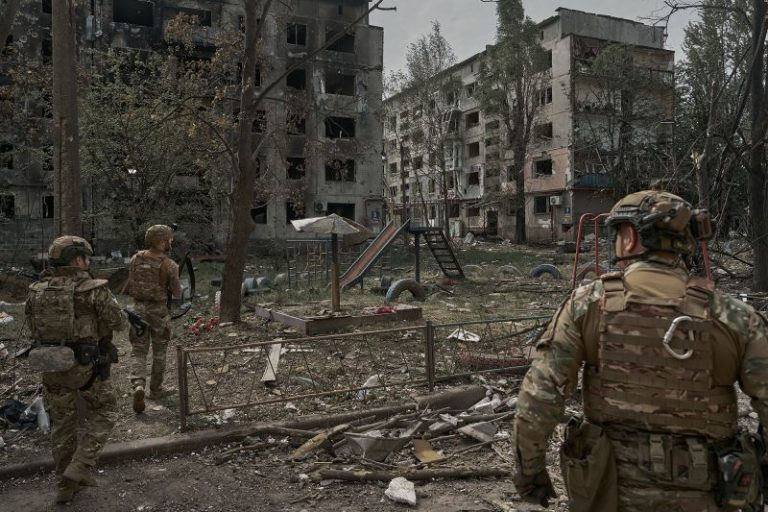
Russia has amassed 110,000 troops in the vicinity of Pokrovsk as part of its efforts to take over the strategic eastern Ukrainian city, the Ukrainian military chief said Friday.

Oleksandr Syrskyi said on Friday that the area around Pokrovsk was the “hottest spot”along the 1,200-kilometre (745 miles) front line which runs across the east.

Russian forces have been trying to capture Pokrovsk for almost a year, staging one grinding offensive after another. But despite having a clear advantage in terms of the number of troops and weapons available, Moscow has failed to take over the city.

Pokrovsk is a strategic target for Moscow. Russian President Vladimir Putin has made it clear that his goal is to seize all of the eastern Ukrainian regions of Donetsk and Luhansk his forces partially occupy.

Kyiv and its allies accuse Russia’s President Vladimir Putin of stalling on peace efforts so that his forces can seize more Ukrainian territory.

Although not a major city, Pokrovsk sits on a key supply road and railroad that connect it with other military hubs in the area. Together with Kostiantynivka, Kramatorsk and Sloviansk, it forms the backbone of Ukrainian defenses in the part of Donetsk region that are still under Kyiv’s control.

Some 60,000 lived in Pokrovsk before the war, but the majority have left in the three years since Russia launched its full-scale invasion in February 2022.

Ukraine’s last operating coking coal mine was in Pokrovsk and many of its employees were staying in the area to keep it going. Once it was forced to shut down early this year, they too began to leave.

The Institute for the Study of War (ISW), a US-based conflict monitor, said late last year that Ukrainian defensive operations in Pokrovsk have forced Russia to abandon its original plan to take over Pokrovsk in a frontal assault.

The ISW said this was because Ukrainian troops began using drones as integral part of their defensive strategy, successfully integrating drone operators with their ground forces.

At the same time, Russia was unable to increase the number of troops in the area by much, because it was trying to contain the surprise incursion of Ukrainian troops into its own territory in the southern Kursk region.

Syrskyi told reporters last week that at one point, the Kursk operation pulled back nearly 63,000 Russian troops and some 7,000 North Korean troops.

“This allowed us to weaken the enemy’s pressure on the main fronts and regroup our troops. And the enemy’s capture of Pokrovsk, announced back in September 2024, has not yet taken place, thanks in part to our Kursk operation,” he said.

Instead of continuing to attacking the city directly, Russian troops then began encircling the city from south and northeast.

The ISW said in its most recent assessment on Friday that Russian forces were continuing assaults with small fireteams of one to two soldiers, sometimes on motorcycles, in all-terrain vehicles and buggies.

In a statement issued on Friday, Syrksky said Russia continued to try to break through to the administrative border of the Donetsk region.

“They want to do this not only to achieve some operational results, but primarily for demonstrative purposes. To achieve a psychological effect: to put the infamous ‘foot of the Russian soldier’ there, plant a flag and trumpet another pseudo-‘victory’,” he said.

This post appeared first on cnn.com

Oslo police on Friday announced charges against Marius Borg Høiby, the eldest son of Norway’s crown princess, on multiple counts including rape, sexual assault and bodily harm after a months-long investigation of a case that involved a “double-digit” number of alleged victims.

Høiby, the son of Crown Princess Mette-Marit and stepson of the heir to the throne, Crown Prince Haakon, has been under scrutiny since he was repeatedly arrested in 2024 amid allegations of rape and on preliminary charges of bodily harm and criminal damage.

Oslo Police Attorney Andreas Kruszewski said Høiby was cooperative during police questioning, which is now complete. Evidence in the case was drawn from sources including text-messages, witness testimonies and police searches, the police attorney said.

The charges included one case of rape involving intercourse and two cases of rape without intercourse, four cases of sexual assault and two cases of bodily harm, Kruszewksi said at a news conference.

“I cannot go into further detail about the number of victims in the case beyond confirming that it is a double-digit number,” he said.

Defense attorney Petar Sekulic, in an email to The Associated Press, said Høiby was “absolutely taking the accusations very seriously, but doesn’t acknowledge any wrongdoing in most of the cases — especially the cases regarding sexual abuse and violence.”

The royal palace did not immediately respond to an e-mailed request from the AP seeking comment. The palace was quoted by the Norwegian newswire NTB saying it would not comment while the case winds its way through the “normal procedures.”

The case was top news in Norway, where the royals are popular.

Høiby, 28, previously lived with the royal couple and their two children, Princess Ingrid Alexandra and Prince Sverre Magnus, but now lives in a separate house nearby, according to Sekulic.

Høiby remains free pending a possible trial and is entitled to a presumption of innocence until a court rules otherwise.

Once known affectionately as “Little Marius,” Høiby grew up in the public eye enjoying the same wealth and privilege as his royal siblings, although his biological father, Morton Borg, served time in prison for drugs and violent offenses. Høiby has acknowledged cocaine use and addiction.

Norway’s future queen made headlines in 2001 when she married Haakon because she was a single mother who had lived a freewheeling life with a companion who had been convicted on drug charges.

This post appeared first on cnn.com

Min Young-jae has not seen or heard anything about her eldest brother for 75 years. He was 19 and she was only 2 when, during the early days of the Korean War, he was kidnapped to the North.

Their peaceful days were shattered on June 25, 1950, when North Korea invaded the South. The three-year war would kill more than 847,000 troops and about 522,000 civilians from both sides, and tear apart more than 100,000 families, including Min’s.

After the war, the family kept the rusting doors of their tile-roofed house open, in hopes that their eldest would one day return. But over time, barbed wire has been installed between the two Koreas, and a modern apartment complex has replaced the house.

Though 75 years have passed without a single word about or from the brother, Min and her siblings remain hopeful that they will hear about him some day. Or, if not him, then his children or grandchildren.

A happy family

The family lived in Dangnim village, nestled between green mountains on the western side of Chuncheon city, nearly 100 kilometers northeast of Seoul. It was a village of chirping birds, streaming water and chugging tractors.

It was also dangerously close to the 38th parallel, which divided the peninsula after World War II.

Min Young-jae, the youngest of seven, does not remember fighting with any of her siblings growing up; only sharing tofu that her parents made, splashing in the stream and being carried around on her eldest brother’s shoulders.

Handsome, kind and smart, Min Young-sun was studying at the Chuncheon National University of Education, following in the footsteps of his father, the principal of Dangnim Elementary School.

“His nickname was ‘Math Whiz.’ He excelled in math, even his classmates called him Math Whiz,” Min Jeong-ja, the fifth child of the family, said.

Some days, students followed him all the way home, as he commuted via train and boat, asking him to teach math, the sisters recalled.

The sisters remember Min Young-sun as a caring brother. They caught fish and splashed in the nearby stream, now widely covered with reeds and weeds and almost out of water.

“We grew up in real happiness,” Min Jeong-ja said.

Torn apart

Living near the frontier between the newly separated Koreas – backed by the rival ideological forces of communism or capitalism – Min’s family was among the first to experience the horrors of the Korean War.

When Kim Il Sung’s North Korean troops invaded, Min Jeong-ja remembers seeing her grandmother running in tears, with a cow in tow, screaming: “We’re in a war!”

“We all spread out and hid in the mountains, because we were scared. One day, we hid the 4-year-old, Young-jae, in the bushes and forgot to bring her back because we had so many siblings. When we returned that night, she was still there, not even crying,” Min Jeong-ja said.

While the family was running in and out of the mountains, taking shelter from the troops coming from the North, Min Young-sun was kidnapped, taken to the North by his teacher.

“The teacher gathered smart students and hauled them (away). He took several students, tens of them. Took them to the North,” Min Jeong-ja said.

It is unknown why the teacher would have kidnapped the students to North Korea, but the South Korean government assumes that Pyongyang had abducted South Koreans to supplement its military.

“People called the teacher a commie,” Min Jeong-ja said.

That heartache was soon followed by another: the death of the second-eldest brother. He died of shock and pain, in deep sorrow from the kidnap of his brother, according to the sisters.

“The grief was huge. Our parents lost two sons… imagine how heartbreaking that would be,” Min Jeong-ja said.

For their father, the pain of losing two sons was overwhelming. He developed a panic disorder, she said, and would struggle to work for the rest of his life.

“He couldn’t go outside; he stayed home all the time. And because he was hugely shocked, he struggled going through day-to-day life. So, our mom went out (to work) and suffered a lot,” Min Young-jae said.

The mother jumped into earning a living for the remaining five children and her husband. Still, every morning she prayed for Min Young-sun, filling a bowl with pure water as part of a Korean folk ritual and leaving the first scoop of the family’s rice serving that day in a bowl for a son whom she believed would return one day.

“She couldn’t move house; in case the brother cannot find his way back home. She wouldn’t let us change anything of the house, not even the doors. That’s how she waited for him… We waited for so long, and time just passed,” Min Jeong-ja said.

The pain continues

Min Jeong-ja was 8 years old when the war started, but witnessed brutality that would overwhelm many adults.

“So many kids died. When I went out to the river to wash clothes, I occasionally saw bodies of children floating,” she recalled.

She remembers witnessing North Korean soldiers lining up people in a barley field, and shooting at them with submachine guns. “Then one by one, they fell on the barley field.”

“I saw too much. At one point – I didn’t even know if the soldier was a South Korean or North Korean – but I saw beheaded remains.”

The Min family is one of many torn apart by the war. More than 134,000 people are still waiting to hear from their loved ones believed to be in North Korea, which is now one of the world’s most reclusive states, with travel between the two countries nigh-on impossible.

Years after the Korean War, the two Koreas discussed organizing reunions for the separated families that have been identified from both sides through the Red Cross and both governments.

The first reunion happened in 1985, more than 30 years after the ceasefire agreement was signed, and the annual reunions kicked off in 2000, when many first-hand war victims were still alive, but occasionally halted when tensions escalated on the peninsula.

Once the two governments agree on a reunion date, one of the two Koreas selects families, prioritizing the elderly and immediate relatives, then shares the list with the other, which would cross check the family on its side to confirm the list of around 100 members.

The selected families would meet at an office specifically built for reunions at the Mount Kumgang resort in North Korea.

The Min siblings applied to the Red Cross at least five times and listed themselves under the South Korean government as a separated family. But there was never any word on their brother’s whereabouts from the other side.

As 75 years passed, the siblings grew up, got married, and formed their own families – but questions about their stolen brother linger.

Even worse, the annual reunions of separated families have been halted since 2018, following failed summit between US President Donald Trump and North Korea’s leader Kim Jong Un in Hanoi, while first-hand victims of the war age and pass away.

The Kumgang resort was dismantled by the North in 2022, also amid strained tensions.

But the siblings, following their parents’ wishes, still hope to connect with Min Young-sun, who would now be 94 years old.

“It’s been a long time since we were separated, but I would be so grateful if you’re alive. And if you’re not, I still would love to meet your children. I want to share the love of family, remembering the happy days of the past… I love you, thank you.”

She and the siblings remember the kidnapped brother by singing his favorite song, “Thinking of My Brother,” a children’s song about a brother that never returned.

“My brother, you said you would come back from Seoul with silk shoes,” Min Young-jae sang, while her sister wiped away tears.

This post appeared first on cnn.com

Ecuadorian forces have revealed how they captured the country’s most-wanted man, drug lord Adolfo “Fito” Macías, more than a year after his brazen prison escape prompted the president to declare an internal armed conflict to crack down on the country’s most violent gangs.

After an almost 18-month manhunt for the leader of the criminal group Los Choneros, the Ecuadorian Security Bloc made a breakthrough on June 25. They obtained intelligence that alerted them to a luxurious home in the province of Manabí, the gang’s longtime stronghold for drug operations.

Authorities immediately traveled to the area and launched a 10-hour operation to try to find and capture the notorious gangster. To prevent the raid from being thwarted, the military and police shut down access within a 15-block radius so no one could enter or leave the site.

Special teams from the armed forces eventually entered the property to gather more information and take control of the house.

It was a fully equipped villa, featuring a pool, a gym, appliances, a game room, marble-like walls, and features that indicated the property was still under construction.

In one area of the house, there was a perfectly camouflaged hole in the floor, containing a bunker with hidden access and air conditioning.

“Police and armed forces on the scene began conducting a search with instruments to see where alias ‘Fito’ was hiding,” Ecuador’s Interior Minister John Reimberg said.

A surveillance flight had identified an irregular crop field behind the house, so authorities requested the use of excavators to locate the drug lord.

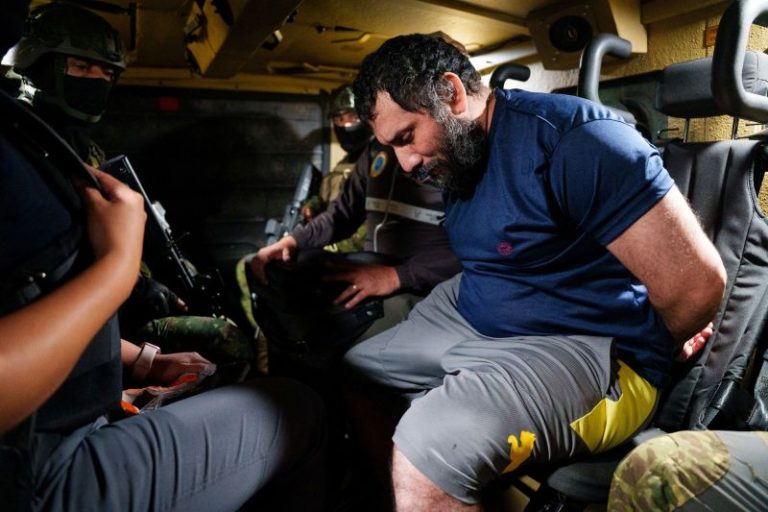
“They started to excavate. As soon as this happened, Fito panicked because if we continued, the roof of his bunker would collapse. At that moment, he opened the hatch, where the military was already located, and climbed out of the hole where he was hiding. That’s how we detained him,” Reimberg said.

Soldiers pinned Macías to the ground, pointed weapons at him and ordered him to say his full name out loud.

“Adolfo Macías Villamar,” he said while lying on the floor with his hands behind his back, footage from the army showed.

After the operation, authorities arrested Macías, along with four other men identified as part of his security detail.

Macías was immediately transferred to the Manta Air Base and then to the Guayaquil Air Base. From there, he was taken to the maximum-security La Roca prison, located in the Guayaquil prison complex, behind La Regional prison, from where he escaped in January 2024.

A photo later released by the interior ministry showed the drug lord locked inside his cell.

President Daniel Noboa said Ecuador is working to extradite him to the United States – where he faces drugs and weapons charges – and is awaiting a response from American officials.

Macías is one of Ecuador’s most notorious gangsters and is the only founding member of Los Choneros believed to still be alive. In 2011 he was sentenced “for a string of crimes, including homicides and narcotics trafficking,” according to think tank Insight Crime, but sprung out of jail in February 2013 before being recaptured months later.

Little is known about his life prior to crime, but he gained a reputation for being the gang’s money laundering expert while incarcerated for over a decade.

Before he fled prison in 2024, the government was planning on moving Macías to a higher-security facility. Noboa’s press secretary told a local channel that the news had likely reached Macías and prompted him to make his escape.

This post appeared first on cnn.com

The Israeli military has denied a new report that soldiers were ordered to fire at unarmed Palestinians waiting for humanitarian aid in Gaza, after hundreds of people were reported killed while approaching food distribution sites in recent weeks.

On Friday, the daily Haaretz newspaper published an article alleging that Israeli soldiers in Gaza were instructed by their commanders to shoot at the crowds of Palestinians approaching aid sites, even as it was evident that the crowds posed no threat.

One soldier who spoke anonymously with Haaretz described the approach routes to the aid sites as a “killing field” where Israeli forces open fire even if there is no immediate threat. According to the article, Israeli forces recently began dispersing crowds with artillery shells, which resulted in a sharp rise in casualties.

“We strongly reject the accusation raised in the article — the IDF did not instruct the forces to deliberately shoot at civilians, including those approaching the distribution centers,” the Israel Defense Forces (IDF) said in response to the article. “To be clear, IDF directives prohibit deliberate attacks on civilians.”

Israeli Prime Minister Benjamin Netanyahu and Defense Minister Israel Katz have also rejected the report as “vicious lies designed to discredit the IDF – the most moral army in the world.”

More than 500 Palestinians have been killed as they approached aid sites or trucks carrying aid since May 27, according to the Palestinian Ministry of Health. Palestinians have come under fire on a near daily basis as they approach the sites, health officials and emergency responders have said.

On multiple occasions, the IDF has acknowledged firing what it called “warning shots” at Palestinians approaching military positions near aid distribution sites. It has also said that it is examining reports of casualties, but it has not publicly released any findings to date.

According to Haaretz, the Military Advocate General has instructed the IDF General Staff’s Fact-Finding Assessment Mechanism – which reviews incidents involving the potential violations of the laws of war – to investigate suspected war crimes near the aid sites.

“Any allegation of a deviation from the law or IDF directives will be thoroughly examined, and further action will be taken as necessary,” the IDF said on Friday.

Shots fired at controversial aid sites

The Gaza aid sites where the deaths have occurred are run by the controversial Israel- and US-backed Gaza Humanitarian Foundation (GHF), which hands out pre-packaged boxes of food at a handful of locations in southern and central Gaza. The group’s distribution was chaotic from the start one month ago, with crowds of desperate Palestinians rushing the sites the moment they open to take the available aid before it runs out, often within less than an hour.

GHF was set up to replace the United Nations aid distribution mechanism, which Israel and the US have accused Hamas of looting. Hamas has rejected those claims, and humanitarian groups say most of the UN-distributed food aid reaches civilians.

GHF coordinates with the Israeli military to designate specific routes for Palestinians traveling to their aid sites and has come under sharp criticism from aid experts. It has acknowledged some episodes of violence occurring outside of its immediate aid sites, but repeatedly described food distribution operations as having “proceeded without incident.”

In response to the Haaretz reporting, the organization said it was “not aware” of the specific incidents described. Nevertheless, it added, “these allegations are too grave to ignore and we therefore call on Israel to investigate them and transparently publish the results in a timely manner.”

On Thursday, the US State Department announced that it is awarding $30 million to the organization, a sign of continued US support for GHF, which says it distributed 46 million meals in four weeks of operations.

This post appeared first on cnn.com

MACD, ADX and S&P 500 action frame Joe Rabil’s latest show, where a drifting index push him toward single-stock breakouts. Joe spotlights the daily and weekly charts of American Express, Fortinet, Parker-Hannifin, Pentair, and ServiceNow as showing strong ADX/MACD characteristics. He outlines how the patterns showing on these charts can outshine the broad market until momentum confirms a larger move.

The video premiered on June 25, 2025. Click this link to watch on Joe’s dedicated page.

Archived videos from Joe are available at this link. Send symbol requests to stocktalk@stockcharts.com; you can also submit a request in the comments section below the video on YouTube. Symbol Requests can be sent in throughout the week prior to the next show.

The S&P 500 ($SPX) just logged its second consecutive 1% gain on Tuesday. That’s three solid 1% advances so far in June. And with a few trading days remaining in the month, the index has recorded only one 1% decline so far.

A lot can still happen before the month ends, but, as it stands, June is looking a lot like May, which also saw three 1% gains and one 1% loss. Taken together, these months resemble May and June of last year, although back then the S&P 500 advanced 52 consecutive sessions without a single 1% decline.

What this means for you: After the volatility of March and April—and the sharp rebound in mid-April—there has been a notable shift toward a more consistent uptrend. We talk about this frequently, and it bears repeating: the characteristics of a steady uptrend are unmistakable. It’s the foundation of our analysis that shapes our market outlook.

FIGURE 1. THE NUMBER OF 1% MOVES IN THE S&P 500 IN 2024 AND 2025. June is looking similar to May, which also saw three 1% gains and one 1% loss. It’s echoing the behavior we saw in May and June of 2024.

It all starts with daily price action. Low two-way volatility has set the tone in recent weeks. If this type of month-to-month tempo in daily moves continues, the uptrend can persist. The opposite, of course, is also true.

Zooming In On the Short-Term Moves

Looking at the S&P 500’s recent price action on the short-term chart, the index is now approximately +3% from its recent low last Friday. If this multi-day bounce were to stop now, it would be among the smallest over the last nine months. Indeed, most didn’t get much further before the next bout of profit taking, but this shows how the staircase-like advance could continue.

In other words, if this cadence persists, the S&P 500 could meander through its former highs, i.e., we may not see a resounding breakout. The more boring a move through 6,147, the better.

FIGURE 2. TWO-HOUR CHART OF THE S&P 500. The staircase-like advance in $SPX could continue, and the index could tiptoe through previous highs.

Also, notice how the recent drawdown only pulled the 14-period relative strength index (RSI) on this two-hour chart marginally below the 50 level, which shows that the momentum shift was limited last week. It’s a reminder of how weak the bounce attempt was in March, which set the stage for the second down leg of that move. If the reverse is now true, then another up leg could be afoot soon.

NVDA Stock: A Daily Perspective

NVDA made a new all-time high on Wednesday, the first since January 7. Its participation since the April 7 low has been a major and necessary piece to the SMH, XLK, NDX, and SPX’s rallies, and the global equity market’s overall comeback. 

We last cited the stock on May 27 and May 29 (before and right after it reported earnings), noting the bull flag pattern. The flag has held throughout, and NVDA is now close to achieving that price target. So, what’s next?

FIGURE 3: DAILY CHART OF NVDA’S STOCK PRICE. After the bull flag pattern, NVDA is close to achieving its price target.

NVDA vs. 200-Day Moving Average

NVDA’s comeback has pulled the stock back above its 200-day moving average. We’ve shown this before as the stock was coming back. The last few times NVDA reclaimed the long-term line after spending a long time below it, the stock advanced higher for years.

FIGURE 4. DAILY CHART OF NVDA WITH 200-DAY MOVING AVERAGE. The last few times NVDA broke above its 200-day moving average after spending a long time below it, the stock advanced higher for years.

NVDA Stock: A Weekly Perspective

Even though NVDA made a marginal new high in early January, there was no follow-through. Thus, NVDA remains net flat since November 2024 and isn’t too far above its spike highs from last June either.

Altogether, the round trip can now be viewed as one big bullish pattern. We’ve seen similar formations play out three times since the October low. Once NVDA finally got through those volatile periods and broke out, those strong extensions that we all remember well ensued. Past performance is no guarantee of future returns, but patterns tend to repeat no matter the timeframe. So, we need to respect that the same kind of breakout could happen again with the stock is sitting at the same levels as it was eight months ago, but with strong market-wide demand at its back.

FIGURE 5. WEEKLY CHART OF NVDA. Could a breakout with strong market-wide demand occur?

NVDA – GoNoGo

NVDA’s weekly trend just flipped to positive on the GoNoGo chart, as well. As is clear, the last time this happened was in early 2023, the same time that the first bullish pattern on the preceding chart happened.

FIGURE 6. NVDA’S PRICE ACTION USING GONOGO CHART. The weekly trend just switched to positive. This happened in 2023, which is around the time the first bullish pattern occurred in the weekly chart in Figure 5.

NVDA Stock: A Monthly Perspective

Zooming way out, this also could be the fourth major breakout from a monthly perspective. The prior ones happened in 2015, 2020, and 2023.

FIGURE 7. MONTHLY CHART OF NVDA. There could be a fourth major breakout in NVDA’s stock price.

The Bottom Line

If you’re someone who likes to stay invested with an eye on the long-term, this is the kind of environment where patience pays off. The S&P 500 appears to be building strength, and NVDA is helping lead the charge.


Take a tour of the FIVE latest updates and additions to our fan-favorite, professionally-curated Market Summary dashboard with Grayson!

In this video, Grayson walks viewers through the new charts and indexes that have been added to multiple panels on the page. These include mini-charts for the S&P sectors, a new index-only put/call ratio, intermarket analysis ratios to compare performance across asset classes, and a massive collection of key economic indexes that you can track like a pro. Plus, Grayson will show you how to install the accompanying Market Summary ChartPack – a pre-built collection of over 30 organized ChartLists designed to enhance your use of the Market Summary dashboard page.

This video originally premiered on June 26, 2025. Click on the above image to watch on our dedicated Grayson Roze page on StockCharts TV.

You can view previously recorded videos from Grayson at this link.

Over a month ago, Super Micro Computer, Inc. (SMCI) appeared on our StockCharts Technical Rank (SCTR) Top 10 list. SCTRs are an exclusive StockCharts tool that can help you quickly find stocks showing strong technical strength relative to other stocks in a similar category.

Now, the stock market is dynamic, and SMCI, like many stocks, went through a consolidation period with its price trading within a certain range. While SMCI was basically moving sideways, other stocks, such as Palantir Technologies, Inc. (PLTR), Robinhood Markets Inc. (HOOD), and Roblox Corp. (RBLX), took their turn on the Top 10 SCTR list.

Spotting SMCI’s Potential Turnaround

After over a month of this sideways movement, SMCI is starting to show signs of a breakout. This can often be a sign of renewed strength for a stock to move higher, though there’s no guarantee.

A significant factor behind SMCI’s rise is the strength in AI-related tech stocks, which has given the broader market a big boost. The Nasdaq 100 ($NDX) hit record highs, and other major indexes such as the Nasdaq Composite ($COMPQ) and S&P 500 ($SPX) are just a hair away from hitting their record highs. For as long as this positive trend remains in place, SMCI will likely ride higher with the market.

Let’s break down SMCI’s daily chart.

FIGURE 1. DAILY CHART OF SMCI STOCK. SMCI broke out of a trading range and has the potential to rise higher if momentum strengthens. Monitor momentum indicators such as the RSI and PPO.Chart source: StockCharts.com. For educational purposes.

SMCI’s SCTR score was at 95.5 after Thursday’s close. The stock is trading comfortably above its 50-day simple moving average, its relative strength index (RSI) is approaching the 70 level, and the percentage price oscillator (PPO) is starting to show encouraging signs of positive momentum (see daily chart below).

Since SMCI has hit a high of $122.90, your initial thought might be that the stock has significant upside potential. It very well could. However, a key part of smart investing is understanding and managing risk. You know very well that any negative news headline is bound to send SMCI tumbling back to its lows; after all, it’s happened before.

Let’s say you spotted this breakout. The ideal approach is to wait for a pullback and a reversal back to the upside with strong follow-through before entering a long position. However, given the stock is moving relatively quickly, you let FOMO get to you and decided to enter a long SMCI position at around $48.

With the stock closing near its high for the day, there is the possibility of a higher move at the open, short of any negative news. But nothing is guaranteed, and you need downside protection for your position. Initially, your stop loss would be the top end of SMCI’s trading range. But what about your upside price targets?

For this, I turned to the weekly chart of SMCI and, using the annotation tool, added Fibonacci retracement levels from the March 2024 high to the November low.

FIGURE 2. WEEKLY CHART OF SMCI STOCK. Annotating Fibonacci retracement levels from the March 2024 high to the November 2024 low is one way to identify price targets.Chart source: StockCharts.com. For educational purposes.

Your first price target could be the 38.2% level, which falls just below $60. This aligns with the February high and was an area where the stock price stalled during August 2024 before it continued lower. If SMCI’s stock price hits that level, don’t be surprised if it wavers here. It could continue higher or fall lower depending on investor sentiment toward AI stocks.

Closing Position

Remember, protecting your capital is of utmost importance, regardless of whether the trade goes in your favor or not. Use stops with discipline, since stocks like SMCI can move both up and down quickly. Your objective should be to keep your losses small and let your profits run until the upside momentum dries up.


Disclaimer: This blog is for educational purposes only and should not be construed as financial advice. The ideas and strategies should never be used without first assessing your own personal and financial situation, or without consulting a financial professional.