Author

admin

Browsing

An empty base as a target, with many hours warning, and a limited number of missiles fired at some of the best air defense systems in the world. Iran’s retaliation for the US’s weekend strikes on three of its nuclear facilities can only have been designed to deescalate.

The US-run Al Udeid airbase in Qatar had been evacuated days earlier, with satellite images showing the departure of planes and personnel widely publicised in the media. It is the most important US military airbase in the region, the home of Central Command. It even launched the drone that killed Iran’s top military personality, General Qasem Soleimani, in 2020, Iranian state media said in the hours after “Operation Glad Tidings of Victory.” The Monday strike against Al-Udeid had close to zero chance of American casualties – and provided the perfect moment of quasi-absurd face-saving for Iran.

The first hint of a possible strike came when the US Embassy in Doha, Qatar, issued an emergency “shelter in place” order for US citizens. As if to remove any doubt, Qatar closed its airspace about an hour prior to the launch of what appears to have been close to a dozen missiles by Iran. Adding to the favourable conditions of the launch for Iran’s dwindling arsenal, Qatar is close enough to permit the use of shorter-range missiles, stocks of which have not been as depleted as the medium-range missiles used to hit Israel over the past week.

To pour water on anything resembling a flame, Iran’s National Security Council said moments after the attack the number of missiles fired had been “as many as the number of bombs used in the attack on Iranian nuclear facilities.” Packaging the barrage as the definition of a proportionate response, the Iranian statement went on to insist the attack posed “no dangerous aspect to our friendly and brotherly country of Qatar and its noble people.”

Tehran’s method of retaliation-without-fangs has been successfully tried and tested. After Soleimani was killed, Iran’s retaliatory missile attack against the US’s Al Asad airbase in Iraq was reportedly telegraphed to Baghdad beforehand, possibly helping reduce the level of US injury suffered to mostly concussions. Iran’s response to Israel’s assassination of Hamas leader Ismail Haniyeh in July 2024 in the heart of Tehran heavily telegraphed in advance.

“We knew they’d retaliate. They had a similar response after Soleimani,” a senior White House official said Monday night.

A playbook appears to be forming. But it is one that compounds Iran’s military weakness each time it is employed. In 2020, the Islamic Republic lost its pre-eminent military personality – an Iranian hardline hero. In 2024, it showed that valuable allies were not safe in central Tehran. This year, the regime has lost control of its own airspace to the point of previously unthinkable strikes on their prized nuclear facilities by both Israel and the US.

This is stark testament to the differing powers on display. Iran has to feign its strength in a managed presentation of restrained and muted anger. The US and Israel get to break taboos daily, shattering Iran’s long-held position as a regional power in under ten days, and perhaps ending its ambitions to be a nuclear power.

There is now only one real red line left for the United States or Israel to cross, and that is to directly target Iran’s Supreme Leader Ayatollah Ali Khamenei. But that may seem ill-advised, given the likelihood this octogenarian theocrat would be replaced by a younger hardliner who is keener to flex Iran’s muscles of deterrence. Better to accept toothless retaliations amid Tehran’s slow decline.

Each expression of Iran’s anger has confirmed its slow erosion of power. An angry fledging nuclear power would have accelerated its race to an atomic bomb. That may still happen. But it looks more likely that Iran is desperately hoping its performative lashing out can sate what remains of its hardliners, decimated by Israeli strikes. It may even hope to shuffle back to diplomacy, with talks to contain a nuclear program and ballistic missile stockpile likely severely depleted to shadows of what they were merely ten days ago.

This post appeared first on cnn.com

Apple was sued on Friday by shareholders in a proposed securities fraud class action that accused it of downplaying how long it needed to integrate advanced artificial intelligence into its Siri voice assistant, hurting iPhone sales and its stock price.

The complaint covers shareholders who suffered potentially hundreds of billions of dollars of losses in the year ending June 9, when Apple introduced several features and aesthetic improvements for its products but kept AI changes modest.

Apple did not immediately respond to requests for comment.

CEO Tim Cook, Chief Financial Officer Kevan Parekh and former CFO Luca Maestri are also defendants in the lawsuit filed in San Francisco federal court.

Shareholders led by Eric Tucker said that at its June 2024 Worldwide Developers Conference, Apple led them to believe AI would be a key driver of iPhone 16 devices, when it launched Apple Intelligence to make Siri more powerful and user-friendly. But they said the Cupertino, California-based company lacked a functional prototype of AI-based Siri features and could not reasonably believe the features would ever be ready for iPhone 16s.

Shareholders said the truth began to emerge on March 7 when Apple delayed some Siri upgrades to 2026 and continued through this year’s Worldwide Developers Conference on June 9 when Apple’s assessment of its AI progress disappointed analysts.

Apple shares have lost nearly one-fourth of their value since their Dec. 26, 2024 ,record high, wiping out approximately $900 billion of market value.

This post appeared first on NBC NEWS

Walmart has agreed to pay $10 million to settle a Federal Trade Commission civil lawsuit accusing the world’s largest retailer of ignoring warning signs that fraudsters used its money transfer services to fleece consumers out of hundreds of millions of dollars.

The settlement was filed on Friday in Chicago federal court, and requires approval by U.S. District Judge Manish Shah.

Walmart also agreed not to process money transfers it suspects are fraudulent, or help sellers and telemarketers it believes are using its services to commit fraud.

“Electronic money transfers are one of the most common ways that scammers tell consumers to send them money, because once it’s sent, it’s gone for good,” said Christopher Mufarrige, director of the FTC consumer protection bureau. “Companies that provide these services must train their employees to comply with the law and work to protect consumers.”

The Arkansas-based retailer did not admit or deny wrongdoing in agreeing to settle. Walmart did not immediately respond to requests for comment.

In its June 2022 complaint, the FTC accused Walmart of turning a blind eye to fraudsters who used its money transfer services to cash out at its stores.

Walmart acts as an agent for money transfers by companies such as MoneyGram and Western Union. Money can be hard to trace once delivered.

The FTC said fraudsters used many schemes that included impersonating Internal Revenue Service agents, impersonating family members who needed money from grandparents to avoid jail, and telling victims they won lotteries or sweepstakes but owed fees to collect their winnings.

Shah dismissed part of the FTC case last July but let the regulator pursue the remainder. Walmart appealed from that decision. Friday’s settlement would end the appeal.

This post appeared first on NBC NEWS

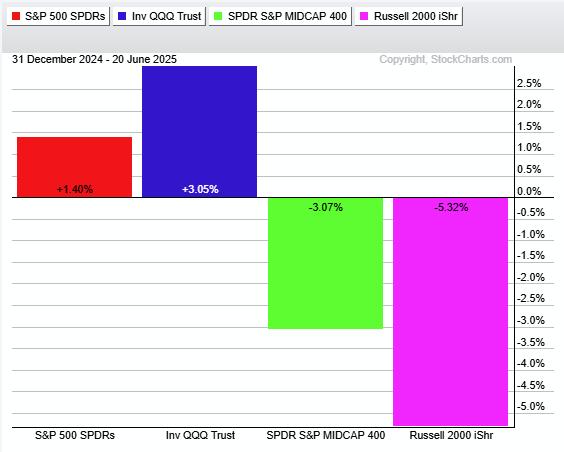
The S&P MidCap 400 SPDR (MDY) is trading at a moment of truth as its 5-day SMA returns to the 200-day SMA. A bearish trend signal triggered in early March. Despite a strong bounce from early April to mid May, this signal remains in force because it has yet to be proven otherwise. Today’s report will show how to quantify signals and reduce whipsaws using the percentage difference between two SMAs.

First note that MDY is lagging SPY and QQQ because its 5-day has yet to cross above its 200-day. The latter two saw bullish crosses in mid May, over a month ago. A bullish breakout in MDY would reflect broadening upside participation, which would be bullish for stocks. The PerfChart below shows SPY and QQQ with year-to-date gains. MDY and IWM are down year-to-date. 


***********************

TrendInvestorPro continues to follow the leading uptrends and recent breakouts in metals-related ETFs. These include gold, silver, palladium, platinum, copper and associated miners. Tech-related ETFs are also leading and featured in our reports/videos. Click here to learn more and get full access to our research.

***********************

The chart below shows MDY hitting its moment of truth as the 5-day SMA (black line) bumps against the underside of the 200-day SMA (blue line). A bearish cross occurred in late February and this signal has yet to be reversed. However, I am not watching for a simple 5/200 cross. Instead, I want to see the 5-day SMA clear the 200-day SMA by a certain percentage. This is a signal threshold.

The indicator window shows Percent above MA (5,200,1), which measures the percentage difference between the 5 and 200 day SMAs. See the TIP Indicator Edge Plugin for details. I placed signal thresholds at +3% and -3% to reduce whipsaws. A bullish signal triggers with a move above +3% and a bearish signal triggers with a move below -3%. At the very least, this indicator value is still negative and bearish. A move above 0 would reflect a positive 5/200 cross, while a move above +3% would trigger a bullish trend signal. This indicator is part of the TIP Indicator Edge Plugin for StockCharts ACP.

The signal threshold levels depend on your personal preferences and trading styles. Tighter thresholds generate earlier signals, but with more whipsaws. Wider thresholds reduce whipsaws, but increase signal lag. This is always the tradeoff. I prefer plus/minus 1 percent when using the 5/200 cross for SPY. I widened these thresholds to plus/minus 3 percent for MDY because it is more volatile.

TrendInvestorPro continues to follow the leading uptrends and recent breakouts in metals-related ETFs. These include gold, silver, palladium, platinum, copper and associated miners. Tech-related ETFs are also leading and featured in our reports/videos. Click here to learn more and gain immediate access. 

In today’s “Weekly Market Recap”, EarningsBeats.com’s Chief Market Strategist Tom Bowley looks ahead to determine the likely path for U.S. equities after the weekend bombing of Iran nuclear sites. Are crude prices heading higher? Will energy stocks outperform? What additional roadblocks might we have to negotiate after the latest Fed meeting and policy statement? Could we see fallout from June monthly options expiring on Friday? Check it all out in the video below….

Happy trading!

Tom

(TheNewswire)

June 23, 2025 TheNewswire – Vancouver, British Columbia Blue Lagoon Resources Inc. (the ‘ Company ‘) (CSE: BLLG; FSE: 7BL; OTCQB: BLAGF) is pleased to announce that it has entered into a credit agreement with its toll milling partner, Nicola Mining Inc . providing the Company with a $2 million line of credit without any security against the Company’s mineral property or physical assets.

The facility, which carries a competitive interest rate linked to the 3-month SOFR (Secured Overnight Financing Rate), is repayable over a 12-month term with interest-only payments during the first eleven months. At the Company’s discretion, the loan can be extended for an additional 12 months, with adjusted terms.

Importantly, the loan is structured to allow maximum operational flexibility , with no requirement for project collateralization — underscoring Nicola’s confidence in the Dome Mountain Gold Project and its near-term production trajectory.

‘We’re extremely pleased to have the continued support of Nicola Mining, not only as our toll milling partner but also as a continued financial backer,’ said Rana Vig , President and CEO of Blue Lagoon. ‘This line of credit adds an extra layer of security to our already strong balance sheet and gives us added flexibility as we finalize preparations for gold production this summer. It’s a clear sign that sophisticated investors recognize the value of Dome Mountain and its cash flow potential.’

This agreement comes on the heels of Blue Lagoon’s recently completed financing, which was fully subscribed by long time existing shareholders that included Crescat Capital and Phoenix Gold fund as well as new strategic investors. The Company remains fully funded , with no short-term debt and over $3.6 million in in-the-money warrants , positioning it strongly as it enters the final phase of development.

While the Company may ultimately never need to draw on this facility, having access to it provides an important financial backstop. It ensures capital is available if needed to support production ramp-up, seize opportunity, or manage any unforeseen short-term needs – all without causing further dilution to existing shareholders.

Peter Espig , President and CEO of Nicola Mining, commented: ‘We’ve worked closely with the Blue Lagoon team for some time and continue to be impressed by their methodical and disciplined approach. Successfully navigating B.C.’s rigorous permitting process, while also building a strong, trust-based relationship with the Lake Babine Nation, speaks volumes about their leadership. We are pleased to provide this credit facility and look forward to supporting their transition to gold and silver production.’

If the Company chooses to access this facility, Nicola Mining will maintain a short-term security interest over the Company’s gold and silver production from the Dome Mountain Gold Project until the loan is repaid in full.

About Blue Lagoon Resources Inc.

Blue Lagoon Resources is a Canadian based publicly listed mining company (CSE: BLLG; FSE: 7BL; OTCQB: BLAGF) focused on building shareholder value through the aggressive development of its 100% owned Dome Mountain Gold project. The Company is run by professionals with significant finance and mining experience and operates within a prime mining jurisdiction in British Columbia, Canada. With the granting of a full mining permit, a key milestone achieved in February 2025 – one of only nine such permits issued in British Columbia since 2015 – Blue Lagoon is now focused on last preparatory activities and tasks related to the safe and secure opening of the Dome Mountain Gold Mine, targeting Q3 2025 as the start of gold production . The Company’s primary objective has always been to become a cash-flowing mining company, to ultimately deliver tangible monetary value to shareholders, state, and local communities.

The Company is not basing its production decision at Dome Mountain on a feasibility study of mineral reserves demonstrating economic and technical viability. The production decision is based on having existing mining infrastructure, past bulk sampling and processing activity, and the established mineral resource.  The Company understands that there is increased uncertainty, and consequently a higher risk of failure, when production is undertaken in advance of a feasibility study.

For further information, please contact:

Rana Vig

President and CEO

Telephone: 604-218-4766

Email: ranavig@bluelagoonresources.com

The CSE has not reviewed and does not accept responsibility for the adequacy or accuracy of this release.

Statement Regarding Forward-Looking Information: This release includes certain statements that may be deemed ‘forward-looking statements’. All statements in this release, other than statements of historical facts, that address events or developments that Blue Lagoon Resources Inc. (the ‘Company’) expects to occur, are forward-looking statements. Forward-looking statements are statements that are not historical facts and are generally, but not always, identified by the words ‘expects’, ‘targets’, ‘plans’, ‘anticipates’, ‘believes’, ‘intends’, ‘estimates’, ‘projects’, ‘potential’, ‘mine’, ‘production’ and similar expressions, or that events or conditions ‘will’, ‘would’, ‘may’, ‘could’ or ‘should’ occur. Although the Company believes the expectations expressed in such forward-looking statements are based on reasonable assumptions, such statements are not guarantees of future performance and actual results may differ materially from those in the forward-looking statements. Factors that could cause the actual results to

differ materially from those in forward-looking statements include results of exploration activities may not show quality and quantity necessary for further exploration or future exploitation of minerals deposits, volatility of gold and silver prices, delays in mine development activities, future cash flow expectations and continued availability of capital and financing, permitting and other approvals, and general economic, market or business conditions.  Investors are cautioned that any such statements are not guarantees of future performance and actual results or developments may differ materially from those projected in the forward-looking statements. Forward-looking statements are based on the beliefs, estimates and opinions of the Company’s management, contractors and consultants on the date the statements are made. Except as required by applicable securities laws, the Company undertakes no obligation to update these forward-looking statements in the event that management’s, contractor’s and consultants’ beliefs, estimates or opinions, or other factors, should change.

Copyright (c) 2025 TheNewswire – All rights reserved.

News Provided by TheNewsWire via QuoteMedia

This post appeared first on investingnews.com

Canada’s tech sector saw momentum this week, with announcements spanning venture capital and quantum computing, as well as global policy leadership news out of the G7 summit.

Axl on a mission to retain Canadian innovation

On Tuesday (June 17), Axl, a newly founded Canadian venture studio, announced plans to help launch 50 artificial intelligence (AI) companies in Canada over the next five years, supported by a C$15 million fund led by co-founder Daniel Wigdor, a computer science professor at the University of Toronto.

The venture’s other founders are Tovi Grossman, another University of Toronto professor, entrepreneur Ray Sharma and former Telus (TSX:T,NYSE:TU) executive David Sharma. Mining magnate Rob McEwen of McEwen Mining (TSX:MUX,NYSE:MUX) and Smart Technologies co-founder David Martin are also investors.

According to Wigdor, Axl will tackle practical business problems and connect them with promising academic research in a bid to keep Canadian innovation at home. “The social contract academics believe we have with society is that we invent these technologies and inspire people,” he told the Globe and Mail on Tuesday. “The tragedy is that the foundational technologies we’re inventing in Canada are not accruing capital for Canada.’

Wigdor pointed to his own career as a cautionary tale, explaining that the iPhone’s multi-touch interface was presaged by research he conducted in the early 2000s for his University of Toronto thesis, which itself built on concepts pioneered by University of Toronto professor Bill Buxton in the 1980s.

Other University of Toronto AI breakthroughs fueled the international rise of figures like Geoffrey Hinton, OpenAI co-founder Ilya Sutskever and xAI’s Jimmy Ba, all of whom took their expertise to US-based companies.

Carney talks tech leadership at G7 summit

Initiatives like Axl’s signal a proactive approach to Canada’s challenge of retaining tech talent and capitalizing on its world-class research; however, its success will hinge on broader public support.

Prime Minister Mark Carney has signaled that fostering tech innovation at home is a priority. He told G7 leaders that driving the digital transition, led by AI and quantum computing, would be one of his top goals at the summit.

Quantum technology was reportedly discussed at length during the two day meeting, which took place in Kananaskis, Alberta. In addition, a joint statement from members released by the prime minister’s office indicates that Canada will launch the G7 GovAI Grand Challenge and host a series of Rapid Solution Labs “to develop innovative and scalable solutions to the barriers we face in adopting AI in the public sector.”

That emphasis echoes longstanding concerns from the research community.

A 2024 letter acquired by the Logic and sent to then-innovation minister François-Philippe Champagne by the Quantum Advisory Council cites the significant sums that other countries have invested in quantum technology.

“The cost of inaction is tremendous,” the group wrote at the time, pointing to Canada’s history of “inventing core technologies,” but letting other countries “grow industries around our inventions.”

The council proposed a C$1 billion program that would mirror the Quantum Benchmarking Initiative (QBI), which fosters domestic quantum computing in the US. The QBI has selected 18 companies for its first phase, including three from Canada; firms that demonstrate the ability to build a functional quantum computer by 2033 will be eligible to receive up to US$316 million, making it a potential “kingmaker” program.

The second phase of the program is set to launch in August 2025. While no relocation demands have been made, concerns exist that later-stage QBI terms could force Canadian winners to the US.

The Quantum Advisory Council said its proposed program would be run by the National Research Council, which would independently assess firms to accelerate the development of competitive domestic quantum companies.

It would build on a C$360 million national quantum strategy announced in April 2021.

The council’s recommendations include increased grants for scientific and social science research into quantum technologies, and a new federal clusters program to foster regional quantum ecosystems encompassing research, development and training, alongside ethical and secure use. It also calls for significant investment in quantum-safe software certification and the development of other security systems.

In a speech at the Quantum Now conference in Montreal on Thursday (June 19), Canada’s AI minister, Evan Solomon, emphasized the need to protect Canada’s talent pipeline. “We cannot allow short-term funding opportunities to hollow out our domestic capabilities or transfer generations of Canadian innovation outside our borders,” he said.

Earlier this month, the minister said he would move away from “over-indexing on warnings and regulation” and instead focus on finding ways to unleash the economic potential of AI. The ongoing collaboration between government initiatives and private ventures will be key to unlocking Canada’s full potential in the new digital era.

Securities Disclosure: I, Meagen Seatter, hold no direct investment interest in any company mentioned in this article.

This post appeared first on investingnews.com

DY6 Metals Ltd (ASX: DY6, “DY6” or the “Company”) is pleased to announce the initial visual estimations from the reconnaissance exploration program at the Douala Basin HMS Project, Cameroon. Desktop studies incorporating detailed geological mapping, geophysics, and known mineral occurrences, were used to define initial, high priority targets for ground- truthing. The reconnaissance programme, which consisted of hand auger and channel sampling, was successful in identifying high estimated concentrations of heavy mineral (HM) mineralisation across all the six tenements that make up the project. Additionally, the Company’s consultants have observed the presence of natural rutile grains within panned concentrates.

HIGHLIGHTS

  • The Company’s reconnaissance auger and channel sampling programme has been completed at the Douala Basin HMS Project
  • Reconnaissance sampling undertaken across the 6 Douala Basin tenements has identified thick zones of high estimated concentrations of heavy minerals (HM) as well as natural rutile
  • Work at the Douala Basin Project followed up on historical HM occurrences identified by previous Eramet drilling, as well as priority areas identified through the Company’s internal reviews
  • Samples collected from the reconnaissance program are due to be submitted for laboratory analysis in the coming weeks, with results expected in the September quarter
  • At Douala Basin, exploration will transition to a detailed campaign of auger drilling

Samples collected from this initial exploration programme are currently being prepped for dispatch to the Company’s laboratory for analysis in South Africa, with results expected in the September quarter.

Technical Consultant, Cliff Fitzhenry, commented:“While the Company’s primary focus is on the Central Rutile Project, where we have recently reported the presence of wide-spread residual natural rutile mineralisation, we believe that the Douala Basin HMS project has significant potential. The reconnaissance programme has over the last few weeks demonstrated the potential of the area, with the identification of high concentrations of visible heavy mineral sands across the project tenements through a mixture of auger, channel, and soil sampling work. Pleasingly, we have also observed natural rutile grains at Douala Basin.

We look forward to the assay results of the reconnaissance programme in the coming months.”

Reconnaissance exploration at the Douala Basin HMS Project

As announced on 5 June 2025, the Company commenced reconnaissance auger and grab sampling programmes at the Central Rutile and Douala Basin HMS projects, Cameroon. At the Douala Basin project, the Company has completed 12 hand auger drill holes (refer Figure 1), collecting 53 samples in the process, as well as collected 38 channel samples from 11 surfaces for analysis (refer Tables 1 & 2).

Cautionary Statement:

The Company cautions that, with respect to any visual mineralisation indicators, visual observations and estimates of mineral abundance are uncertain in nature and should not be taken as a substitute or proxy for appropriate laboratory analysis. Visual estimates also potentially provide no information regarding impurities or deleterious physical properties relevant to valuations. Assay results from the drilling and sampling programmes will be required to understand the grade and extent of mineralisation. Initial assay results are expected in August 2025.

Click here for the full ASX Release

This post appeared first on investingnews.com

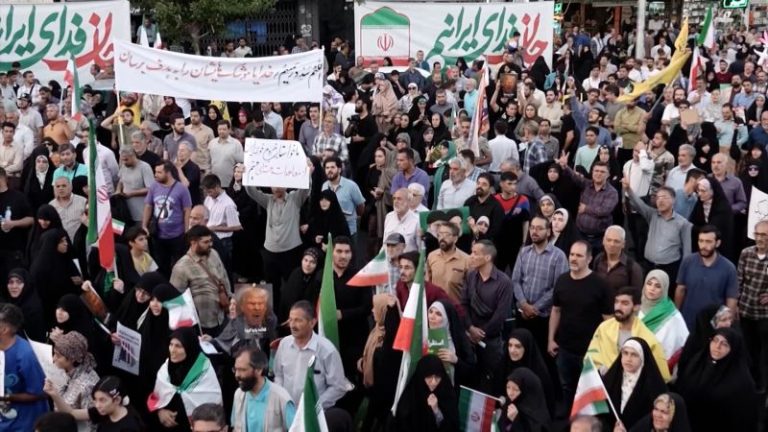
Large crowds gathered at the Enqelab Square in central Tehran on Sunday evening, protesting the strikes. Footage published by the state-affiliated Fars News Agency showed people waving Iranian flags and punching the air, carrying signs that read: “Down with the USA, down with Israel.”

Hamid Rasaee, a politician, said even people critical of the regime were protesting.

Trump ordered attacks on three of Iran’s most important nuclear facilities early Sunday morning – a move that has placed the US in the center of the conflict between Israel and Iran.

Iranians had faced the possibility of US intervention ever since Israel launched its strikes on nuclear and military targets last week – but many believed any action was days away.

That’s in part because Trump said Thursday he would decide whether to strike Iran within two weeks, seemingly opening a window for negotiations. That all changed early Sunday, when American bombers dropped more than a dozen massive “bunker buster” bombs on Iran’s Fordow and Natanz nuclear facilities, and Tomahawk missiles launched from the sea struck Isfahan.

“We do not have nuclear weapons, so why does he strike us?” he added, alluding to the Iranian regime’s insistence the country’s nuclear program is peaceful. Trump has claimed Iran was weeks away from acquiring a nuclear weapon, dismissing assessments from his own intelligence community that Iran was still years away from a weapon.

Qom residents slept through the attacks

While Trump has claimed the three sites struck by the US were “totally obliterated,” his defense secretary has said the full impact is still being assessed. And unlike the strikes by Israel in recent days, some of which targeted densely populated areas, the US attacks were concentrated in locations off-limits to most civilians.

Residents of Qom, a city some 30 kilometers (18 miles) from the Fordow nuclear site, woke to the sound of emergency vehicles’ sirens and the news that the secretive complex had been bombed a few hours earlier.

Five people living in Qom said they were surprised to learn what had happened when they got up, having heard nothing overnight.

Qom does not have an aerial attack warning system, so residents would have had no warning before the strikes.

Qom is considered a holy city, home to Iran’s largest and most famous Shia seminary. Iran’s Supreme Leader Ayatollah Ali Khamenei studied at the Qom Seminary, as did several of Iran’s former presidents.

Similarly, people living in a village some 35 kilometers (22 miles) from the Natanz facility said they heard nothing overnight.

In Tehran, far from the targeted nuclear sites, many were calling for Iran to respond with force. Fars released a compilation of short interviews with people on the streets of the capital Sunday.

Each of the eight people featured urged a retaliation – with most saying Iran should strike US bases in the region and close down the Strait of Hormuz on Iran’s southern shore, through which a third of global seaborne oil trade passes.

In Iran, signs of dissent tend to be quickly quashed, making it dangerous for people to express disagreement with the regime.

But Mohsen Milani, an Iranian scholar who has lived in the US for decades, said the US attack on Iran could spark more genuine support for the regime.

“It could ignite a new wave of nationalism, damage the future of U.S.-Iran relations more than the 1953 coup, accelerate Tehran’s pivot to Russia and China, and fundamentally reshape Iran’s defense, deterrence, and nuclear posture,” he said in a post on X.

Some of this sentiment was already on show in Tehran on Sunday.

“I will stay here and I will sacrifice my life and my blood for my country,” she said.

Everywhere around her, people were protesting the US, many holding anti-Trump signs and posters. Some of the posters ended up on the ground, where people stamped on them.

“We were living our normal lives and they attacked us. If someone strikes the United States, would they not answer? Of course they would,” she said.

Another person living in Tehran said they believed the regime was greatly weakened by the US strikes – because its opponents would now be able to call its bluff.

“The claims that the Iranian regime has always made – that it will attack all American bases and close the Strait of Hormuz – they made all these claims and the whole world saw that (the US) came and easily hit the Fordow and Natanz sites … but Iran was completely silent and no fighter planes took off and (it) used no defenses or missiles,” the person said, adding that if there is no response in the coming days, the regime’s supporters could abandon it.

“No sane person will stand by someone who is in a weak position, not even their own supporters,” they said.

This post appeared first on cnn.com

US President Donald Trump’s decision to strike Iran’s nuclear facilities puts the Middle East in a volatile position, with all eyes now on Tehran’s next move.

Speaking in Istanbul, Iran’s Foreign Minister Abbas Araghchi said on Sunday his country has “a variety of options” when deciding how to respond to the US attacks.

From striking US bases in the region, to possibly closing a key waterway to global shipping, Iran is likely mulling its next moves. All carry inherent risks for the Islamic Republic, Israel and the United States.

Here’s what to know:

Iran could hit US military interests in the region

Direct US involvement in the conflict could see Iran’s Islamic Revolutionary Guard Corps (IRGC) activate what remains of its proxies across Iraq, Yemen and Syria, groups which have previously launched attacks on American assets in the region.

While Iran’s strongest ally in the region was once Lebanon’s Hezbollah, that group has been significantly weakened by Israeli attacks.

The Council on Foreign Relations (CFR) says the US maintains a presence at 19 sites in total across the region, with eight of those considered by analysts to have a permanent US presence. As of June 13, the CFR estimated some 40,000 US troops were in the Middle East.

In Iraq, for example, there were 2,500 US troops as of late last year. An Iranian attack on these forces is not inconceivable. In 2020, an Iranian missile attack on a US garrison left more than 100 soldiers with traumatic brain injuries.

A resurgence of attacks from Yemen against US assets is already on the table. Yemen’s Iran-backed Houthi rebels previously vowed to attack American ships in the Red Sea should the US join Israel’s conflict with Iran. A prominent Houthi official said in a social media post early Sunday that “Trump must bear the consequences” of the US airstrikes on Iranian nuclear facilities.

It is unclear if this marks the end of a US-Houthi ceasefire struck in May, in which Washington said it would halt its military campaign against the Houthis in exchange for the group stopping its attacks on US interests in the region.

Knowing that it can’t outright win a conflict against Israel and the US, experts have said that Tehran could seek to engage in a war of attrition, where it tries to exhaust its adversary’s will or capacity to fight in a drawn-out and damaging conflict, which Trump at the outset of his presidency said he wanted to avoid.

Iran could disrupt global oil trade

Iran also has the power to influence the “entire commercial shipping in the Gulf,” Ravid said, should it decide to close the Strait of Hormuz, a key oil shipping route.

There have so far been no material disruptions to the global flow of oil. But if oil exports are disrupted, or if Iran tries to block the Strait of Hormuz, the global oil market could face an existential crisis.

The strait links the Persian Gulf to the open ocean and is a key channel for oil and liquefied natural gas exports from the Middle East to the global market. About 20 million barrels of oil flow through the strait each day, according to the US Energy Information Administration.

A prominent adviser to Iran’s supreme leader has already called for missile strikes and the closure of the Strait of Hormuz.

“Following America’s attack on the Fordow nuclear installation, it is now our turn,” warned Hossein Shariatmadari, the editor-in-chief of the hardline Kayhan newspaper, a well-known conservative voice who has previously identified himself as a Khamenei “representative.”

Iran could race to build a bomb

Some experts say that Iran is very likely to race for a nuclear bomb now, even if the current regime collapses and new leaders come in place.

“Trump just guaranteed that Iran will be a nuclear weapons state in the next 5 to 10 years,” Trita Parsi, executive vice president of the Quincy Institute in Washington, DC, said on X. “Particularly if the regime changes.”

Parsi has said that even if the regime collapses and new military elements assume power, they are likely to be much more hawkish than the current regime and race toward a nuclear weapon as their only deterrent.

Experts have previously said that Iran likely moved its stocks of enriched uranium from its key nuclear facilities amid Israeli strikes.. Nuclear power plants that generate electricity for civil purposes use uranium that is enriched to between 3.5% and 5%. When enriched to higher levels, uranium can be used to make a bomb Israel and the US accuse Iran of pursuing nuclear weapons; Tehran insists its program is peaceful.

Iran is also likely to withdraw from the Nuclear Non-Proliferation Treaty, or the NPT, under which it has pledged not to develop a bomb.

“Iran’s response is likely not just limited to military retaliation. NPT withdrawal is quite likely,” Ali Vaez, director of the Iran Project at the International Crisis Group, said on X.

Iran could just keep hitting Israel for now

Iran’s first response to the US’ attack on its nuclear sites was to attack Israel, not US bases.

Iranian missiles hit a group of buildings in Tel Aviv, where 86 people were admitted to hospital with injuries overnight and on Sunday morning, according to Israel’s ministry of health.

Knowing it may not be able to sustain a full-on confrontation with the US, and hoping that Trump will scale back on his involvement following Sunday’s strike, Iran may merely seek to perpetuate the status quo, fighting only Israel.

Trump at the time wanted to “send a big message, get the headlines, show US resolve, but then avoid a wider war,” Shabani said.

While Iran may feel it has to retaliate to save face, it may be a bloodless response, similar to what happened in 2020, when it launched a barrage of missiles at US bases in Iraq, which resulted in traumatic brain injuries to personnel but no deaths.

Iran could resort to cyberattacks or terrorism

Two military analysts have said Iran could resort to “asymmetric” measures – such as terrorism or cyberattacks – to retaliate against the US because Israeli attacks have reduced Iran’s military capabilities.

“I think (the IRGC is) going to be a little bit careful, and I suspect that’s going to take us to all of the asymmetric things they can do: cyber, terrorism. I think that they’re probably going to be looking for things where the US cannot just put up the traditional defenses,” he added.

But, “albeit wounded,” the IRGC still has “some tremendous capacity,” he said. “It has capabilities that are already within the region and then outside the region. We are vulnerable… around the world, where the IRGC has either influence or can make things happen asymmetrically.”

Iran could resume nuclear talks

Iran has refused to return to the negotiating table while under Israeli attacks.

On Sunday, Araghchi said he does not know how “much room is left for diplomacy” after the US military strikes on Iranian nuclear facilities.

“They crossed a very big red line by attacking nuclear facilities. … We have to respond based on our legitimate right for self-defense,” Araghchi said.

Parsi said that by doing so, “the Iranians have cornered themselves.”

“Their aim is to force Trump to stop Netanyahu’s war, and by that show his ability and willingness to use American leverage against Netanyahu,” Parsi wrote. “But the flip side is that Tehran has given Israel a veto on US-Iran diplomacy – by simply continuing the war, Israel is enabled to block talks between the US and Iran.”

Iranian and European officials met Friday in Geneva for talks, which an Iranian source said started out tense but became “much more positive.”

Speaking Sunday, Araghchi said the US had decided to “blow up” diplomacy.

“Last week, we were in negotiations with the US when Israel decided to blow up that diplomacy. This week, we held talks with the E3 (group of European ministers)/EU when the US decided to blow up that diplomacy,” Araghchi said on X.

“The more likely situation is that the talks are over for now.”

This post appeared first on cnn.com