Author

admin

Browsing

Britain’s foreign intelligence service, MI6, will be led by a woman for the first time in its history, UK Prime Minister Keir Starmer has announced.

Blaise Metreweli will take up the position of Chief of the Secret Intelligence Service in the fall. She is currently head of the service’s technology and innovation teams, a position immortalized as “Q” in the James Bond movies.

It was revealed in 2017 that “Q” was a woman – but Metreweli was not named at the time.

Metreweli, a graduate of Oxford University, has previously held senior positions in both the domestic and foreign intelligence services.

Starmer described the appointment as “historic.”

“I know Blaise will continue to provide the excellent leadership needed to defend our county and keep our people safe,” he said in a statement.

Metreweli said she was “proud and honored” to be appointed to the role.

This post appeared first on cnn.com

Anne Wojcicki, the co-founder and former CEO of 23andMe, has regained control over the embattled genetic testing company after her new nonprofit, TTAM Research Institute, outbid Regeneron Pharmaceuticals, the company announced Friday.

TTAM will acquire substantially all of 23andMe’s assets for $305 million, including its Personal Genome Service and Research Services business lines as well as telehealth subsidiary Lemonaid Health. It’s a big win for Wojcicki, who stepped down from her role as CEO when 23andMe filed for Chapter 11 bankruptcy protection in March.

Last month, Regeneron announced it would purchase most of 23andMe’s assets for $256 million after it came out on top during a bankruptcy auction. But Wojcicki submitted a separate $305 million bid through TTAM and pushed to reopen the auction. TTAM is an acronym for the first letters of 23andMe, according to The Wall Street Journal.

“I am thrilled that TTAM Research Institute will be able to continue the mission of 23andMe to help people access, understand and benefit from the human genome,” Wojcicki said in a statement.

23andMe gained popularity because of its at-home DNA testing kits that gave customers insight into their family histories and genetic profiles. The five-time CNBC Disruptor 50 company went public in 2021 via a merger with a special purpose acquisition company. At its peak, 23andMe was valued at around $6 billion.

The company struggled to generate recurring revenue and stand up viable research and therapeutics businesses after going public, and it has been plagued by privacy concerns since hackers accessed the information of nearly seven million customers in 2023.

TTAM’s acquisition is still subject to approval by the U.S. Bankruptcy Court for the Eastern District of Missouri.

This post appeared first on NBC NEWS

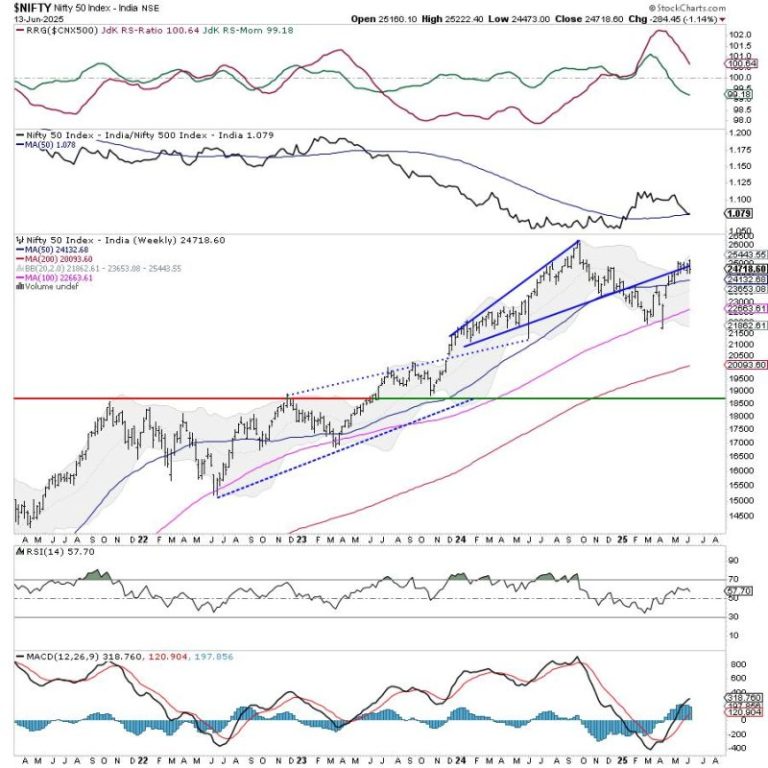
An attempt to break out of a month-long consolidation fizzled out as the Nifty declined and returned inside the trading zone it had created for itself. Over the past five sessions, the markets consolidated just above the upper edge of the trading zone; however, this failed to result in a breakout as the markets suffered a corrective retracement. The trading range stayed wider on anticipated lines; the Index oscillated in a 749-point range over the past week. The volatility rose; the India Vix climbed 3.08% to 15.08 on a weekly basis. The headline Index closed with a net weekly loss of 284.45 points (-1.14%).

We have a fresh set of geopolitical tensions to deal with Israel attacking Iran. The global equity markets are likely to remain affected, and India will be no exception to this. Having said this, the Indian markets are relatively stronger than their peers and are likely to stay that way. Despite the negative reaction to the global uncertainties, Nifty has shown great resilience and has remained in the 24500-25100 trading zone, in which it has been trading for over a month now. There are high possibilities that over the coming week, the Nifty may stay volatile and oscillate in a wide range, but it is unlikely to create any directional bias. A sustainable trend would emerge only after Nifty takes out 25100 on the upside or violates the 24500 level.

The levels of 25100 and 25300 are likely to act as resistance points in the coming week. The supports are likely to come in at 24500 and 24380.

The weekly RSI stands at 57.67; it stays neutral and does not show any divergence against the price. The weekly MACD is bullish and remains above its signal line.

The pattern analysis of the weekly chart shows that the Nifty has failed to break above the rising trendline resistance. This trendline begins from 21150 and joins the subsequent higher bottoms. Besides this, it reinforces the 25100 level as a strong resistance point. For any trending upmove to emerge, it would be crucial for the Index to move past this level convincingly.

Overall, it is unlikely that the Nifty will violate the 24500 levels. The options data shows very negligible call writing below 24500 strikes, increasing the possibility of this level staying defended over the coming days. Unless there is a situation with more gravity to be dealt with, the markets may stay largely in a defined trading range. The sector rotation stays visible in favor of traditionally defensive pockets and low-beta stocks. We continue to recommend a cautious stance as long as the Index does not move past the 25100 level and stays above that point. Until then, a highly stock-specific approach is recommended while guarding profits at higher levels.


Sector Analysis for the coming week

In our look at Relative Rotation Graphs®, we compared various sectors against the CNX500 (NIFTY 500 Index), representing over 95% of the free-float market cap of all the listed stocks. 

Relative Rotation Graphs (RRG) show that the Nifty Midcap 100 has rolled inside the leading quadrant and is set to outperform the broader markets relatively. The Nifty PSU Bank and PSE Indices are also inside the leading quadrant; however, they are giving up on their relative momentum.

The Nifty Infrastructure Index has rolled into the weakening quadrant. The Banknifty, Services Sector Index, Consumption, Financial Services, and Commodities Sector Indices are also inside the weakening quadrant. While stock-specific performance may be seen, the collective relative outperformance may diminish.

The Nifty FMCG Index languishes in the lagging quadrant. The Metal and Pharma Indices are also in the lagging quadrant, but they are improving their relative momentum against the broader Nifty 500 Index.

The Nifty Realty, Media, Auto, and Energy Sector Indices are inside the improving quadrant; they may continue improving their relative performance against the broader markets.


Important Note: RRG charts show the relative strength and momentum of a group of stocks. In the above Chart, they show relative performance against NIFTY500 Index (Broader Markets) and should not be used directly as buy or sell signals.  


Milan Vaishnav, CMT, MSTA

Consulting Technical Analyst

www.EquityResearch.asia | www.ChartWizard.ae

Israel’s unprecedented attacks on Iran had at their core an elusive and high-risk goal: eradicating the country’s controversial nuclear program.

Israel targeted three key Iranian nuclear facilities – Natanz, Isfahan and Fordow – and a number of top scientists involved in nuclear research and development.

The extent of the damage – and whether Iran’s nuclear program can survive – is not immediately clear. An Israeli military official said at a briefing Saturday that strikes on Iran’s nuclear sites in Natanz and Isfahan were able to damage the sites “significantly;” Iran said that damage to the facilities was limited but acknowledged the deaths of nine experts.

“We are at a key point where, if we miss it, we will have no way to prevent Iran from developing nuclear weapons that will threaten our existence,” Israel’s Defense Minister Israel Katz said on Friday.

“We have dealt with Iran’s proxies over the past year and a half, but now we are dealing with the head of the snake itself.”

Iran insists its program is peaceful – here’s what we know about the damage to the three sites.

Natanz

“This was a full-spectrum blitz,” said another source familiar with the assessments.

The strikes destroyed the above-ground part of Natanz’s Pilot Fuel Enrichment Plant, a sprawling site that has been operating since 2003 and where Iran had been enriching uranium up to 60% purity, according to the International Atomic Energy Agency (IAEA). Weapons-grade uranium is enriched to 90%.

That aspect of the operation is crucial, because much of the Natanz facility is heavily fortified and underground, so wiping out the power to those parts of the facility is the most effective way to impact underground equipment and machinery.

It does not appear that Israel damaged those underground parts of the plant directly, the IAEA said, but the loss of power to the underground cascade hall “may have damaged the centrifuges there.”

Natanz has six above-ground buildings and three underground buildings, two of which can hold 50,000 centrifuges, according to the non-profit Nuclear Threat Initiative (NTI). Centrifuges are machines that can enrich uranium by spinning the gas at high speeds.

There is no wider radiological impact. “The level of radioactivity outside the Natanz site has remained unchanged and at normal levels,” the IAEA said. “However, due to the impacts, there is radiological and chemical contamination inside the facilities in Natanz,” it added – though the levels would be manageable.

Isfahan

The extent of damage at the Isfahan nuclear site in central Iran was more difficult to parse in the hours after it was struck, with conflicting claims over the attack’s impact emerging in Israel and Iran.

Behrouz Kamalvandi, the spokesperson of Atomic Energy Organization of Iran said Saturday that damage at the site – Iran’s largest nuclear research complex – was limited.

Equipment at the two facilities was moved in anticipation of the strikes, Kamalvandi said. A shed at the facility caught fire, he added, and there is no risk of contamination.

But Israel were more bullish; an IDF official said during a Saturday briefing that the site took significant damage.

The facility was built with support from China and opened in 1984, the NTI says. According to the non-profit, 3,000 scientists are employed at Isfahan, and the site is “suspected of being the center” of Iran’s nuclear program.

It “operates three small Chinese-supplied research reactors,” as well as a “conversion facility, a fuel production plant, a zirconium cladding plant, and other facilities and laboratories,” the NTI says.

At a Saturday briefing, an IDF official said Israel had “concrete intelligence” that Iran was “moving forward to a nuclear bomb” at the Isfahan facility. Despite advancing its uranium enrichment significantly, Iran has repeatedly said that its nuclear program is for peaceful purposes and denied that it was developing an atomic bomb.

Fordow

The Fordow Fuel Enrichment Plant is a far more difficult site to target. The plant is buried deep in the mountains near Qom, in northern Iran, and houses advanced centrifuges used to enrich uranium up to high grades of purity.

Israel targeted the site during its Friday attacks, but the IAEA said it was not impacted and the IDF has not claimed any significant damage there. Iranian air defenses shot down an Israeli drone in the vicinity of the plant, Iranian state media Press TV reported Friday evening.

Fordow’s fate could be pivotal to the overall success of Israel’s attacks.

In 2023, the Vienna-based International Atomic Energy Agency confirmed that uranium particles enriched to 83.7% purity – which is close to the 90% enrichment levels needed to make a nuclear bomb – had been found in Fordow.

“If Fordow remains operational, Israel’s attacks may barely slow Iran’s path to the bomb,” James M. Acton, the co-director of the Nuclear Policy Program at the Carnegie Endowment for International Peace, wrote on Friday.

Acton said Israel might be able to collapse the entrance to the facility, but noted that destroying much more of the Fordow site will be a difficult task for Israel.

This post appeared first on cnn.com

U.S. President Donald Trump said on Friday that concerns over national security risks posed by Nippon Steel’s $14.9 billion bid for U.S. Steel can be resolved if the companies fulfill certain conditions that his administration has laid out, paving the way for the deal’s approval.

Shares of U.S. Steel rose 3.5% on the news in after-the-bell trading as investors bet the deal was close to done. Trump, in an executive order, said conditions for resolving the national security concerns would be laid out in an agreement, without providing details. “I additionally find that the threatened impairment to the national security of the United States arising as a result of the Proposed Transaction can be adequately mitigated if the conditions set forth in section 3 of this order are met,” Trump said in the order, which was released by the White House.

The companies thanked Trump in a news release, saying the agreement includes $11 billion in new investments to be made by 2028 and governance commitments including a golden share to be issued to the U.S. government. They did not detail how much control the golden share would give the U.S. Shares of U.S. Steel had dipped earlier on Friday after a Nippon Steel executive told the Japanese Nikkei newspaper that its planned takeover of U.S. Steel required “a degree of management freedom” to go ahead after Trump earlier had said the U.S. would be in control with a golden share.

The bid, first announced by Nippon Steel in December 2023, has faced opposition from the start. Both Democratic former President Joe Biden and Trump, a Republican, asserted last year that U.S. Steel should remain U.S.-owned, as they sought to woo voters ahead of the presidential election in Pennsylvania, where the company is headquartered.

Biden in January, shortly before leaving office, blocked the deal on national security grounds, prompting lawsuits by the companies, which argued the national security review they received was biased. The Biden White House disputed the charge.

The steel companies saw a new opportunity in the Trump administration, which began on January 20 and opened a fresh 45-day national security review into the proposed merger in April.

But Trump’s public comments, ranging from welcoming a simple “investment” in U.S. Steel by the Japanese firm to floating a minority stake for Nippon Steel, spurred confusion.

At a rally in Pennsylvania on May 30, Trump lauded an agreement between the companies and said Nippon Steel would make a “great partner” for U.S. Steel. But he later told reporters the deal still lacked his final approval, leaving unresolved whether he would allow Nippon Steel to take ownership.

Nippon Steel and the Trump administration asked a U.S. appeals court on June 5 for an eight-day extension of a pause in litigation to give them more time to reach a deal for the Japanese firm. The pause expires Friday, but could be extended.

June 18 is the expiration date of the current acquisition contract between Nippon Steel and U.S. Steel, but the firms could agree to postpone that date

This post appeared first on NBC NEWS

French President Emmanuel Macron is due to land in Greenland Sunday, in a move designed to bolster European support for the Danish territory, which is still batting away advances from the Trump administration to acquire it for the United States.

Macron will be the first foreign leader to visit the resource-rich island since US President Donald Trump began his campaign to buy or annex Greenland, which he insists the US needs for national security purposes.

A source at the Élysée Palace said that the French president’s trip had a “dimension of European solidarity and one of strengthening sovereignty and territorial integrity,” without mentioning the Trump administration’s threats to purchase Greenland, or take it by force.

Additionally, Macron’s visit would focus on Arctic security, climate change and Greenland’s economic development, the source added.

During his time on the world’s biggest island the French leader will tour a glacier, a hydroelectric power station and a Danish warship moored near the semiautonomous territory’s capital, Nuuk, per the Élysée.

“The deeps are not for sale, any more than Greenland is for sale, any more than Antarctica or the high seas are for sale,” Macron said on June 9 as he opened a United Nations conference on the oceans in Nice, France.

Trump’s intentions for Greenland can’t be far from the French president’s thoughts on his first visit to the Arctic territory, which Macron will conduct alongside Danish Prime Minister Mette Frederiksen and Greenland’s political leader, Jens-Frederik Nielsen.

French Foreign Minister Jean-Noel Barrot said in January that Paris had “started discussing (the deployment of French troops) with Denmark,” but that Copenhagen did not want to proceed with the idea.

Trump has repeatedly expressed interest in buying the island, or the US taking it by military or economic coercion, even as NATO ally Denmark and Greenland have firmly rejected the idea. Last month, the US president renewed his threat of using military force to annex the territory.

US Vice President JD Vance also made a stopover to visit American troops in Greenland in late March. During that trip, the vice president made a high-profile case for US control of the island. He said Greenland would be better off “coming under the United States’ security umbrella than you have been under Denmark’s security umbrella.”

In a move widely seen as an effort to ease American ambitions for the territory, on June 12 Denmark’s parliament widened a military agreement with Washington to allow US bases on Danish soil. US soldiers had previously been based at Danish facilities.

Denmark is also moving to bolster its military presence in Greenland, some 1,500 miles from the Danish mainland, including with fighter jets to patrol the western coastline toward the US and a navy frigate, per Greenland’s parliament.

This post appeared first on cnn.com

On a recent evening in Kyiv, 4-year-old Olexander Reshetnik made a simple suggestion to his parents: “Let’s go to the parking garage now so we can sleep properly, and you don’t have to wake us up twice to take us there and back.”

The family lives on the 18th floor of a high-rise building and getting into the underground garage that doubles as a bomb shelter during Russian attacks is an uncomfortable experience. With aerial attacks becoming more common, it made sense to Oleksander to simply stay there.

Even at his young age, he knew the Russians would likely attack again.

His mother Khrystyna Reshetnik said the family has gotten used to seeing drones being shot down in the skies over Ukraine’s capital. In days gone by there would be one or two, maybe three, but things have changed.

Russia has ramped up its airborne attacks against Ukraine in recent weeks, launching as many as 479 drones and missiles in a single night. These assaults are not just bigger and more frequent; they are also more concentrated and executed in a way that makes them a lot more difficult to combat – as they are flown at higher altitudes, out of reach of machine guns.

Russia ramps up drone production

Russia successfully scaled up the domestic production of its most frequently used drone – the Iranian-designed Shahed – last fall and is now churning out hundreds of these killing machines every day.

Christina Harward, a Russia analyst at the Institute for the Study of War, said that according to current estimates, Moscow can now produce about 2,700 Shahed drones per month, as well as some 2,500 decoy drones.

The fact that some of the drones are decoys makes little difference to the Ukrainian defenses as Moscow has adapted them in a way that makes it very difficult to distinguish them from the real thing.

“So, either Ukrainian forces spend time trying to identify the decoys or they spend precious resources shooting them down. Either way, this helps the Russian missiles and Shaheds – with their large payloads – (as they) have the chance to get through to their targets,” Harward said.

The increased number of drones launched each night is overwhelming Ukrainian air defenses, especially since Russia began to zero in on handful of locations at a time.

On Monday night, it targeted the Ukrainian capital and the Black Sea port city of Odesa. The following night, it was Kharkiv, Ukraine’s second-largest city.

Russia maintains that it does not target civilians, but evidence to the contrary continues to mount. At least 154 Ukrainian civilians – including children – have been killed by drones, in Russian missile assaults and by artillery across the country in the last four weeks. A further 900 civilians have been injured.

The deadly attacks are designed to undermine Ukrainian morale and create the illusion that Russia has the upper hand in the war – even though Moscow is far from “winning.”

The front line in Ukraine has not moved in any significant way since Ukrainian forces liberated the southern city of Kherson in November 2023.

Russia has only managed to seize about 5,000 square kilometers (1,900 square miles) of Ukraine’s territory since then. Russian troops have advanced in some areas in eastern and northern Ukraine in recent months but have not managed to break through or take over a major city.

‘Impossible to shoot them down’

Yuriy Chumak spends many of his nights perched on Kyiv’s rooftops, machine gun in hand. A Supreme Court judge by day, he is part of a volunteer drone-hunting unit by night. He said the skies have gotten significantly busier in recent weeks.

He said after Moscow started flying drones at higher altitudes, it has become much harder, if not impossible, for his unit to destroy them.

Previously, Russian forces would fly the drones low, for example along a riverbed, to avoid being detected by Ukraine’s air defenses for as long as possible.

“The time to respond was very short because we only detected it when it was (close),” he said.

These days, he said, Russian drones are flying two to five kilometers (1 to 3 miles) above the ground.

“We can see them all. Radars can track them. But it has become impossible to shoot them down with machine guns,” Chumak said, adding that Ukraine now has to use missiles to thwart them.

But missiles are in much shorter supply. This is pushing Ukrainian forces to find new solutions on the go. Melnyk said that the efficiency of Ukraine’s air defense system remains remarkable. “Even now, about 80% of drones are being intercepted. A few months ago, this percentage was about 95. (But) we can see the impact of Russia increasing the number (of drones) and changing tactics,” he added.

Speaking to reporters last month, Ukraine’s President Volodymyr Zelensky praised the Ukrainian Air Force and volunteers like Chumak for pivoting as Russia ramped up its air war.

He added that Kyiv was now using drone-to-drone interceptors to combat the higher altitude bombardment. “We have the technology. The question is when we will be able to expand,” he said.

Zelensky said that Russia can produce some 300 to 350 drones a day, while Ukraine can only make 100.

“The issue is no longer about production capacity. It’s financial,” he said.

‘The norm for our children’

Kyiv mom Khrystyna Reshetnik said one of the worst things about the Russian aerial assaults is that they have become commonplace to her three boys, aged 4, 8 and 11. Olexander regularly asks whether the noise he hears is a Kalibr cruise missile or a drone.

“He’s just a little boy and he already understands what’s going on,” Reshetnik said. As the attacks have intensified in size and scope, the family has been spending more time in the underground parking garage, where Olexander and his two brothers sleep in the trunk of their car.

“This has become the norm for our children. It hurts my heart,” she said.

Yet despite the daily horrors they experience, the Reshetniks are among the lucky ones. They live in Kyiv, a city that is relatively well defended. The majority of the explosions they hear are Ukrainian air defenses intercepting Russian drones.

Many others elsewhere around the country are left without protective shields because Ukraine’s access to air defenses is limited by what its Western allies are willing to spare. Closer to the front lines, Russian troops have been using smaller drones to target civilians.

“There is (a) ballistic missile coming, so I am going to go into the shelter. My point is that this is the daily life of Ukrainian citizens and civilians.”

This post appeared first on cnn.com

Catching a sector early as it rotates out of a slump is one of the more reliable ways to get ahead of an emerging trend. You just have to make sure the rotation has enough strength to follow through.

On Thursday morning, as the markets maintained a cautiously bullish tone, I checked the New Highs panel on the StockCharts Dashboard, scanning the 1-, 3-, 6-, and 9-month highs list. A clear theme emerged—biotech and healthcare stocks dominated the shorter-term highs.

Seeing strength in healthcare and biotech, I checked the Market Summary BPI panel to compare breadth across sectors. Healthcare posted a 63.93% reading—an early sign the sector may be turning higher.

Comparing the broader sector with the biotech industry, the Key Ratios – Offense vs. Defense panel showed that Biotech outperformed Healthcare by a modest 2.31% over the past three months. This panel compares the SPDR S&P Biotech ETF (XBI), which represents the biotech sector, with the broader Health Care Select Sector SPDR Fund (XLV).

Are Biotech and Healthcare Starting a Bullish Rotation?

So, are we seeing an early rotation of both industry and sector toward the upside, and could either be shaping up as an opportunity for investment? Let’s take a comparative look at both relative to the SPDR S&P 500 ETF (SPY), our broad market stand-in.

Comparing XBI and XLV to SPY: Signs of Leadership?

FIGURE 1. PERFCHARTS OF XBI, XLV, AND SPY. This is typical of what you’d see during an early-stage rotation.

This PerfCharts view shows a one-year snapshot of relative performance, with biotech lagging behind healthcare, and both trailing the SPY in negative territory. Yet XBI and XLV are showing signs of recovery, with XBI exhibiting a sharper angle of ascent.

Seasonal Strength in Healthcare and Biotech Stocks

Now here’s an interesting addition to the current analysis: what if we considered the industry and the sector from a seasonality perspective? The reason for this is that certain sectors and the industries within them tend to exhibit recurring patterns of strength or weakness during specific times of the year. If we’re seeing a potential turning point in either, could a seasonality lens offer additional insight or clarity to the analysis?

Biotech Seasonality: Strong Months for XBI

Let’s start with XBI, and notice how it’s now entering a cluster of seasonally-favorable months.

FIGURE 2. SEASONALITY CHART OF XBI. The industry is entering a cluster of seasonally strong months.

According to this 10-year seasonality chart, June, July, August, and November tend to be strong months for XBI, with positive closing rates well above 50% (see figures above each bar) and higher-than-average returns (see figures at the bottom of the bars). Among them, June and November stand out as XBI’s strongest seasonal months.

XLV Seasonality: November Still Reigns

FIGURE 3. SEASONALITY CHART OF XLV.  According to this, July is XLV’s second-strongest month after November.

XLV’s seasonal profile shares a similar pattern, with a few key differences. July emerges as XLV’s second-strongest month, boasting a close rate of 89% and an average return of 3.1%. Like XBI, November is XLV’s top month in terms of average return.

What this tells us is that the biotech industry and the broader healthcare sector have historically performed well during these periods (especially November), suggesting that seasonal strength could serve as a tailwind if the current rotation continues to build momentum.

Charting the Rotation: XBI Trend Structure Shows Some Clarity

Next, let’s take a look at their current price action, starting with a daily chart of XBI.

FIGURE 4. DAILY CHART OF XBI. Notice how the trend structure is well-defined by the Fibonacci retracement, providing clear measurements for you to gauge the subsequent directionality once the market decides which way XBI will go.

XBI’s price action shows it reversed at the 50% Fibonacci Retracement level (November high to April low). Will the bears take control, or will XBI’s near-term reaction strengthen into an uptrend, eventually pushing XBI past the 61.8% retracement level, a threshold wherein bears may fold their positions and bulls increase theirs?

In light of the latter, the Relative Strength Index (RSI) is at 61 and rising, indicating room for upside, but only under the condition that the current bullish swing maintains its trajectory.

A few actionable tips. If you’re bullish on XBI and planning to add it to your portfolio, consider the following:

  • If XBI were to pull back deeper, watch to see if it bounces near the last recent swing low area at $76.
  • If XBI reverses to the upside, expect resistance at the 61.8% Fib retracement at around $91. Also, watch the yellow-shaded zone around $94, an area of concentrated trading activity which may also act as a strong resistance zone.

If XBI rotates in a bullish fashion, these key levels can help guide your analysis.

XLV Technical Setup: Strength, But Not Yet a Breakout

Next, shift over to a daily chart of XLV. You’ll notice it’s quite different despite also exhibiting a recovery.

FIGURE 5. DAILY CHART OF XLV. Unlike the previous example, XLV’s price action is more muddled.

XLV’s recovery doesn’t appear as convincing just yet, as it still needs to clear multiple swing highs and resistance levels clustered between $139 and $141 (highlighted in green). If it manages to break above this zone, the next resistance range—shaded in yellow—sits between $148 and $150. In short, the sector proxy faces several hurdles and technical headwinds ahead.

The RSI, at 58 and rising, is nowhere near overbought territory, but it may not immediately indicate bullishness unless XLV is able to establish an uptrend. For now, it isn’t clear if that will happen, so exercise caution.

From an actionable standpoint, the current technical structure doesn’t offer a clear entry setup. That’s largely because the trend lacks a well-defined sequence of higher swing highs and higher swing lows—something you’d typically look for when establishing favorable entry and exit positions.

At the Close

If healthcare and biotech are starting to rotate higher, XBI and XLV are the charts to watch. XBI shows a stronger trend structure, while XLV still faces resistance.  With seasonality on their side, add them to your ChartLists to track key levels and price action.


Disclaimer: This blog is for educational purposes only and should not be construed as financial advice. The ideas and strategies should never be used without first assessing your own personal and financial situation, or without consulting a financial professional.

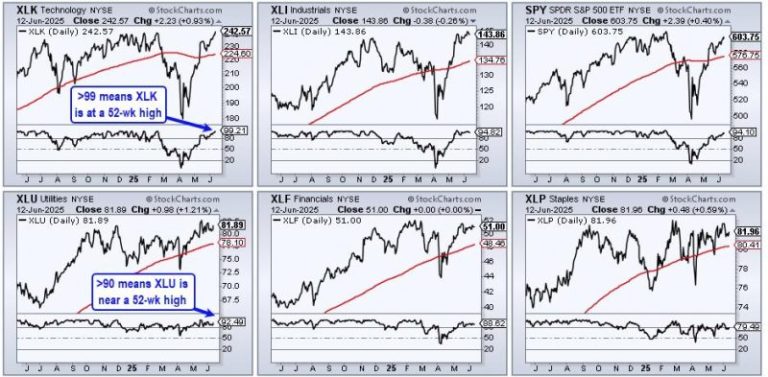
Three sectors stand out, with one sporting a recent breakout that argues for higher prices. Today’s report will highlight three criteria to define a leading uptrend. First, price should be above the rising 200-day SMA. Second, the price-relative should be above its rising 200-day SMA. And finally, leaders should trade at or near 52-week highs. Let’s compare the Utilities SPDR (XLU) to see how it stacks up.

The CandleGlance charts below show the top five sectors and SPY. I am ranking performance using Fast Stochastics (255,1). Stochastic values reflect the level of the close relative to the high-low range over the given period. 255 trading days is around 1 year. An ETF is at a 52-week high when the value is above 99 (XLK) and an ETF is near a new high with a value above 90 (XLU). The CandleGlance charts show XLK, XLI and XLU with values above 90, which means the are near new highs.

***********************

TrendInvestorPro is following the breakout in XLU, the bull flag in GLD, a small wedge in AMLP, a breakout in XLP and more. We also covered trailing stop alternatives for the pennant breakouts in some key tech related ETFs. Take a trial and get three free bonus reports.

***********************

Now let’s turn to price action. XLU is trading above its rising 200-day SMA. Thus, the long-term trend is up. XLU also broke falling channel resistance in early May. The pink lines show a falling channel that retraced around 61.8% of the July-December advance (23.6%). Both the pattern and the retracement amount are typical for corrections within a bigger uptrend. The early May breakout signals a continuation of the long-term uptrend and new highs are expected. The May lows mark first support at 78. A close below this level would warrant a re-evaluation.

And finally, let’s measure relative performance using the price-relative (XLU/RSP ratio). The lower window shows the price-relative in an uptrend for over a year and above its 200-day SMA since early March. This shows long-term relative strength. The pink trendlines show relative performance corrections when XLU underperformed for short periods. XLU is currently experiencing an underperformance correction because the broader market surge from early April to early June.

TrendInvestorPro is following the breakout in XLU, the bull flag in GLD, a small wedge in AMLP, a breakout in XLP and more. We also covered trailing stop alternatives for the pennant breakouts in some key tech related ETFs. Click here to learn more and gain immediate access.

//////////////////////////////////////////////////

Harvest Gold Corporation (TSXV: HVG) (“Harvest Gold ” or the “Company ”) is pleased to announce the results of its annual general meeting (the “AGM”) held on June 12, 2025. All resolutions presented to the shareholders were approved with over 99% of votes cast being in favour of each resolution.

A total of 21,129,144 common shares were voted representing 23.97% of the issued and outstanding common shares. As a result,

  • Dale Matheson Carr‑Hilton Labonte LLP was re-appointed as the auditor of the Company
  • The number of Directors was set at five with the following nominees elected as directors: Richard Mark, Christopher P. Cherry, Edward Zablotny, Patrick Donnelly and Len Brownlie.
  • The Company’s 10% Rolling Stock Options Plan was re-approved.

Following the AGM, the board appointed Len Brownlie (Chair); Edward Zablotny and Patrick Donnelly to its Audit Committee and Patrick Donnelly (Chair) and Edward Zablotny to its Compensation Committee.

About Harvest Gold Corporation

Harvest Gold is focused on exploring for near surface gold deposits and copper-gold porphyry deposits in politically stable mining jurisdictions. Harvest Gold’s board of directors, management team and technical advisors have collective geological and financing experience exceeding 400 years.

Harvest Gold has three active gold projects focused in the Urban Barry area, totalling 377 claims covering 20,016.87 ha, located approximately 45-70 km west of Gold Fields – Windfall Deposit.

Harvest Gold acknowledges that the Mosseau Gold Project straddles the Eeyou Istchee-James Bay and Abitibi territories. Harvest Gold is committed to developing positive and mutually beneficial relationships based on respect and transparency with local Indigenous communities.

Harvest Gold’s three properties, Mosseau, Urban-Barry and LaBelle, together cover over 50 km of favorable strike along mineralized shear zones.

ON BEHALF OF THE BOARD OF DIRECTORS

Rick Mark
President and CEO
Harvest Gold Corporation

For more information please contact:

Rick Mark or Jan Urata
@ 604.737.2303 or info@harvestgoldcorp.com

Neither TSX Venture Exchange nor its Regulation Services Provider (as that term is defined in the policies of the TSX Venture Exchange) accepts responsibility for the adequacy or accuracy of this release.

Forward Looking Information

This news release includes certain statements that may be deemed ‘forward looking statements’. All statements in this news release, other than statements of historical facts, that address events or developments that Harvest Gold expects to occur, are forward looking statements. Forward looking statements are statements that are not historical facts and are generally, but not always, identified by the words ‘expects’, ‘plans’, ‘anticipates’, ‘believes’, ‘intends’, ‘estimates’, ‘projects’, ‘potential’ and similar expressions, or that events or conditions ‘will’, ‘would’, ‘may’, ‘could’ or ‘should’ occur.

Although the Company believes the expectations expressed in such forward-looking statements are based on reasonable assumptions, such statements are not guarantees of future performance and actual results may differ materially from those in the forward-looking statements. Factors that could cause the actual results to differ materially from those in forward looking statements include market prices, exploitation and exploration successes, and continued availability of capital and financing, and general economic, market or business conditions. Investors are cautioned that any such statements are not guarantees of future performance and actual results or developments may differ materially from those projected in the forward-looking statements. Forward looking statements are based on the beliefs, estimates and opinions of the Company’s management on the date the statements are made. Except as required by securities laws, the Company undertakes no obligation to update these forward-looking statements in the event that management’s beliefs, estimates or opinions, or other factors, should change.

Source

This post appeared first on investingnews.com