Author

admin

Browsing

Critical One Energy (CSE:CRTL,OTCQB:MMTLF), formerly Madison Metals, announced on June 12 that it has entered into an agreement with uranium-focused Dark Star Minerals (CSE:BATT) to sell 100 percent of its interests in the Khan West and Cobra North uranium projects in Namibia’s Erongo uranium province.

The acquisition will transfer Critical One’s Namibian uranium assets — specifically the Khan West and Cobra North projects — through staged cash payments and share issuances over a two year period.

The move signals a strategic shift by Critical One toward its Howells Lake antimony-gold project in Ontario, Canada, as it aims to capitalize on growing demand for critical minerals.

The Khan West and Cobra North projects are situated in a well-established Namibian uranium-mining district near the Rössing uranium mine, one of the world’s largest uranium-producing properties.

Cobra North includes two exclusive prospecting licenses and has a historical NI 43-101 inferred resource estimate of 15.6 million metric tons grading 260 parts per million U3O8 for a contained metal total of 9 million pounds of U3O8.

Dark Star said it won’t be treating the historical resource as current.

Similarly, Khan West encompasses a mining license and an exclusive prospecting license. Geological characteristics of the Khan West site reportedly mirror those of Rössing, featuring uranium-anomalous granites within a prominent structural deformation corridor. The mining license includes a license to extract uranium.

For Dark Star, the deal represents a bolstering of its uranium portfolio. In early April, the company announced plans to acquire the Bleasdell Lake uranium project in Northern Saskatchewan, Canada, which has historical uranium resources.

Later in the month, the company entered into a definitive mineral purchase agreement for the property.

Critical One’s pivot away from uranium is part of a broader refocus on critical minerals with promising market dynamics.

The Howells Lake antimony-gold project offers exposure to antimony, an increasingly valuable critical mineral that is tied to clean energy and advanced technology sectors, including the defense industry.

Duane Parnham, executive chair and CEO, emphasized the project’s potential for “higher growth potential and improved returns,” noting the added gold exploration upside amid record-high gold prices.

“The project provides gold exploration upside in a period when the yellow metal’s value is reaching all-time market highs,” Parnham said. To support its refocused strategy, Critical One simultaneously announced a non-brokered private placement financing, saying it is targeting gross proceeds of up to C$1 million.

Parnham highlighted insider participation in the financing, stating that the “ongoing support underscores management’s confidence in the value and potential of the Howells Lake antimony-gold project.”

Proceeds will be used for data processing, geophysics, permitting, drilling and other activities related to advancing Howells Lake, as well as strengthening the company’s financial position and supporting general working capital.

Securities Disclosure: I, Giann Liguid, hold no direct investment interest in any company mentioned in this article.

This post appeared first on investingnews.com

Jp Cortez, executive director at the Sound Money Defense League, breaks down what to know about the Gold Reserve Transparency Act, a measure to audit the gold in Fort Knox and other places where America’s gold is purportedly stored.

‘A space on X will not suffice, and is not a substitute for a true assay, a true audit of every single transaction that that gold was involved in,’ he said.

Securities Disclosure: I, Charlotte McLeod, hold no direct investment interest in any company mentioned in this article.

This post appeared first on investingnews.com

The Trump administration is fast tracking development of Dateline Resources’ (ASX:DTR,OTC Pink:DTREF) Colosseum rare earths project in California as part of its push to boost domestic critical minerals supply.

In a recent interview, Secretary of the Interior Doug Burgum highlighted the project as a priority under the government’s critical minerals strategy, stating that the US has ‘to get back in the game in a serious way around critical minerals.”

For his part, US President Donald Trump has called the project ‘America’s second rare earths mine.” He first announced Colosseum’s approval in an April 21 Truth Social post, listing it as a weekly achievement.

The Colosseum project sits in the Walker Lane Trend in East San Bernardino County, California, only 10 kilometers north of MP Materials’ (NYSE:MP) Mountain Pass mine, the only operating rare earths mine in the US.

Mountain Pass is also the highest-grade rare earths mine in the world.

According to Burgum, the endorsement from the government stems from the US’ push to restart domestic rare earths production and reduce dependence on other countries such as China.

Currently, China remains the biggest rare earths producer by far, producing 270,000 metric tons in 2024. That’s about 70 percent of the total production for the year, which was recorded at 390,000 metric tons.

The ongoing trade war has created tensions between the US and China, raising questions about supply chain security.

Some relief was seen last week — the BBC reported that China has agreed to supply US companies with magnets and rare earths as part of Trump’s deal with Xi Jinping, president of China. In return, the US said it will walk back its threats to revoke the visas of Chinese nationals at US colleges and universities.

Trump addressed the arrangement via a June 11 Truth Social update, stating that he has “always been good” with including Chinese students in colleges and universities.

Dateline has a green light to explore and extract rare earths from Colosseum, as well as gold.

“We have seen growing interest out of the US, particularly after recent milestones at Colosseum,” the Sydney Morning Herald quotes Dateline Managing Director Stephen Baghdadi as saying.

Dateline said in May that it had started the process to uplist to the OTCQB. Should the OTCQB listing go through, the company will still continue to meet its ASX disclosure requirements.

The same month, the company said it had begun preparations for a rare earths-focused drill program at Colosseum, and would complete it alongside a planned gold feasibility study for the site.

Securities Disclosure: I, Gabrielle de la Cruz, hold no direct investment interest in any company mentioned in this article.

This post appeared first on investingnews.com

According to market intelligence firm Newzoo, global gaming revenue came in at US$177.9 billion in 2024, with mobile gaming accounting for more than half of that amount at US$97.6 billion.

The firm states that the mobile gaming market has reached maturity but still achieved higher growth than the console and PC segments, with revenue up by 2.8 percent globally last year. The regions driving that growth are North America and Europe, where markets rebounded due to big releases and diversified revenue streams.

Mobile games are typically accessed through three core operating systems: Apple’s (NASDAQ:AAPL) iOS, Microsoft’s (NASDAQ:MSFT) Windows and Alphabet’s (NASDAQ:GOOGL) Android. Notably, the iOS App Store generated nearly 37 percent of its revenue from mobile gaming apps in 2024, totaling US$3.83 billion. However, figures show that most mobile games on the market today are developed for Android, representing 75 percent of total mobile game downloads.

For investors interested in getting exposure to mobile gaming as the market gains momentum, here’s a look at the top 10 mobile gaming stocks by market cap. All data and figures were accurate as of June 2, 2025.

1. Roblox (NYSE:RBLX)

Market cap: US$60.97 billion

Roblox is the company behind the well-known game platform of the same name. First launched on PC in 2006, in recent years Roblox has become the most popular free-to-play online gaming platform, particularly amongst children and teenagers.

The company draws a majority of its revenues by selling virtual currency known as Robux for in-app purchases.

According to the company’s Q1 2025 report, Roblox garnered over 97.8 million daily active users in the first quarter of 2025, up 26 percent from the same period last year. The platform’s most popular games are role-playing games Brookhaven and Blox Fruits.

2. Take-Two Interactive Software (NASDAQ:TTWO)

Market cap: US$40.15 billion

New York-headquartered Take-Two Interactive Software is a holding company that owns several significant gaming labels that develop and publish video games for Xbox, PlayStation and Nintendo consoles as well as PCs and mobile devices. Some of Take-Two’s most popular game series are widely recognized around the world, including Grand Theft Auto (GTA), Red Dead Redemption and Borderlands.

The majority of Take-Two’s mobile games are published by Zynga, a developer of free-to-play games that Take-Two acquired in 2022 for US$12.7 billion. The publisher’s properties include 2009 hits FarmVille and Words with Friends.

Last year, Zynga’s highest grossing game according to Statista was Empires & Puzzles: Dragon Dawn with approximately US$147 million in revenue, and its most-downloaded title was CSR 2 Realistic Drag Racing.

While Rockstar is largely focused on console and PC games, several of its older games were ported to mobile, such as the classic GTA III, GTA San Andreas and GTA The Trilogy Definitive Edition.

3. Electronic Arts (NASDAQ:EA)

Market cap: US$36.6 billion

Electronic Arts (EA) is a leading gaming and esports company with video game offerings across many genres, from sports to action/adventure to role playing to family games. The California-headquartered company owns many well known series, including the Sims, Madden NFL, FIFA, Battlefield, Need for Speed, Dragon Age and Plants vs. Zombies.

EA has increased its focus on the mobile gaming segment in recent years, and in early 2024 announced it would focus on its fully owned mobile games portfolio instead of its licensed games with other brands. Leading up to that, the company merged its mobile and HD franchise teams across EA Sports FC, Madden NFL and The Sims.

In March 2025, EA announced a partnership with games marketing company Flexion, who will help EA publish its mobile games on the Amazon Appstore, Samsung Galaxy Store, Xiaomi’s GetApps and ONE Store.

4. Tencent Holdings (OTC Pink:TCEHY,HKEX:0700)

Market cap: US$25.78 billion

Tencent Holdings is a Chinese conglomerate with significant holdings through a wide array of sectors. Its large gaming segment built through acquisitions and investments has made it the world’s largest gaming company by revenue.

Tencent owns Riot Games, maker of the popular PC game League of Legends, a multiplayer online battle arena game with a monthly active player base of between 117 million to 135 million. The expanding League of Legends franchise also features three mobile games: Wild Rift, Team Fight Tactics and Legends of Runeterra.

The company also released PUBG Mobile based on the PC game PlayerUnknown’s Battlegrounds. The multiplayer battle royale game is available on Android and iOS.

Tencent is now focusing on building up its in-house AAA and console gaming business segment in order to better compete with western gaming companies.

5. Unity Software (NYSE:U)

Market cap: US$10.91 billion

San Francisco-based Unity Software develops the core software technology or building video games and interactive experiences. It offers developers a suite of tools for designing and launching 2D and 3D games as well as virtual and augmented reality applications. This includes the ability to create and host large-scale, multi-player games.

Two of the most popular mobile games built on the Unity Software engine are the online multiplayer social deduction game Among Us, developed by game studio Innersloth, and augmented-reality mobile game Pokémon Go, developed and published by Niantic in collaboration with Nintendo Co. (LSE:0K85,TSE:7974) and The Pokémon Company.

Although in its Q1 2025 financials, Unity saw its grow revenue and create revenue drop by 4 percent and 8 percent, respectively, year-over-year, its financial performance still included exceeding the high-end of its revenue guidance by 5 percent, and its adjusted EBITDA by 29 percent.

6. Playtika (NASDAQ:PLTK)

Market cap: US$1.79 billion

Headquartered in Israel, Playtika Holdings claims to be among the first mobile gaming entertainment companies to offer free-to-play social games on social networks and on mobile platforms. Today, Playtika has a diverse portfolio of game titles accessed by more than 29 million monthly active users last year.

Playtika has built its mobile entertainment platform through eleven strategic acquisitions totaling US$337 million aimed at increasing its breadth of entertainment genres and leveraging its Boost platform to enhance game operations. Playtika’s most recent acquisition was mobile gaming company SuperPlay, which it picked up for US$700 million in late 2024.

In its first quarter of 2025, the company reported a record quarterly revenue of more than US$700 million. This is up 8.4 percent over the same period in the previous year.

7. Corsair Gaming (NASDAQ:CRSR)

Market cap: US$951.33 million

Corsair Gaming is a global powerhouse in the development and manufacturer of high-performance gamer gear, including keyboards, mice, game controllers and headsets.

While the company primarily targets PC gamers, Corsair has moved into the mobile games market in recent years with the launch of its SCUF Nomad, a compact Bluetooth controller designed for competitive gamers with iPhones. The controller expands to fit the user’s phone in the center and work with any games that offer controller support.

8. Inspired Entertainment (NASDAQ:INSE)

Market cap: US$208.84 million

Inspired Entertainment is a gaming technology company that offers content, tech, hardware and services both offline and online gaming, betting and social gaming platforms. This includes digital games across more than 170 websites.

Last year, the company launched a number of online and mobile slot games, including Gold Cash Free Spins and Big Piggy Bank. In January 2025, Inspired announced the release of its online and mobile slot games into the regulated Brazilian market.

9. PLAYSTUDIOS (NASDAQ:MYPS)

Market cap: US$186.86 million

PLAYSTUDIOS develops free-to-play mobile games for its brand partners in the travel, leisure and entertainment sectors. Through its playAWARDS platform, mobile gamers can earn brand offerings as in-game rewards. The platform has a player network of more than 4.2 million gamers and 737 award partners, including brands such as Royal Caribbean International, MGM Grand and Cirque de Soleil.

The company will be offering its social casino games players an opportunity to win trips to the Atlantis Paradise Island resort in the Bahamas, and seats in the second annual US$1 million myVIP World Tournament of Slots, which will take place at the resort in October 2025.

PLAYSTUDIOS’ full year 2025 guidance for net revenue is US$250 million to US$270 million.

10. MotorSport Games (NASDAQ:MSGM)

Market cap: US$16.24 million

Florida-based Motorsport Games develops and publishes motorsport games, and organizes esports racing competitions and content.

It is officially licensed to develop and publish video games for the FIA World Endurance Championship and the 24 Hours of Le Mans. Motorsport Games’ rFactor 2 is an official racing simulation platform of Formula E, and it powers the F1 Arcade venue chain via a partnership with Kindred Concepts.

In April 2025, Motorsport announced a strategic investment of US$2.5 million led by virtual reality hardware company Pimax Innovation. The two companies plan to combine their offerings to create immersive VR racing sims.

Securities Disclosure: I, Melissa Pistilli, hold no direct investment interest in any company mentioned in this article.

This post appeared first on investingnews.com

Since Israel began its concerted attack on Iran on Friday, calls for regime change in Iran have grown louder – from hawks in the United States Congress to Israeli officials and some Iranian activists abroad.

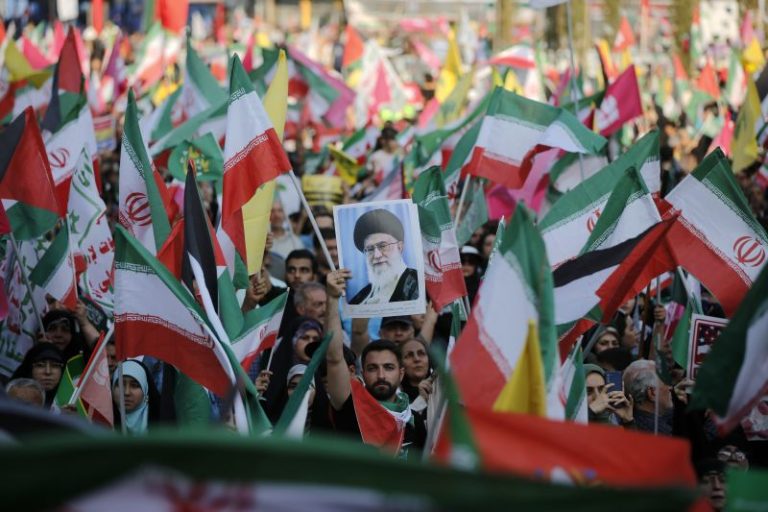
They argue that the Islamic Republic is significantly weakened, and that now is the time to capitalize on domestic unrest and public discontent to bring about the overthrow of its ruling clerical establishment, with Supreme Leader Ayatollah Ali Khamenei at its head.

Israeli Prime Minister Benjamin Netanyahu told Fox News on Sunday that Israel’s operation “could certainly” result in regime change, as the government in Iran is “very weak.” He claimed that “80% of the people would throw these theological thugs out.”

“They shoot women because their hair is uncovered. They shoot students. They just suck the oxygen out from these brave and gifted people, the Iranian people,” Netanyahu said. “The decision to act, to rise up this time, is the decision of the Iranian people.”

Freedom of speech is heavily restricted in Iran, and there have been no major public calls from within the country to overthrow the regime following Israel’s attacks. But experts say Netanyahu may be misreading Iranian public sentiment – and that the strikes could backfire.

Israel’s attacks are more likely to direct public anger toward Israel, as domestic issues are briefly put aside while Iranians run for shelter, experts say.

Iran has in recent years seen nationwide protests against the regime, especially in 2022 and 2023, sparked by the death in custody of Mahsa Amini, a 22-year-old woman arrested by Iran’s morality police for allegedly not wearing her headscarf properly. Many activists have since been detained, and authorities have sought repress further protest, instilling fear with a rise in criminal prosecutions and executions. Disgruntlement is widespread.

But experts, and Iranians currently living under Israeli bombardment, said that most Iranians don’t see Netanyahu or his government as having the solution to their domestic problems.

An uprising is very unlikely right now

“The people of Iran have fought against the Islamic Republic for years, striving for democracy and freedom,” the journalist said from Tehran. “But I believe that in the current situation, those who are terrified under missiles and explosions, trying to protect their children and loved ones, do not have the psychological or practical capacity to ‘take to the streets.’ The streets, which are constantly under attack, are now emptier than ever.”

“Moreover, from the public’s perspective, the Islamic Republic has not yet become weak enough to collapse through protests. Any action against the regime during wartime will lead to brutal repression,” the journalist said, adding that “now the regime has free rein to label anyone it wants as an Israeli spy.”

Others say during a time of national crisis, people are more likely to favor unity, no matter how dissatisfied they are. To them, foreign intervention is a red line.

“There is no support that they will give to Netanyahu’s war on themselves and their society. If anything, they are organizing now to help each other defend their country,” Azizi said, referring to anti-regime Iranians. “Any idea that this will lead to a popular uprising of some sort that will bring down the regime has very little basis in reality.”

Even in the diaspora, where many anti-regime Iranians live, there is anger at Israel’s actions, with activists calling for unity in the face of Israel’s assault.

Narges Mohammadi, one of Iran’s most prominent human rights activists and 2023 Nobel Peace Prize winner, who has spent years in prison in Tehran on what supporters say are politically motivated charges, posted on X: “Iranian Civil Society Says No to War!”

She and other Iranian activists, including fellow Nobel Peace Prize winner Shirin Ebadi and filmmakers Jafar Panahi and Mohammad Rasoulof, all of whom have been pursued by the regime for their activism, wrote a joint opinion piece in France’s Le Monde newspaper Monday calling for an end to the war – but they also demanded that Iran stop enrichment of uranium and that the regime step down.

“This conflict not only destroys infrastructure and claims civilian lives but also constitutes a serious threat to the very foundations of human civilization,” they wrote.

In recent years, Israel has strengthened ties with Reza Pahlavi, the US-based son of Iran’s deposed monarch. Pahlavi voiced support for Israel’s actions, drawing praise from some in the Iranian diaspora and accusations of betrayal from others.

“Soon in Tehran,” Israeli Minister of Diaspora Affairs Amichai Chikli posted on X on Friday, along with a picture of himself shaking hands with a smiling Pahlavi. Pahlavi told BBC News on Sunday that Israel’s conflict with Iran was an opportunity to bring down the Iranian regime.

“The ultimate solution is regime change,” he said. “Now, we have an opportunity, because this regime is at its weakest point. There’s (a) window in which we can operate and hopefully liberate our country.”

His US-backed father had warm ties with Israel before he was overthrown by the Islamic Revolution in 1979.

‘Region cannot be reshaped through force’

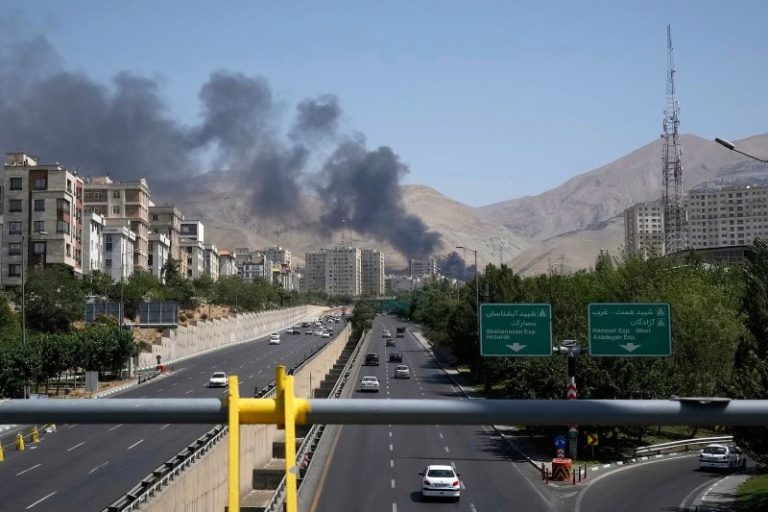
Israel has pounded Iran with strikes for four days, striking residential areas and the country’s civilian infrastructure. At least 224 people have been killed in the country since hostilities began Friday, the health ministry said Sunday, according to state media.

Israel has said it is doing so to stop the Islamic Republic from acquiring a nuclear weapon and has targeted several of the country’s nuclear sites, but civilians appear to have borne the brunt of the attacks.

Iran has retaliated by firing 370 ballistic missiles and hundreds of drones at Israel, the Israeli Prime Minister’s Office said. By Monday morning, 24 people had been killed in Israel and 592 others had been wounded.

Israeli Defense Minister Israel Katz said on Monday that “the residents of Tehran will pay the price,” later clarifying that Israel didn’t intend to harm civilians.

Israeli officials “don’t even pretend” to care about the safety of Iranian civilians, said Azizi, the Iran expert.

Iranian President Masoud Pezeshkian called for unity, in a statement released through state media. “The people of Iran must join hands and stand strong against the aggression that has been launched against us,” Pezeshkian said, adding that the Iranians were “not the aggressors” and defending Iran’s right to a peaceful nuclear program.

In its operation, Israel has taken out some of Iran’s most senior military officials, including in the powerful Revolutionary Guard Corps (IRGC). Even if the leadership changes, it may not look like what Netanyahu hopes for, Iran experts said.

“Regime change is a possibility, just not the kind that Netanyahu has in mind,” Mohammad Ali Shabani, editor of the Amwaj news outlet, wrote on X. “Among potential medium-term outcomes of Israel’s war on Iran: military-led administration, possibly armed with nuclear weapons.”

Netanyahu’s call for regime change by force has also alarmed other countries in the region.

Speaking to the Paris-based journal Le Grand Continent, Anwar Gargash, diplomatic adviser to the president of the United Arab Emirates, warned that “when a country feels under attack, nationalism tends to intensify.”

Asked about Netanyahu’s call for an uprising in Iran, Gargash said: “The region cannot be reshaped through force and confrontation. We may be able to resolve some problems in the short term, but this will lead to others that are at least as serious.”.

“Of course, we’re glad to see the leaders of this regime – whose hands are stained with the blood of our children – killed. But the death of ordinary people is painful.”

This post appeared first on cnn.com

Iran has arrested dozens of people on suspicion of spying as fears grow in the Islamic Republic over the extent of its infiltration by Israel’s Mossad intelligence service.

Since Israeli strikes began Friday, 28 people in the capital have been arrested and accused of spying for Israel, while on Monday, one man arrested on that charge two years ago was hanged in what appeared to be a message to any would-be collaborator.

The Iranian regime has also arrested scores of people across the country for allegedly sharing articles online “in support of the Zionist regime” – accusing them of disrupting the “psychological security of society” – including 60 people in Isfahan, where Israel claims to have targeted a nuclear site.

The wave of arrests comes as Tehran reels from the revelation that Mossad operatives smuggled weapons into Iran before Israel’s unprecedented attack and used them to target the country from within.

So heightened have Iranian suspicions become since then that its Intelligence Ministry has been asking the public to report suspicious activity and issuing guidance on how to spot collaborators.

One statement from the ministry urges people to be wary of strangers wearing masks or goggles, driving pickup trucks and carrying large bags or filming around military, industrial, or residential areas.

Elsewhere, a poster published by the state-affiliated Nour News – which is close to Iran’s security apparatus – singled out for suspicion people who wear “masks, hats, and sunglasses, even at night” and those who receive “frequent package deliveries by courier.”

The poster asks people to report “unusual sounds from inside the house, such as screaming, the sound of metal equipment, continuous banging” and “houses with curtains drawn even during the day.”

Another poster, attributed to the police and published on state media, advised landlords who had recently rented their homes to notify the police immediately.

The fears of Israeli penetration only amplify the anxieties felt by the increasingly isolated leadership of the Islamic Republic, which has been rocked in recent years by anti-regime protests sparked by the death of a young woman in the custody of the country’s so-called morality police.

The same force used to crack down on those protests, the Basij (a paramilitary wing of Iran’s Revolutionary Guard) has been deployed in night patrols to increase “surveillance” in the wake of the Israeli infiltration, according to Iran’s state-controlled media.

In a video statement Monday, Iran’s chief of police Ahmad-Reza Radan urged “traitors” to come forward, suggesting those who realized they had been “deceived by the enemy” might receive more lenient treatment and be “honored” by Iran – while those who were caught would be “taught a lesson that the Zionist enemy is being given now.”

The head of Iran’s judiciary Gholam-Hossein Mohseni-Eje’i called for “swift” punishment of those accused of collaborating with Israel.

“Let’s say we have apprehended someone who is collaborating with (Israel), this matter under these war-like conditions … must be prosecuted swiftly and punished swiftly,” he said.

The Iranian regime’s rising paranoia comes as more details emerge of the Mossad operation that smuggled weapons into Iran ahead of the first strikes on Friday.

According to Israeli officials, operatives established a base for launching explosive drones inside Iran, then used those drones to target missile launchers near Tehran.

Precision weapons were also smuggled in, they say, and used to target surface-to-air missile systems, clearing the way for Israel’s Air Force to carry out more than 100 strikes with upward of 200 aircraft in the early hours of Friday local time.

Intelligence gathered by the Mossad in Iran also reportedly gave Israel’s Air Force the ability to target senior Iranian commanders and scientists.

Since then, according to Iranian media outlets, the government has seized equipment allegedly used during the Israeli operation – including 200 kilograms of explosives, several suicide drones, launchers and equipment used to manufacture the drones – in the city of Rey in Tehran province.

A video published by the state-affiliated Fars News Agency showed a building with drone parts and other equipment.

This post appeared first on cnn.com

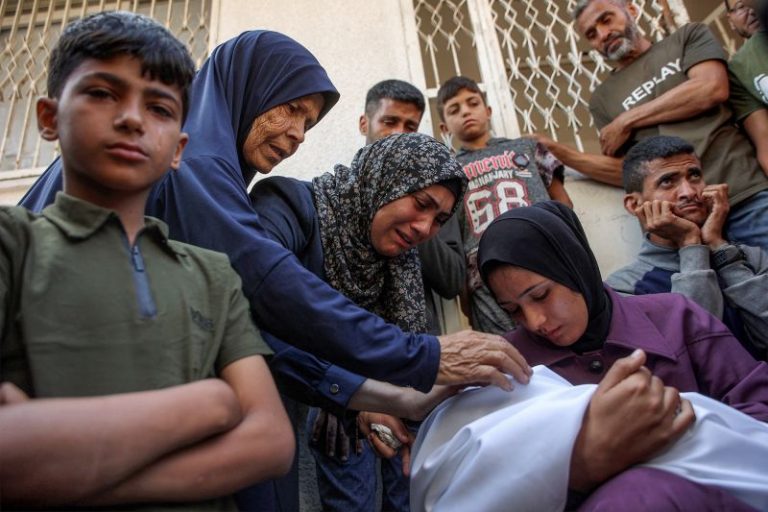
The young girl sits on the dusty floor, clutching her father’s shoe close to her chest as she cries and screams in anger. Bisan Qwaider is unconsolable. Her father has just been killed while trying to get food for her and her 10 hungry siblings.

Shadi knew travel to the area was dangerous: Ma’an had been under an Israeli evacuation order for some time and has come under Israeli bombardment. But, despite the risk, his children were hungry and he believed he could get some food there for them.

Gaza is facing a hunger crisis. A UN-backed report published in late April warned that one in five people in Gaza were facing starvation and that the entire enclave was edging closer to famine. The situation has only worsened since then, according to the UN.

Sha’ath said Qwaider was killed in an airstrike and his body was pulled from the rubble on Sunday. He is one of hundreds of people who have died while attempting to find food in Gaza in recent weeks, according to Gaza health authorities.

In late May, Israel partially lifted an 11-week total blockade on Gaza, but humanitarian organizations say the aid entering now is only a tiny fraction of what is needed.

“Without immediate and massively scaled-up access to the basic means of survival, we risk a descent into famine, further chaos, and the loss of more lives,” the UN’s humanitarian chief Tom Fletcher said last week.

The humanitarian catastrophe in Gaza has sparked outrage around the world, recently prompting even some of Israel’s closest allies to speak up.

France, the United Kingdom and Canada issued a rare statement last month criticizing Israel and threatening “concrete steps” if the situation in Gaza does not improve. The UK paused trade negotiations with Israel and sanctioned West Bank settlers last month, and the European Union said it would review a key cooperation agreement with Israel.

But as tensions continue to escalate between Israel and Iran, people in Gaza are now worried that even the limited pressure on Israel over their suffering will quickly evaporate.

“All the (focus) has shifted to the Israeli-Iranian war, even though the Gaza Strip has been wiped off of the map,” Mustafa said.

One in 40 dead

More than 55,300 people have been killed and more than 128,700 injured in Gaza since October 7, 2023, according to health authorities there.

The numbers are staggering: The death toll represents some 2.5% of the entire Gaza population, meaning that out of every 40 Palestinians living in Gaza before the war, one is now dead.

And the deadly hunger crisis is worsening. The International Committee of the Red Cross said on Monday that people are struggling to access basic goods because of Israeli restrictions on what can be brought into the territory.

Meanwhile, a US and Israeli-backed aid initiative, the Gaza Humanitarian Foundation (GHF) – a controversial organization that was established amid Israeli accusations that Hamas is stealing aid in Gaza and profiting off its sale – is struggling to fulfill the task.

The organization has been criticized by multiple international aid agencies that it isn’t fit for purpose.

According to Gaza health authorities, at least 300 people have been killed since the GHF opened its distribution points in late May, which are located in areas surrounded by active combat zones.

The UN Office for the Coordination of Humanitarian Affairs (OCHA) said last week that Israeli authorities have allowed only a select number of UN agencies and international non-governmental organizations (NGOs) to resume the delivery of aid into Gaza after partially lifting the blockade and that “only very limited amounts of certain food items, nutrition supplies, some health supplies, and water purification items” are allowed.

Other aid supplies, such as shelter materials, hygiene products and medical equipment are still being blocked by Israel, according to OCHA.

For young Bisan Qwaider, the only thing from her father she could get a hold of was his shoe.

As she screamed for her father, she looked to the sky and shouted a message for those she believed were responsible for his death. “May God hold you accountable,” she said.

This post appeared first on cnn.com
Russian overnight drone and missile attacks on Kyiv killed 14 people, officials said on Tuesday, in the deadliest strikes on the capital in weeks.

More than 55 people were wounded in the city, according to Kyiv Mayor Vitaliy Klitschko, making it one of the deadliest nights for its residents in weeks.

Kyiv residents heard loud sirens from late Monday, through the early morning hours of Tuesday, making it a loud and sleepless night for many in the city. The sirens continued as day broke Tuesday – an alarm purportedly for a ballistic threat, according to the Ukrainian Air Force.

Of those wounded, more than 40 have been taken to hospitals, Klitschko said, with residential buildings and other infrastructure severely damaged.

“We hope that no dead will be found under the rubble, but we cannot rule it out,” Klitschko added. “The death toll may increase.”

“During the attack on Kyiv in the Solomyanskyi district, a 62-year-old US citizen died in a house opposite to the one where medics were providing assistance to the victims,” Kyiv mayor Vitali Klitschko said in a message on Telegram, without giving details.

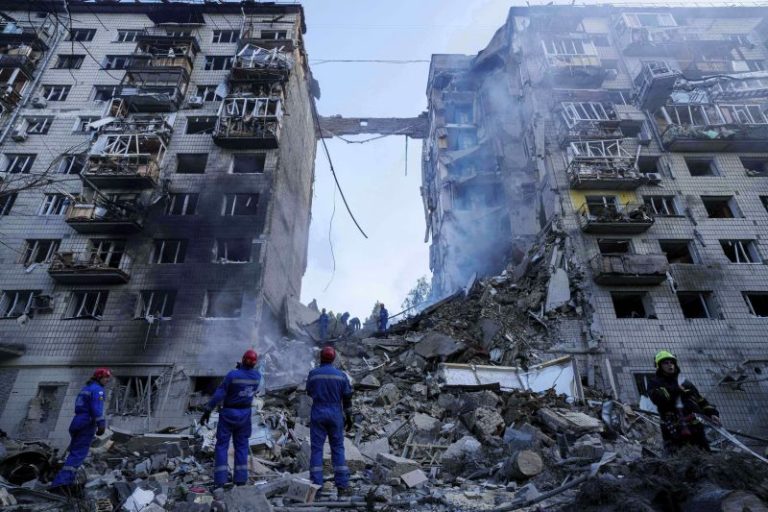
Paramedics and police were seen working to rescue people wounded in a building that appears partially collapsed, according to video posted by the State Emergency Service of Ukraine.

Smoke could be seen rising from the site and debris was strewn all over the ground. Vehicles in front of the building were charred and destroyed.

Some 27 locations in different districts came under fire, according to a statement from Ukraine’s Minister of Internal Affairs, Ihor Klymenko.

“Rescuers, police and medics are working. They are doing everything they can to help the victims, clear the rubble and save lives,” he said.

The strikes come as Trump announced he would return to Washington a day early from the Group of 7 summit in Canada.

His early departure means he will miss a key meeting with Ukraine President Volodymyr Zelensky on the sidelines of the event.

It would have been the leaders’ third meeting since Trump took office in January.

Ukrainian officials had been hoping that a positive interaction with Trump could advance Kyiv’s case as Russia has ramped up its airborne attacks in recent weeks.

Meanwhile, Russian Security Council Secretary Sergey Shoigu arrived in Pyongyang on a “special mission” from Russian leader Vladimir Putin, according to Russian state news agency TASS.

Shoigu is scheduled to meet North Korean leader Kim Jong Un, Tass reported Tuesday.

Pyongyang has continued support for Moscow’s war on Ukraine as world leaders push for an end to the three-year conflict.

North Korea has sent soldiers and millions of munitions, including missiles and rockets, to Russia over the past year, according to a May report by an international watchdog, the Multilateral Sanctions Monitoring Team.

The US has warned that Russia may be close to sharing advanced space and satellite technology with North Korea in exchange for continued support for the war in Ukraine.

In April, Russia launched its deadliest wave of attacks on Kyiv in nine months, sending 70 missiles and 145 drones toward Ukraine, mainly targeting the capital city, killing at least 12 people and injuring 90 more.

Under Trump, the US has been less willing to equip badly outgunned Ukraine directly, has pushed European partners to pick up more of the support and threatened to walk away altogether from peace talks.

This post appeared first on cnn.com

President Donald Trump continues to enjoy income streams from scores of luxury properties and business ventures, many of which are worth tens of millions of dollars, according to a financial disclosure form filed late Friday.

Released by the Office of Government Ethics, Trump’s 2025 financial disclosure spans 234 pages in all, including 145 pages of stock and bond investments. It is dated Friday with Trump’s signature.

One of the largest sources of income is the $57,355,532 he received from his ownership stake in World Liberty Financial, the cryptocurrency platform launched last year. The form shows that World Liberty’s sales of digital tokens have been highly lucrative for Trump and his family. Trump’s three sons, Donald Jr., Eric and Barron, are listed on the company’s website as co-founders of the firm.

Separately, Trump’s meme coin, known on crypto markets simply as $TRUMP, was not released until January and is therefore not subject to the disclosure requirements for this form, which covered calendar year 2024.

It was a lucrative year for Trump when it came to royalty payments for the various goods that are sold featuring his name and likeness.

Among the royalty payments:

The filing also includes a listing of liabilities, including at least $15,000 on an American Express credit card and payments due to E. Jean Carroll, the woman who successfully sued Trump over sexual abuse and defamation, though he is still seeking to appeal the decision.

The rest of the document includes dozens of pages of lengthy footnotes about his various assets.

The form was filed to comply with federal requirements for executive branch office holders. By comparison, the form former President Joe Biden filed in 2024 was 11 pages and consisted largely of conventional sources of income like bank and retirement accounts, while Kamala Harris’ was 15 pages.

Many of Trump’s key assets are held in a revocable trust overseen by Donald Trump Jr., his eldest son. They include more than 100,000 shares of Trump Media and Technology Group, the social media company that went public in 2024. Trump is the largest shareholder, and his nearly 53% is worth billions of dollars. Those holdings were still disclosed in the form.

This post appeared first on NBC NEWS