
Author

admin

Browsing

(TheNewswire)

TORONTO, ON TheNewswire – June 19, 2025 Silver Crown Royalties Inc. (‘ Silver Crown ‘, ‘ SCRi ‘, or the ‘ Company ‘) (Cboe:SCRI; OTCQX:SLCRF; FRA:QS0) is pleased to announce the signing of a Letter of Intent (‘ LOI ‘) with Kuya Silver Corp. (CSE: KUYA; OTCQB: KUYAF; FSE: 6MR1) (‘ Kuya ‘ or ‘ Kuya Silver ‘) to acquire a 4.5% royalty on silver produced from Kuya’s Bethania Silver Mine in Huancavelica, Central Peru.

The Bethania Silver Mine, which resumed production in May 2024, includes the Bethania Mine and Carmelitas property and is accessible year-round via a 4-hour drive from Huancayo. The Bethania Silver Mine was previously operational until 2016.

Under the terms of the LOI, Silver Crown will acquire the royalty for US$3,000,000 in cash and US$2,000,000 in Silver Crown units at C$6.50 per unit (the ‘ Units ‘) or the 5-day volume-weighted average price (VWAP) of SCRi’s common shares (the ‘ Common Shares ‘) prior to closing. Each Unit will consist of one Common Share and one-half of a warrant, with each whole warrant exercisable at C$13.00 per Common Share for a period of three years.

SCRi will receive: (i) 4,500 ounces of silver per quarter for the first four (4) quarters, (ii) 9,000 ounces per quarter for quarters five (5) through eight (8), and (iii) 12,375 ounces per quarter for quarters nine (9) through 40. After delivering 475,000 ounces, the royalty will reduce to 1% for the mine’s remaining life.

Peter Bures, Silver Crown’s Chairman and Chief Executive Officer, commented, ‘We are excited to initiate a partnership with Kuya Silver that can potentially translate to a materially impactful increase to SCRi’s silver revenue profile paving a way from 78,000 to over 128,000 annual silver ounces.’

ABOUT Silver Crown Royalties INC.

Founded by industry veterans, Silver Crown Royalties ( Cboe: SCRI | OTCQX: SLCRF | BF: QS0 ) is a publicly traded, silver royalty company. Silver Crown (SCRi) currently has four silver royalties of which three are revenue-generating. Its business model presents investors with precious metals exposure that allows for a natural hedge against currency devaluation while minimizing the negative impact of cost inflation associated with production. SCRi endeavors to minimize the economic impact on mining projects while maximizing returns for shareholders. For further information, please contact:

Silver Crown Royalties Inc.

Peter Bures, Chairman and CEO

Telephone: (416) 481-1744

Email: pbures@silvercrownroyalties.com

FORWARD-LOOKING STATEMENTS

This release contains certain ‘forward looking statements’ and certain ‘forward-looking information’ as defined under applicable Canadian and U.S. securities laws. Forward-looking statements and information can generally be identified by the use of forward-looking terminology such as ‘may’, ‘will’, ‘should’, ‘expect’, ‘intend’, ‘estimate’, ‘anticipate’, ‘believe’, ‘continue’, ‘plans’ or similar terminology. The forward-looking information contained herein is provided for the purpose of assisting readers in understanding management’s current expectations and plans relating to the future. Readers are cautioned that such information may not be appropriate for other purposes. Forward-looking statements and information include, but are not limited to: the anticipated execution of a definitive agreement with Kuya Silver; expected silver deliveries under the proposed royalty; the potential for exploration bonuses; projected increases in SCRi’s silver revenue profile; the successful completion of due diligence and regulatory approvals; the ability to finance the cash portion of the transaction; the future operational performance of the Bethania Silver Mine; and the realization of strategic and financial benefits from the proposed royalty acquisition.

Forward-looking statements and information are based on forecasts of future results, estimates of amounts not yet determinable and assumptions that, while believed by management to be reasonable, are inherently subject to significant business, economic and competitive uncertainties and contingencies. Forward-looking information is subject to known and unknown risks, uncertainties and other factors that may cause the actual actions, events or results to be materially different from those expressed or implied by such forward-looking information, including but not limited to: the impact of general business and economic conditions; the absence of control over mining operations from which SCRi will purchase gold and other metals or from which it will receive royalty payments and risks related to those mining operations, including risks related to international operations, government and environmental regulation, delays in mine construction and operations, actual results of mining and current exploration activities, conclusions of economic evaluations and changes in project parameters as plans continue to be refined; accidents, equipment breakdowns, title matters, labor disputes or other unanticipated difficulties or interruptions in operations; SCRi’s ability to enter into definitive agreements and close proposed royalty transactions; the inherent uncertainties related to the valuations ascribed by SCRi to its royalty interests; problems inherent to the marketability of gold and other metals; the inherent uncertainty of production and cost estimates and the potential for unexpected costs and expenses; industry conditions, including fluctuations in the price of the primary commodities mined at such operations, fluctuations in foreign exchange rates and fluctuations in interest rates; government entities interpreting existing tax legislation or enacting new tax legislation in a way which adversely affects SCRi; stock market volatility; regulatory restrictions; liability, competition, the potential impact of epidemics, pandemics or other public health crises on SCRi’s business, operations and financial condition, loss of key employees. SCRi has attempted to identify important factors that could cause actual results to differ materially from those contained in forward-looking statements, there may be other factors that cause results not to be as anticipated, estimated or intended. There can be no assurance that such statements will prove to be accurate, as actual results and future events could differ materially from those anticipated in such statements. Accordingly, readers are advised not to place undue reliance on forward-looking statements or information. SCRi undertakes no obligation to update forward-looking information except as required by applicable law. Such forward-looking information represents management’s best judgment based on information currently available.

This document does not constitute an offer to sell, or a solicitation of an offer to buy, securities of the Company in Canada, the United States or any other jurisdiction. Any such offer to sell or solicitation of an offer to buy the securities described herein will be made only pursuant to subscription documentation between the Company and prospective purchasers. Any such offering will be made in reliance upon exemptions from the prospectus and registration requirements under applicable securities laws, pursuant to a subscription agreement to be entered into by the Company and prospective investors. There can be no assurance that forward-looking statements will prove to be accurate, as actual results and future events could differ materially from those anticipated in such statements. Accordingly, the reader is cautioned not to place undue reliance on forward-looking statements.

CBOE CANADA DOES NOT ACCEPT RESPONSIBILITY FOR THE ADEQUACY OR ACCURACY OF THIS NEWS RELEASE.

Copyright (c) 2025 TheNewswire – All rights reserved.

News Provided by TheNewsWire via QuoteMedia
This post appeared first on investingnews.com

Investor Insight

With multiple significant lithium discoveries under its belt and a proven exploration strategy that yields results, Brunswick Exploration makes a compelling investment proposition in the ever-expanding lithium space.

Overview

Brunswick Exploration (TSXV:BRW,OTCQB:BRWXF,1XQ:FF) is one of North America’s few publicly traded companies aggressively pursuing grassroots lithium exploration across Canada and Greenland. The company is leveraging cutting-edge exploration technologies and systematic geological fieldwork to uncover new spodumene-bearing pegmatite discoveries in underexplored districts.

Brunswick has staked and is actively exploring large-scale pegmatite fields in Quebec and both western and eastern Greenland. Its multi-regional strategy is designed to fast-track discoveries of high-grade lithium deposits to meet rising global demand driven by the energy transition.

Brunswick’s exploration process begins with comprehensive data compilation and geological analysis to pinpoint promising target areas. Its experienced field teams then deploy traditional prospecting techniques—including bedrock mapping, sampling, and geophysical surveys—to validate targets on the ground. This hands-on approach has led to multiple new lithium discoveries and remains central to the company’s value creation strategy.

The company has launched an aggressive, regional-scale prospecting and mapping campaign across its extensive Greenland portfolio which will run for six weeks, supported by four field crews and two helicopters. The initial phase will see one team conducting detailed mapping and sampling around the Ivisaartoq spodumene discovery and surrounding areas. A second team will cover the expanded Nuuk and Paamiut licenses, including follow-up at the historical spodumene showing at Paamiut.

Starting in July 2025, fieldwork will pivot based on June results, with one crew continuing follow-up at Nuuk and Paamiut, and another moving to Disko Bay and Uummannaq. Findings will guide advanced exploration in August–September, including first-pass work at the newly acquired Hinksland project.

In Quebec, Brunswick Exploration has prioritized three key lithium projects in the Eeyou Istchee–James Bay region: Mirage, Anatacau, and PLEX with active drilling underway at Mirage following 2023 grassroots discoveries.

In 2024, the company made Greenland’s first lithium-bearing spodumene pegmatite discovery at the Ivisaartoq field under its Nuuk license—an area characterized by ancient Mesoarchean geology. Brunswick is now expanding its land position in both western and eastern Greenland to build on this breakthrough.In 2025, the company reported it had submitted license applications covering 20,785 hectares at Paamiut that include multiple metavolcanic amphibolite belts and nine mapped pegmatites 500–900 m in strike length, with approval pending. Brunswick had also applied for a 17,800-hectare Hinksland license in eastern Greenland containing over 50 mapped and interpreted pegmatite outcrops, including nine that are between 500 m and roughly 10,000 m in strike length, likewise awaiting government sign-off.

The exploration team is led by Executive Chairman Robert Wares, a renowned geologist and co-founder of Osisko Mining. Wares played a pivotal role in discovering the Canadian Malartic gold deposit, which became one of Canada’s largest gold producers. His leadership and exploration success provide strong technical guidance for Brunswick’s operations.

Company Highlights

  • Brunswick Exploration (BRW) is a Montreal-based mineral exploration company listed on the TSXV under symbol BRW. The company is focused on grassroots exploration for lithium in Canada and Greenland, a critical metal necessary to global decarbonization and energy transition.
  • This has generated one of the largest grassroots lithium portfolios globally.
  • BRW’s board includes Robert Wares, one of the founders of Osisko Mining.
  • The company has staked hundreds of untested prospective pegmatites measuring a minimum strike length of 500 meters and within 50 kms of infrastructure.
  • In 2023, three discoveries were made in the Eeyou Istchee-James Bay region of Quebec at the Mirage, Anatacau Main and Elrond projects.
  • In 2024, BRW announced a newly discovered pegmatite outcrop from its Nuuk License, making it the first confirmed lithium discovery in Greenland.
  • In 2025 BRW bolstered its first-mover position in Greenland by staking about 38,500 ha across two new licenses — 20,785 ha at Paamiut (SW Greenland) hosting nine 500-900 m pegmatite trends and 17,800 ha at Hinksland (E Greenland) with over 50 mapped pegmatites, including nine 500-10,000 m trends — making BRW one of the country’s largest mineral-license holders and giving it hundreds of untested targets for lithium exploration.

Key Projects

Mirage Project

The Mirage Project consists of 427 claims covering 21,230 hectares (including both staked and optioned claims), situated approximately 40 km south of the Trans-Taiga Highway in Quebec’s James Bay region. The project was initially staked following insights from a geologist who explored the area for gold over two decades ago and documented numerous angular pegmatitic glacial boulders containing large, well-defined spodumene crystals, including one boulder measuring 8 x 4 x 3 meters.

In fall 2023, Brunswick Exploration uncovered multiple high-grade spodumene outcrops along a 2.5-km trend, alongside a distinct 3 km boulder train with different mineralogical characteristics, suggesting the presence of multiple lithium-bearing sources within the project area.

The company intersected 37 m at 1.14 percent Li₂O in hole MR-24-87 at the MR-3 dyke; 36 m at 1.51 percent Li₂O in hole MR-24-102 within the Stacked Dyke area where the same hole also cut thirteen additional spodumene-bearing dykes and 28 m at 1.32 percent Li₂O in hole MR-24-101 at the MR-6 dyke, together extending the combined MR-3–MR-6–Stacked Dyke swarm to more than 1 km by 450 m. In the past drillings, Brunswick intercepted 1.55 percent and 1.64 percent Li₂O at 93.45 m and 69.3 m respectively at the MR-6 dyke The project continues to show excellent continuity and scale, with stacked dykes and new zones being delineated through ongoing drilling.

The winter 2025 drill program covering over 5,000 meters is designed to test new extensions to MR-3, MR-4, and MR-6 dykes, as well as additional targets within the broader Central Zone. Mirage is quickly emerging as a potential high-grade, large-tonnage lithium system.

Spodumene crystals at Mirage are massive and white to pale grey, both at the surface and in the core.

In 2025, BRW has continued to advance Mirage through additional drilling and metallurgical testing. The winter drill program intersected 36 meters at 1.51percent Li2O in the Stacked Dyke area and 28 meters at 1.32 percent Li2O at the MR-6 dyke, significantly extending these pegmatites along strike. This drilling confirms that the MR-3, MR-6 and Stacked Dyke systems form a major spodumene-bearing pegmatite swarm now traced over ~1,000 by 450 meters and open in multiple directions. Phase 1 metallurgical results indicate the potential for a dense media separation (DMS)-only flowsheet (no flotation required), capable of producing a clean spodumene concentrate grading ~5.5–5.7 percent Li2O with up to 76 percent recovery and low impurities.

PLEX Project

The company is also advancing the early-stage Poste Lemoyne Extension (PLEX) project, located along the La Grande shear zone approximately 75 km west of Patriot Battery Metals’ Corvette project. PLEX consists of 375 claims covering 19,175 hectares and remains a target for future prospecting campaigns.

Anatacau

Comprising the Anatacau Main and Anatacau West projects, these assets are under an option agreement with Osisko GP, a subsidiary of Osisko Development, under which Brunswick Exploration can earn a 90 percent interest in the projects. The Anatacau property is located just east of Rio Tinto (NYSE:RIO) recently acquired James Bay Lithium deposit (previously known as the Cyr deposit), previously owned by Arcadium (NYSE:ALTM) which has a total mineral resource of 110.2 million tons (Mt) at 1.30 percent lithium oxide and a total ore reserve of 37.3 Mt at 1.27 percent lithium oxide.

BRW completed a maiden drill program at the Anatacau West property totalling 3,712 meters. 17 of the 18 drilled holes intersected spodumene mineralization that generated up to 26.5 metres at 1.51 percent Li2O.

In the summer of 2023, Brunswick discovered a significant lithium pegmatite outcrop, measuring at least 100 meters long by 15 meters wide known as the Anais showing in Anatacau Main. The outcrop is within a larger cluster of pegmatite dykes all of which contain high-grade lithium mineralization.

This discovery is located 22 km east of Anatacau West and Rio’s James Bay project along a large-scale E-W deformation corridor which is host to the known lithium-bearing pegmatite dykes in the region.

Greenland

Brunswick Exploration is now one of Greenland’s largest mineral license holders and the only company actively exploring for lithium in the country, capitalizing on a clear first-mover advantage. With supportive regulations, highly prospective geology, and excellent outcrop exposure, 2025 is set to be a breakthrough year as the company launches a major lithium exploration campaign.

A six-week regional program begins in June, with four field crews and two helicopters deployed across Brunswick’s vast land package. One team will focus on the Ivisaartoq spodumene discovery, while another targets the Nuuk and Paamiut licenses. In July, follow-up work will continue at Nuuk and Paamiut, while a second team begins prospecting at the Disko Bay and Uummannaq properties.

Initial results will guide advanced exploration phases in August and September across high-priority targets.

2025 Paamiut license area

Brunswick Exploration has applied for new licenses covering 20,785 hectares, approximately 90 to 130 km northeast of Paamiut, a coastal town about 260 km south of Nuuk. The area lies within the Bjornesund tectonic block of the North Atlantic Craton, a geologically favorable region comprising tonalitic and granodioritic orthogneiss and Mesoarchean metavolcanic amphibolite belts.The newly staked ground includes multiple amphibolite belts up to 1.5 km wide and 15 km long, along with nine mapped and interpreted pegmatite targets ranging from 500 to 900 meters in strike length. License applications have been submitted and are currently pending final government approval

Nuuk Expansion

Brunswick Exploration’s Nuuk holdings include the Ivisaartoq spodumene discovery within the Ivisaartoq belt. The company has applied to stake the adjacent Ujarassuit amphibolite belt, which is up to 1 km wide and 40 km long. Additional claims have been secured within the Fiskefjord Complex, located 95 km north of Nuuk and 75 km southeast of Maniitsoq, covering amphibolite belts up to 4.5 km wide and 20 km long. The newly acquired and applied-for claims span 33,138 hectares and host hundreds of mapped and interpreted pegmatite outcrops, including six targets with strike lengths between 500 and 2,000 m.

Disko Bay

The Disko Bay licenses are located roughly 30 to 80 kms from the coastal city of Ilulissat, which is the third largest city in Greenland. The licenses are near multiple seaports and container terminals, including Ilulissat. The area is situated within the Aasiaat domain, part of the Paleoproterozoic Nagssugtoqidian Orogen, sandwiched to the south by the Archean North Atlantic Craton and to the north by the Archean Rae Craton. The Orogen extends west into the Trans-Hudson orogeny of Canada that continues to the lithium deposits near Snow Lake Manitoba and the Black Hills of South Dakota.

Multiple amphibolite and metasedimentary belts were acquired with some belts being over 20 km in strike length. The new claims have hundreds of mapped and interpreted pegmatite targets with a total license area of 49,639 hectares.

Uummannaq

The licenses are located roughly 70 km from the coastal city of Uummannaq, about 80 km north of Ilulissat. Uummannaq has a population of about 1,660, an airport and a ferry terminal as well as a nearby container terminal. The area is located within the Archean Rae Craton that is intermixed with the Paleoproterozoic Rinkian fold-thrust belt, both of which are in contact with the Paleoproterozoic Nagssugtoqidian Orogen to the south.

The new license contains multiple amphibolite and metasedimentary belts with dozens of mapped and interpreted pegmatites with a total license area of 9,770 hectares.

Management Team

Robert Wares – Executive Chairman

Robert Wares is a professional geologist with more than 35 years of experience in mineral exploration and development. He was responsible for discovering the Canadian Malartic bulk tonnage gold mine, which was subsequently developed by Osisko Mining into one of Canada’s largest gold producers. Wares was a co-winner of the Prospectors and Developers Association of Canada’s ‘Prospector of the Year Award’ for 2007. He was also named one of the ‘Mining

Men of the Year’ for 2009 by the Northern Miner. He has a Bachelor of Science and an honorary doctorate in earth sciences from McGill University.

Killian Charles – President and CEO

From 2017 to 2021, Killian Charles worked as VP of corporate development for Osisko Metals. Charles was previously the manager of corporate development at Integra Gold Corp, which was an advanced-stage gold development company until it was acquired by Eldorado Gold in July 2017. He worked as a mining analyst at Industrial Alliance Securities and Laurentian Bank Securities. Charles covered small and mid-cap exploration and production companies as a mining analyst. Charles holds a Bachelor of Science with a major in Earth and planetary sciences from McGill University.

Anthony Glavac – CFO

Anthony Glavac has more than 17 years of experience in financial reporting, including over 12 years in the mining industry. Since August 2017, Glavac has served as vice-president, and corporate controller for Falco Resources, and previously served as director, financial reporting and internal controls at Dynacor Gold Mines. Glavac spent 10 years at KPMG, working with both public and private companies, providing audit, taxation, strategic advisory and public offering services. Glavac is also involved with other public companies in the mining industry.

Simon Hébert – Vice-president, Development

Simon Hébert is a professional geologist with over 13 years of experience in mineral exploration, having begun his career with Virginia Mines and Osisko Mining. He has worked on numerous metallogenic projects across Baie-James, Nunavik, and the Northwest Territories. In 2019, he helped form NQ Mining Investment, becoming its general manager in 2023. A member of the Ordre des Géologues du Québec since 2012, Hébert also serves as vice president of the AEMQ and is chair of the Table Jamésienne de concertation minière. He holds a BSc in Geology from Université Laval.

François Goulet – Exploration Manager, Quebec

François Goulet holds a master’s degree in structural geology from UQÀM and has extensive exploration experience in James Bay and internationally. He was recently president and CEO of Harfang Exploration, a gold project generator in Quebec. Goulet has worked with companies including Virginia Mines, Unigold, Maya Gold & Silver, the Canadian Malartic Partnership, and Glencore Canada. He is a board member of the AEMQ and a registered geologist with the Ordre des géologues du Québec since 2011.

Charles Kodors – Exploration Manager, Atlantic Canada

Charles Kodors is the Manager, Atlantic Canada at Brunswick Exploration Inc. and has been with the company since January 2021. Having 15 years of experience in the mining and exploration industry, he most recently served as an exploration manager for Osisko Metals and a senior exploration geologist for Kirkland Lake Gold. Kodors received his B.Sc. from Brock University and is a registered professional geologist within the provinces of New Brunswick, Newfoundland, Nova Scotia, Ontario, Quebec, Manitoba and Saskatchewan.

Shayaan Belluzzo – Corporate Secretary

Ms. Shayaan Belluzzo is a seasoned Corporate Secretary with over 8 years of experience of board governance and compliance, corporate restructuring matters for various global entities and investment vehicles, focusing on corporate regulatory and corporate governance best practices, and providing strategic legal support. Recently, Belluzzo also held key roles as Corporate Secretary of Windfall Mining Group and Assistant Corporate Secretary of Osisko Mining, supporting both companies during a $2.16 billion acquisition. Ms. Belluzzo’s diverse industry experience stems from her work in global investment, asset management, and law firms, including McCarthy Tétrault LLP.

This post appeared first on investingnews.com

Auric Mining Limited (ASX: AWJ) (Auric or the Company) is pleased to provide an update on mining of the Starter Pit at the Munda Gold Mine, 5km from Widgiemooltha, Western Australia.

Highlights

  • First blast 17 June 2025.
  • Mining is well underway in Starter Pit.
  • Approximately 70,000 BCM mined in first month.
  • Largely free-dig to date.
  • Site preparation for Waste Dump and ROM pads completed.
Management Comment

Managing Director, Mark English, said:

“It’s a momentous time in our progression and development of the Company, we are delighted.

“Mining is in full swing and all activities are progressing as we expected. Nothing is holding us back. We are achieving our targets and are exactly where we expected to be in the mine development.

“We are pleased to be monetising our major asset in such a bullish gold market, the timing is excellent. It is a great place to be as an unhedged gold producer,” said Mr English.

Approximately 70,000 BCM (Bank Cubic Metres) of material have been mined at Munda over the first 4 weeks of operations from a pit design encapsulating 380,000 BCM. Mining to this stage has been largely free-dig with the first blast completed 17 June 2025.

Auric personnel are utilising a dry hire fleet comprising a 125t excavator and four 40t articulated ‘Moxi’ dump trucks together with relevant ancillary equipment.

Both RC grade control and blast hole drilling, together with blast supervision is managed by Kalgoorlie-based Total Drilling Services Pty Ltd.

The Company has estimated that approximately 125,000 tonnes of ore will be extracted from the Starter Pit at a grade of 1.8g/t Au1. Most of that ore will be mined toward the base of the Starter Pit, during the last two months of operations. The Starter Pit is scheduled for completion in October.

Munda has an estimated resource of 145,000 ounces of gold at a 0.5g/t cut-off2. Once the Starter Pit is finished Auric expects to complete detailed planning for a larger pit, to commence in 2026.

The Company is fully funded to mine the Starter Pit at Munda from the proceeds of gold sales from the Jeffreys Find Gold Mine near Norseman.

Click here for the full ASX Release

This post appeared first on investingnews.com

  • All reported holes intersected gold mineralization, reinforcing continuity and improving structural understanding at the Jagger Zone
  • Results support   the Company’s systematic exploration and targeting approach for further resource definition at Kossou

Kobo Resources Inc. (‘ Kobo’ or the ‘ Company ‘) ( TSX.V: KRI ) is pleased to announce additional diamond drill results from the ongoing exploration program at its 100%-owned Kossou Gold Project (‘ Kossou ‘) in Côte d’Ivoire. Results from the Jagger Zone continue to confirm broad zones of mineralisation and extend the footprint of gold-bearing structures along strike and at depth.

This press release features multimedia. View the full release here: https://www.businesswire.com/news/home/20250619919405/en/

Diamond Drill Results Highlights:

Jagger Zone:

  • KDD0081
    • 8.0 m at 2.13 g/t Au from 140.0 metres (‘m’), including 2.0 m at 7.00 g/t Au from 140.0 m
  • KDD0082
    • 30.0 m at 0.64 g/t Au from 128.0 m, including 10.25 m at 0.80 g/t Au, from 128.0 m and 2.0 m at 1.90 g/t Au from 143.0 m
  • KDD0083
    • 7.0 m at 1.18 g/t Au from 123.0 m
    • 6.0 m at 2.07 g/t Au from 138.0 m, including 1.0 m at 8.47 g/t Au from 64.0 m
    • 7.3 m at 1.63 g/t Au from 95.0 m
  • KDD0084
    • 8.0 m at 1.41 g/t Au from 88.0 m
    • 21.5* m at 1.14 g/t Au from 106.0 m, including 4.0 m at 1.98 g/t Au from 106.0 m, 4.0 m at 1.27 g/t Au from 115.0 m, and 1.5 m at 4.93 g/t Au from 126.0 m
  • KDD0085
    • 20.0 m at 1.41* g/t Au from 106.0 m, including 5.0 m at 3.70 g/t Au from 121.0 m and including 2.0 m at 8.47 g/t Au from 123.0 m

Edward Gosselin, CEO and Director of Kobo commented: ‘These latest results reinforce the scale and continuity of gold mineralisation at the Jagger Zone. We are encouraged by the width and tenor of the intercepts, which continue to validate our structural model and further support our systematic exploration approach at Kossou. With drilling still underway across our other high-priority targets, we are well-positioned to advance Kossou toward its maiden resource estimate next year as our exploration work continues.’

Jagger Zone Drilling Highlights Scale and Continuity

Results from seven diamond drill holes (KDD0080 to KDD0086), completed on sections JZ 525 to JZ 725 within the Jagger Zone, have been received and continue to expand the Company’s understanding of this highly prospective target (see Figure 1).

Gold mineralisation is hosted within and along the contacts of quartz feldspar porphyry and diorite intrusions, as well as within sheared contacts of basaltic massive and pillowed flow units. These structures define significant, laterally and vertically continuous gold-bearing zones that are traceable along strike and down dip. Notably, wide mineralised intervals in hole KDD0084, including 8.0 m at 1.41 g/t Au from 88.0 m and 21.5 m at 1.14 g/t Au* from 106.0 m (see Figure 2), demonstrate the presence of multiple stacked gold zones across the broader Jagger Shear Zone.

On section JZ 700, gold mineralisation continues to demonstrate strong continuity and consistent geological associations observed in earlier drilling. Notable intercepts include 20.0 m at 1.41 g/t Au* from 106.0 m, including 5.0 m at 3.70 g/t Au, and 7.0 m at 1.20 g/t Au from 154.0 m. These results support the broader interpretation of the Jagger Shear Zone as a robust, multi-zone gold system and correlate well with previously reported drill holes and surface trench KTR030a (see Figure 3 for Section JZ 700.)

Geological and Structural Setting of Gold Mineralisation at Kossou and the Jagger Zone

Gold mineralisation at Kossou is hosted within a N-S trending, steeply west-dipping deformation corridor associated with the regional Contact Zone Fault, which separates basaltic volcanic flows from volcano-sedimentary rocks. Within this corridor, the ‘Jagger Shear Corridor’, brittle-ductile shear zones act as the primary structural controls on gold emplacement, particularly where lithological contrasts occur between basaltic units and intrusive rocks, including diorite and quartz-feldspar porphyry dykes.

At the Jagger Zone, the main shear system is developed within a zone approximately 70-m wide and is closely associated with intrusive contacts. Drill core analysis has identified multiple quartz vein generations related to mineralisation. The V1 vein set consists of quartz veins and veinlets parallel to the S1 foliation, commonly occurring within the main shear zones and bearing gold. The dominant mineralized structures, however, are V2A veins, which trend west-northwest to northwest and are prominent both within and adjacent to the shears. A secondary vein set, V2B, is characterized by sub-horizontal hairline fractures and veinlets, which carry only sporadic gold mineralisation.

Drilling to date indicates that gold mineralisation pinches and swells along strike and at depth, consistent with structurally controlled orogenic gold systems commonly found within the Birimian terrane of West Africa.

Table 1: Summary of Significant Diamond Drill Hole Results

BHID

East

North

Elev.

Az.

Dip

Length

From
(m)

To (m)

Int.
(m)

Au
g/t

Target

KDD0080

228997

775340

338

70

-50

233.05

32.00

34.00

2.00

1.80

Jagger

49.00

51.00

2.00

2.18

Jagger

60.00

61.00

1.00

2.31

Jagger

70.00

76.00

6.00

0.91

Jagger

100.00

102.20

2.20

0.99

Jagger

115.00

117.00

2.00

0.59

Jagger

126.00

127.00

1.00

1.86

Jagger

181.00

182.00

1.00

1.10

Jagger

201.00

207.05

6.05

0.67

Jagger

incl.

205.00

207.05

2.05

1.43

Jagger

221.85

223.00

1.15

1.19

Jagger

KDD0081

228958

775353

333

70

-50

266.05

31.00

32.00

1.00

2.02

Jagger

45.00

46.00

1.00

1.52

Jagger

70.00

72.40

2.40

1.04

Jagger

78.00

80.00

2.00

0.67

Jagger

123.00

124.00

1.00

1.49

Jagger

130.00

133.00

3.00

1.15

Jagger

140.00

148.00

8.00

2.13

Jagger

incl.

140.00

142.00

2.00

7.00

Jagger

175.10

176.20

1.10

1.79

Jagger

KDD0082

228973

775257

364

70

-50

293.05

22.00

23.00

1.00

1.51

Jagger

104.00

105.00

1.00

6.61

Jagger

110.00

111.00

1.00

1.42

Jagger

128.00

158.00

30.00

0.64*

Jagger

incl.

128.00

138.25

10.25

0.80

Jagger

incl.

143.00

145.00

2.00

1.90

Jagger

incl.

148.00

158.00

10.00

0.60

Jagger

161.40

164.00

2.60

0.65

Jagger

KDD0083

229013

775240

361

70

-50

236.05

32.00

33.00

1.00

3.73

Jagger

62.00

63.00

1.00

3.17

Jagger

71.00

72.00

1.00

8.42

Jagger

80.00

84.00

4.00

0.87

Jagger

100.00

101.00

1.00

1.33

Jagger

104.00

105.00

2.00

1.29

Jagger

109.40

117.00

7.60

0.35

Jagger

123.00

130.00

7.00

1.18

Jagger

138.00

144.00

6.00

2.07

Jagger

161.00

163.60

2.60

1.04

Jagger

KDD0084

229018

775216

361

70

-50

164.05

67.00

69.00

2.00

0.83

Jagger

80.00

83.00

3.00

1.00

Jagger

88.00

96.00

8.00

1.41

Jagger

106.00

127.50

21.50

1.14*

Jagger

incl.

106.00

110.00

4.00

1.99

Jagger

incl.

115.00

119.00

4.00

1.27

Jagger

incl.

126.00

127.50

1.50

4.93

Jagger

KDD0085

228982

775175

358

70

-50

182.05

83.00

84.00

1.00

2.38

Jagger

106.00

126.00

20.00

1.41*

Jagger

incl.

113.00

117.00

4.00

1.25

Jagger

incl.

121.00

126.00

5.00

3.70

Jagger

incl.

123.00

125.00

2.00

8.47

Jagger

154.00

161.00

7.00

1.20

Jagger

169.00

172.00

3.00

1.38

Jagger

KDD0086

229024

775165

345

70

-50

143.00

71.60

73.00

1.40

1.63

Jagger

82.00

89.00

7.00

1.04

Jagger

95.00

107.00

12.00

0.68

Jagger

118.00

123.00

5.00

0.69

Jagger

Notes:

Cut-off using 2.0 m at 0.30 g/t Au

Intervals are reported with no more than 3 m of internal dilution of less than 0.3 g/t Au except where indicated*

An accurate dip and strike and controls of mineralisation are unconfirmed at this time and the true width of mineralisation are unconfirmed at this time. Drill holes are planned to intersect mineralised zones perpendicular to interpreted targets. All intercepts reported are downhole distances.

The Company also reports the filing of its audited consolidated financial statements for the twelve-month period ended March 31, 2025, and related management’s discussion and analysis. Copies of these financial statements and related management’s discussion and analysis can be found on the Company’s issuer profile on SEDAR+ at www.sedarplus.ca as well as on the Company’s website at www.koboresources.com .

Sampling, QA/QC, and Analytical Procedures

Drill core was logged and sampled by Kobo personnel at site. Drill cores were sawn in half, with one half remaining in the core box and the other half secured into new plastic sample bags with sample number tickets. Core samples are drilled HQ to below oxidation level and then is reduced to NQ for the remainder of the drill hole. Samples are transported to the SGS Côte d’Ivoire facility in Yamoussoukro by Kobo personnel where the entire sample was prepared for analysis (prep code PRP86/PRP94). Sample splits of 50 grams were then analysed for gold using 50g Fire Assay as per SGS Geochem Method FAA505. QA/QC procedures for the drill program include insertion of a certificated standards every 20 samples, a blank every 20 samples and a duplicate sample (split of the 1 m original sample) every 20 samples. All QAQC control samples returned values within acceptable limits.

Review of Technical Information

The scientific and technical information in this press release has been reviewed and approved by Paul Sarjeant, P.Geo., who is a Qualified Persons as defined in National Instrument 43-101. Mr. Sarjeant is the President and Chief Operating Officer and Director of Kobo.

About Kobo Resources Inc.

Kobo Resources is a growth-focused gold exploration company with a compelling new gold discovery in Côte d’Ivoire, one of West Africa’s most prolific and developing gold districts, hosting several multi-million-ounce gold mines. The Company’s 100%-owned Kossou Gold Project is located approximately 20 km northwest of the capital city of Yamoussoukro and is directly adjacent to one of the region’s largest gold mines with established processing facilities.

With over 15,000 metres of diamond drilling, nearly 5,900 metres of reverse circulation (RC) drilling, and 5,900 metres of trenching completed since 2023, Kobo has made significant progress in defining the scale and prospectivity of its Kossou’s Gold Project. Exploration has focused on multiple high-priority targets within a 9+ km strike length of highly prospective gold-in-soil geochemical anomalies, with drilling confirming extensive mineralisation at the Jagger, Road Cut, and Kadie Zones. The latest phase of drilling has further refined structural controls on gold mineralisation, setting the stage for the next phase of systematic exploration and resource development.

Beyond Kossou, the Company is advancing exploration at its Kotobi Permit and is actively expanding its land position in Côte d’Ivoire with prospective ground, aligning with its strategic vision for long-term growth in-country. Kobo remains committed to identifying and developing new opportunities to enhance its exploration portfolio within highly prospective gold regions of West Africa. Kobo offers investors the exciting combination of high-quality gold prospects led by an experienced leadership team with in-country experience. Kobo’s common shares trade on the TSX Venture Exchange under the symbol ‘KRI’. For more information, please visit www.koboresources.com .

Twitter: @KoboResources | LinkedIn: Kobo Resources Inc.

NEITHER THE TSXV NOR ITS REGULATION SERVICES PROVIDER (AS THAT TERM IS DEFINED IN THE POLICIES OF THE TSXV) ACCEPTS RESPONSIBILITY FOR THE ADEQUACY OR ACCURACY OF THIS RELEASE.

Cautionary Statement on Forward-looking Information:

This news release contains ‘forward-looking information’ and ‘forward-looking statements’ (collectively, ‘forward-looking statements’) within the meaning of the applicable Canadian securities legislation. All statements, other than statements of historical fact, are forward-looking statements and are based on expectations, estimates and projections as at the date of this news release. Any statement that involves discussions with respect to predictions, expectations, beliefs, plans, projections, objectives, assumptions, future events or performance (often but not always using phrases such as ‘expects’, or ‘does not expect’, ‘is expected’, ‘anticipates’ or ‘does not anticipate’, ‘plans’, ‘budget’, ‘scheduled’, ‘forecasts’, ‘estimates’, ‘believes’ or ‘intends’ or variations of such words and phrases or stating that certain actions, events or results ‘may’ or ‘could’, ‘would’, ‘might’ or ‘will’ be taken to occur or be achieved) are not statements of historical fact and may be forward-looking statements Forward-looking statements are necessarily based upon a number of estimates and assumptions that, while considered reasonable, are subject to known and unknown risks, uncertainties, and other factors which may cause the actual results and future events to differ materially from those expressed or implied by such forward-looking statements. Such factors include, but are not limited to: general business, economic, competitive, political and social uncertainties; and the delay or failure to receive board, shareholder or regulatory approvals. There can be no assurance that such statements will prove to be accurate, as actual results and future events could differ materially from those anticipated in such statements. Accordingly, readers should not place undue reliance on the forward-looking statements and information contained in this news release. Except as required by law, Kobo assumes no obligation and/or liability to update the forward-looking statements of beliefs, opinions, projections, or other factors, should they change, except as required by law.

View source version on businesswire.com: https://www.businesswire.com/news/home/20250619919405/en/

For further information, please contact:

Edward Gosselin
Chief Executive Officer and Director
1-418-609-3587
ir@kobores.com

News Provided by Business Wire via QuoteMedia

This post appeared first on investingnews.com

  • All three methods tested: BIOX®, POX, and the Albion Process yield over 90% gold recovery
  • Further work to enhance sulphide recoveries through oxidation, as well as gravity, flotation and CIL recoveries, is in progress

Freegold Ventures Limited (TSX: FVL) (OTCQX: FGOVF) (‘Freegold’ or the ‘Company ‘) is pleased to announce further results from the ongoing metallurgical test work currently underway.

The current initiatives are focused on refining the flowsheet options for the pre-feasibility study. This includes testing and ongoing evaluation of sulphide-oxidizing methods such as BIOX®, POX, and the Albion Process, as well as further gravity, flotation and CIL test work.

Earlier this year, Freegold reported 93% recovery using the Albion Process oxidation-CIL, with further test work ongoing.  Comminution tests using half-PQ core have been conducted on over 50 samples from various locations and lithologies within the deposit. These tests provide information to evaluate the trade-off between grind size and liberation versus power consumption, to optimize power requirements and operating costs while enhancing gold recovery.

The BIOX test work has been in progress for several months, and results have shown that gold recovery rates of greater than 90% can be achieved.

2025 PROGRAM

  • Drilling is now underway with three rigs

Conversion of inferred resources into indicated & further exploration drilling.

  • Updated mineral resource
  • Ongoing metallurgical work, focusing on flowsheet optionality with sulphide oxidation is a key part of our strategy to maximize the potential of the resource.
  • Commencement of a Pre-Feasibility Study (PFS)

Summary of Gold Recovery using   BIOX®,

A series of BIOX® amenability oxidation tests have been completed using a sulphide rougher concentrate produced from a composite of Golden Summit material sourced from eight diamond drill hole assay rejects.  The duration of the biological oxidation tests conducted was 10, 15, 20, 30 and a duplicate 30 days.  The residue from these BIOX® tests was subjected to CIL treatment, and overall gold recovery from gravity, rougher flotation, BIOX® treatment, and CIL averaged 91% from this suite of test work.

Summary of Gold Recovery using   POX,

Pressure oxidation (POX) treatment of sulphide rougher concentrate, as well as a cleaner concentrate, with lower mass and only marginally lower gold deportment, has been completed.  The POX residue was washed and neutralized and subjected to CIL leaching for gold recovery.  The POX-CIL testwork has yielded an average overall gold recovery of over 92% in a process flowsheet incorporating gravity, flotation, POX, and CIL.

This testwork utilized eight drill core composites comprising 1,192 meters of drill intercepts that represent 587 continuous mineralized intervals, with a total material weight of over 5,100 kilograms. These composites represent different locations and grades within the Dolphin and Cleary area and were created using continuous drill intervals chosen to reflect potential mill feed (Refer to the map below for hole locations.) The selections of drill holes and intervals included the primary gold-hosting lithologies.  These composites were prepared from laboratory assay rejects of fresh rock intervals located well below the existing oxide cap at Golden Summit.  Additionally, four large-diameter PQ holes were drilled during 2024. A total of 7,600 kg has been made available for comminution testing and ongoing metallurgical testwork.

Two additional PQ holes are being drilled in the 2025 program to enhance our metallurgical test work. This work aims to provide data for trade-off studies in the pre-feasibility study, developing a process flowsheet to maximize economic returns. Ongoing tests indicate that part of the mineralization is non-refractory and can be processed conventionally, although additional sulfide processing is necessary for optimal recovery. The September 2024 resource estimate, based on a gold price of $1,973 , included grinding, gravity separation, flotation, regrinding of sulphide concentrate, and CIL treatment, achieving a 72% gold recovery rate at a processing cost of $14 per ton.

The current program is designed to test sulphide oxidation methods, aiming to increase recoveries beyond the 72% gold recovery reported in the September 2024 resource estimate. Each of the three oxidation methods tested successfully demonstrated the potential to achieve gold recoveries exceeding 90%. These methods may increase costs; however, higher gold recoveries and gold prices could offset the additional capital expenditures (CAPEX) and operating expenditures (OPEX ) costs. Ongoing work will focus on identifying the most suitable oxidation method for use in the pre-feasibility study.

Discovery costs at Golden Summit are under $4.00 per ounce. Since 2020, exploration at Golden Summit has transformed the project, evolving to one of North America’s most significant undeveloped gold resources, owing to a revised interpretation, extensive drilling, and a robust metallurgical program. There remains considerable potential for further expansion and optimisation as the project advances. The revised mineral resource estimate, incorporating the 2024 drilling, is expected to be finalised soon.

The current 2025 drilling program aims to upgrade inferred resources to indicated through infill drilling. Drilling for geotechnical purposes, resource definition, and additional metallurgical test holes will also be carried out. A total of 30,000 metres of drilling is planned. Archaeological fieldwork and geotechnical drilling are scheduled to commence shortly, with a fourth drill rig added to enhance exploration efforts. A pre-feasibility study is set to begin later this year.

Link to the Plan Map:

https://freegoldventures.com/site/assets/files/6287/fvl06192025_ddhplan.png

HQ Core is logged, photographed and cut in half using a diamond saw, and one-half placed in sealed bags for preparation and subsequent geochemical analysis by MSA Laboratories in Prince George, BC , and/or Fairbanks, Alaska .  At MSALABS, the entire sample will be dried and crushed to 70% passing -2mm (CRU-CPA). A ~500g riffle split will be analyzed for gold using CHRYSOS PhotonAssay (CPA-Au1). From this, 250g will be further riffle split from the original PhotonAssay sample, pulverized, and a 0.25g sub-sample analysed for multi-element geochemistry using MSA’s IMS230 package, which includes 4-acid digestion and ICP-MS finish. MSALABS operates under ISO/IEC 17025 and ISO 9001 certified quality systems. A QA/QC program includes laboratory and field standards inserted every ten samples. Blanks are inserted at the start of the submittal, and at least one blank every 25 standards.

The Qualified Person for this release is Alvin Jackson, P.Geo., Vice President of Exploration and Development for Freegold, who has approved the scientific and technical disclosure in this news release.

About Freegold Ventures Limited  
Freegold is a TSX-listed company focused on exploration in Alaska . It holds the Golden Summit Gold Project near Fairbanks and the Shorty Creek Copper-Gold Project near Livengood through leases.

Some statements in this news release contain forward-looking information, including, without limitation, statements as to planned expenditures and exploration programs, potential mineralization and resources, exploration results, the completion of an updated NI 43-101 technical report, and any other future plans. These statements address future events and conditions and, as such, involve known and unknown risks, uncertainties, and other factors which may cause the actual results, performance, or achievements to be materially different from any future results, performance, or achievements expressed or implied by the statements. Such factors include, without limitation, the completion of planned expenditures, the ability to complete exploration programs on schedule, and the success of exploration programs. See Freegold’s Annual Information Form for the year ended December 31st, 2024 , filed under Freegold’s profile at www.sedar.com , for a detailed discussion of the risk factors associated with Freegold’s operations. On January 30, 2020 , the World Health Organization declared the COVID-19 outbreak a global health emergency. Reactions to the spread of COVID-19 continue to lead to, among other things, significant restrictions on travel, business closures, quarantines, and a general reduction in economic activity. While these effects have been reduced in recent months, the continuation and re-introduction of significant restrictions, business disruptions, and related financial impact, and the duration of any such disruptions cannot be reasonably estimated. The risks to Freegold of such public health crises also include employee health and safety risks and a slowdown or temporary suspension of operations in geographic locations impacted by an outbreak. Such public health crises, as well as global geopolitical crises, can result in volatility and disruptions in the supply and demand for various products and services, global supply chains, and financial markets, as well as declining trade and market sentiment and reduced mobility of people, all of which could affect interest rates, credit ratings, credit risk, and inflation. As a result of the COVID-19 outbreak, Freegold has implemented a COVID management program and established a full-service Camp at Golden Summit to attempt to mitigate risks to its employees, contractors, and community. While the extent to which COVID-19 may impact Freegold is uncertain, it is possible that COVID-19 may have a material adverse effect   on Freegold’s business, results of operations, and financial condition.

SOURCE Freegold Ventures Limited

View original content to download multimedia: http://www.newswire.ca/en/releases/archive/June2025/19/c8191.html

News Provided by Canada Newswire via QuoteMedia

This post appeared first on investingnews.com

Hungarian police said on Thursday in a statement that they were banning the Budapest Pride march of the LGBTQ+ community planned for June 28.

Hungary’s parliament, in which Prime Minister Viktor Orban’s right-wing Fidesz Party has a big majority, passed legislation in March that created a legal basis for police to ban LGBTQ marches, citing the protection of children.

Budapest’s liberal mayor Gergely Karacsony tried to circumvent the law when he announced on Monday that since the Budapest Pride march will be a municipal event “no permits from authorities are needed”.

Budapest metropolitan police, however, said the law applied to the event organised by the mayor and banned it.

The police ban has “no relevance” as authorities were not officially notified of the plans for the event, Karacsony said on Facebook.

“The Metropolitan Municipality will host the Budapest Pride Freedom Celebration on June 28, the day of Hungarian freedom, as a municipal event. Period,” the mayor wrote. Tens of thousands of people are expected to attend the protest.

Orban faces a challenging election in 2026 where a new surging opposition party poses a threat to his rule.

His government has a Christian conservative agenda and its intensifying campaign against the LGBTQ community has aimed to please Fidesz’s core voters, mostly in the countryside.

Orban said in February that organisers should not even bother organizing Pride in Budapest this year.

This post appeared first on cnn.com

Leaving hospital with wounds still fresh, the sole survivor of last week’s Air India plane crash solemnly carried the coffin of his brother, performing the last rites for a life lost in the deadly disaster.

Vishwash Kumar Ramesh, a 40-year-old British national, appeared overcome with grief as he led the funeral procession through the streets of the western Indian coastal town of Diu on Wednesday.

Ramesh, who was discharged from hospital a day prior, had bandages on his face from cuts and bruises sustained after flight AI171 traveling to London’s Gatwick Airport from the western city of Ahmedabad plunged to the ground seconds after takeoff last Thursday, killing 241 people on board.

How Ramesh escaped with a few wounds is being described as nothing short of a miracle.

“I don’t know how I survived,” he told Indian state broadcaster DD News while in the hospital, explaining how he unbuckled himself from his seat in 11A – an emergency exit seat – shortly after the crash and walked away from the scene.

“For some time, I thought I was going to die. But when I opened my eyes, I realized I was alive,” he said.

He and his brother, who had been sitting a few rows away, had been returning to the UK after spending a few weeks visiting family in India.

Video of Ramesh stumbling from the crash has been viewed widely on news channels and across social media. Flames can be seen billowing behind him, with thick plumes of smoke rising high into the sky.

Authorities tasked with identifying the victims’ bodies have described just how difficult that process has been. High temperatures from the burning fuel left “no chance” to rescue passengers, India’s Home Minister Amit Shah said, making bodies difficult to recognize.

The Boeing 787 Dreamliner was carrying 125,000 liters – enough to last a 10-hour flight from Ahmedabad to London – but it crashed less than a minute after takeoff, plunging into a hostel for medical students, killing several on the ground.

As of Thursday, more than 150 bodies have been handed over to loved ones, according to health officials, with funerals taking place in various cities across the country.

Investigators, meanwhile, are looking at the wreckage to determine what could have caused one of the worst air crashes India has seen in decades.

A mayday call from the cockpit was made to air traffic control shortly before the crash, Indian civil aviation authorities said.

Both black boxes, the plane’s cockpit voice recorder and flight data recorder, are now being analyzed for valuable clues that could help determine the cause. India’s Aircraft Accident Investigation Bureau are leading the probe into the crash with assistance from the United Kingdom and the United States, as well as officials from Boeing.

The Indian government has also set up a separate high-level committee to examine what led to the crash. The committee is expected to file their preliminary findings within three months.

Air India – the country’s flagship carrier – said on Wednesday it is conducting safety inspections across all of its Boeing 787-8/9 aircraft fleet.

“Out of total 33 aircraft, inspections have now been completed on 26 and these have been cleared for service, while inspection of the remainder will be complete in the coming days,” it said in a statement on X.

Meanwhile, it has reduced international services on its widebody aircraft by 15% due to the ongoing inspections and the conflict in the Middle East, it added.

For days, families of victims have gathered near morgues awaiting to collect the bodies of their loved ones and searching for answers.

Grieving families

As Ramesh laid his brother to rest Wednesday, another family around 160 miles south in the city of Mumbai, performed burials for four members killed in the crash.

Imtiaz Ali Syed, 42, whose brother Javed, sister-in-law, nephew and niece were on board the Air India flight, said he received their bodies from authorities in Ahmedabad and brought them to the family’s hometown on Wednesday.

Syed’s sister, who also lives in the UK, took a direct flight from Mumbai to London, he said. But Javed and his family were on a different flight via Ahmedabad.

He described his disbelief when he learned that Javed was on the ill-fated Air India plane. “Someone woke me up and said a plane crashed in Ahmedabad and asked me to check what flight Javed was on,” Syed recalled.

Syed fondly described his brother as someone who was “always available” for their family.

“He looked after my grandmother’s medicines, he looked after my mother, he would take care of our sister,” he said, describing the unbearable pain of losing Javed.

“Within a week or fifteen days, or a month, maybe he will call,” Syed said. “Telling me he is somewhere.”

This post appeared first on cnn.com

Hurricane Erick powered up into a Category 3 major hurricane Wednesday evening as it bore down on the southern Mexico coast, threatening to unleash destructive winds, flash floods and a dangerous storm surge on the region in coming hours, forecasters said.

Swiftly strengthening from a Category 1 hurricane hours earlier, Erick had maximum sustained winds of 125 mph (200 kph) by nightfall as it churned offshore about 55 miles (85 kilometers) southwest of Puerto Angel, the Miami-based U.S. National Hurricane Center said.

Erick was also about 125 miles (200 kilometers) southeast of Punta Maldonado and moving northwest at 9 mph (15 kph) toward an expected landfall sometime Thursday morning, according to the center’s latest advisory. A major hurricane is defined as Category 3 or higher and wind speeds of at least 111 mph (180 kph). Forecasters said further strengthening is expected and devastating wind damage is possible near where the eye crashes ashore.

Acapulco warily eyes the approaching hurricane

The projected path would take its center near the resort of Acapulco, which was devastated in October 2023 by Hurricane Otis, a Category 5 hurricane that rapidly intensified and caught many unprepared. At least 52 people died in Otis and 32 were missing, after the storm severely damaged almost all of the resort’s hotels.

In Acapulco on Wednesday, there was a strong presence of National Guard and police in the streets, but most visible were trucks from the national power company. Crews worked to clear drainage canals and brush.

Some beaches were already closed, but tourists continued to sunbathe on others hours earlier as the storm gained strength well offshore.

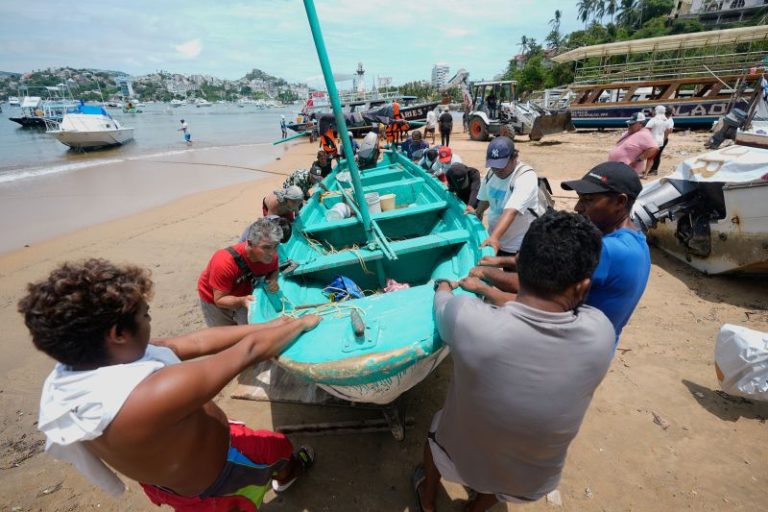
On a beach in Acapulco, a line of people waited for the help of a backhoe to pull their boats out of the water.

Adrián Acevedo Durantes, 52, hauls tourists around Acapulco’s picturesque coastline in boats. Two of his boats sank in Hurricane Otis and a third was badly damaged.

“We’re taking precautions because with Otis we never expected one of that magnitude to come and now with climate change the water is warmer and the hurricanes are more powerful,” Acevedo said.

This time the port administration ordered that no one ride out the storm aboard their boats. During Otis many lost their lives by staying on boats in the harbor, which had traditionally been how they ensured their safety during previous storms. He said knew some of those lost at sea.

He acknowledged that it was sunny and the water calm Wednesday afternoon, making it hard to imagine a major storm was on the way, but said “with Otis it was calm all day, sunny, then at midnight there were two hours of strong winds and we saw what had happened the next day.”

Some rush to finish storm preparations

Francisco Casarubio, a 46-year-old choreographer, carried a carton of eggs as he did some last-minute shopping ahead of the storm. He planned to pick up rice, beans and some canned food as well.

His home flooded and lost power in Otis and said he was taking Erick more seriously, but hadn’t had time to shop until Wednesday.

Forecasters said Erick was expected to lash Mexico’s Pacific coast with heavy rain, strong winds and a fierce storm surge. Rains of up to 16 inches (40 centimeters) could fall across the Mexican states of Oaxaca and Guerrero, with lesser totals in Chiapas, Michoacan, Colima and Jalisco states, the center’s advisory said. The rainfall threatened flooding and mudslides, especially in areas with steep terrain.

A hurricane warning was in effect from Acapulco to Puerto Ángel. A hurricane warning means hurricane conditions are expected in the area, and preparations to protect life and property should be rushed to completion, according to the hurricane center advisory.

Down the coast in Puerto Escondido near the southern edge of Erick’s possible path, some fishermen began pulling their boats out of the water under a drizzling sky Wednesday.

Surfers ignore red flag warnings to ride the waves

Even though the wind had yet to pick up at the Zicatela beach, red flags were up to warn people to stay out of the water. But some surfers ignored them as they continued to ride waves.

Laura Velázquez, Mexico’s national civil defense coordinator, said Erick was forecast to bring “torrential” rains to Guerrero, Oaxaca and Chiapas in southern Mexico. The mountainous region along the coast is especially prone to mudslides with numerous rivers at risk of flooding.

Guerrero Gov. Evelyn Salgado said all schools were closed Wednesday and the state had alerted all of the fishing and tourism operators to make their boats storm-ready. Acapulco’s port closed Tuesday evening. Salgado said 582 shelters were set to receive people who might evacuate their homes.

President Claudia Sheinbaum warned in her daily briefing that those in the hurricane’s path should heed government instructions and wait out the storm in their homes or designated shelters.

Erick quickly doubled in strength

Having doubled in strength in less than a day, Erick was churning through an ideal environment for quick intensification. Last year, there were 34 incidents of rapid intensification — when a storm gains at least 35 mph in 24 hours — which is about twice as many as average and causes problems with forecasting, according to the hurricane center.

This post appeared first on cnn.com

Hackers stole the equivalent of roughly $90 million from Iran’s largest cryptocurrency exchange on Wednesday, according to multiple independent crypto-tracking firms.

A skilled pro-Israel hacking group known as “Predatory Sparrow” took credit for the cyberattack, which appeared to be aimed at further weakening Iran amid Israeli’s military strikes on Tehran.

In a post in Farsi on X, the hackers said that they had hit Iranian crypto exchange Nobitex, claiming that Iran used the exchange to skirt international sanctions. And in an extraordinary move, the hackers may have effectively thrown the stolen crypto away by transferring it to digital “wallets” that they don’t have control over, according to multiple cybersecurity experts.

Nobitex acknowledged the incident in a statement on its website on Wednesday, saying that access to the crypto exchange had been “suspended,” as a precaution, until further notice. Crypto-tracking firms Elliptic and TRM Labs confirmed the crypto was stolen and sent to “wallets” or crypto accounts, with an expletive that referenced Iran’s Islamic Revolutionary Guard Corps (IRGC).

In a separate hack on Tuesday, Predatory Sparrow said it had destroyed data at Iran’s state-owned Bank Sepah, claiming IRGC members used the bank’s services as a justification for the action. Iran’s state-affiliated Fars news agency warned of potential disruptions to bank services at gas stations.

The pair of stunning cyberattacks mark an escalation in Israel and Iran’s years-long shadow war in cyberspace, where the arch-enemies — or their supporters — have conducted digital spying and data-destroying attacks for tactical advantage.

Predatory Sparrow has emerged in the last five years to claim spectacular cyberattacks that have previously disrupted an Iranian steel mill and payments at Iranian gas stations. The hackers cast themselves as anti-government Iranian hacktivists but are widely suspected among cybersecurity experts of having ties to Israel.

Much of the cyber activity in recent days, as Israel and Iran trade missile strikes, appears aimed at sowing panic in the two countries. Israelis, for example, have received mass text messages impersonating authorities that claim that bomb shelters aren’t safe.

The Iranian government, meanwhile, has warned citizens not to use the WhatsApp messaging service out of fear that Israel was collecting information from those chats. A spokesperson for Meta, which owns WhatsApp, has called those claims false and underscored that WhatsApp messages are end-to-end encrypted.

This post appeared first on cnn.com

A new king reigns in TV land.

Streaming has officially surpassed broadcast and cable as a share of total television viewing, according to Nielsen data.

In May, streaming accounted for 44.8% of viewership, while broadcast (20.1%) and cable (24.1%) together represented 44.2% of overall people tuning in.

‘While many have expected this milestone to have occurred sooner, sporting events, news and new-season content have kept broadcast and cable TV surprisingly resilient,’ Brian Fuhrer, senior vice president at Nielsen, said in a video for Nielsen’s The Gauge monthly viewership report. ‘The trend, however, has been very consistent.’

While Netflix has boasted the most overall TV use for four years straight, YouTube has now seen four straight months of TV share increase, Nielsen said. The platform, owned by Google and its parent company, Alphabet, boasted the highest share of TV consumption among all streamers in May, with a 12.5% share. Rounding out the top five were Netflix, Disney-owned platforms including ESPN and Hulu, Amazon’s Prime Video, and the Roku Channel.

The three largest so-called free, ad-supported services, or FAST channels — Paramount’s Pluto TV, the Roku Channel and Fox’s Tubi — combined for 5.7% of total TV viewing in May, more than any individual broadcast network.

Streaming’s overall share is likely to remain neck and neck with traditional TV viewership for some time before it eventually surpasses it permanently in the near future, Nielsen said.

This post appeared first on NBC NEWS